








Artificial intelligence is becoming increasingly advanced, so much so that it is blurring the line between a human and a machine. A US-based startup has now claimed that its latest AI avatar can convincingly
imitate a human interviewer, with nearly half of the people who tested it believing they were interacting with a real person.
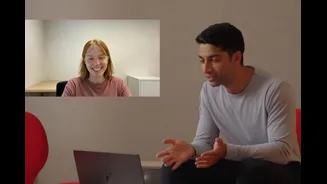
Bay Area-based AI startup Tavus said its latest model, Griffin, convinced 48 per cent of 54 participants in a simulated job interview that they were speaking to a human. As the New York Post reported, the findings suggest the technology closely replicated aspects of face-to-face communication.
People Were 79% Confident They Were Talking To A Human
Tavus said the results indicate that Griffin could pass the Turing Test, a benchmark used to assess whether a machine’s behaviour is indistinguishable from that of a human during an interaction. Participants who mistook the AI avatar for a human were, on average, 79% confident in their judgement. Meanwhile, those who correctly identified it as an AI system were, on average, 81% confident in their judgement.
As shared by Tavus, Griffin generates every pixel of each video frame in real time using a single reference image. Its technology recreates visual elements, such as arms, fingers, chairs, shadows and the surrounding background, along with facial features and movements.
The avatars are available in male and female appearances and are designed to replicate natural human behaviours, such as blinking and breathing, to make interactions feel more authentic.
Hassaan Raza, CEO and co-founder of Tavus, said human communication relies on much more than spoken language. Facial expressions, gestures, vocal tone, and timing all shape how people understand one another.
“Humans are evolutionarily designed to communicate face to face. We speak as much through our words as we do our expressions, tone, gestures and timing. So much of human communication is non-verbal. It’s an art, a dance,” Raza said. “Machines don’t understand this art. They require us to meet them where they are, to learn their language- the right command, the right button click, the right prompt.”
He also highlighted how Griffin aims to overcome shortcomings of earlier AI avatars, particularly unnatural reactions that can make digital characters seem artificial, such as smiling when receiving bad news.
Griffin Helped A Participant Solve Rubik’s Cube
Tavus said Griffin can respond to changing conversations, interrupt appropriately and handle interruptions without losing track of the discussion. It can also adapt to new topics as an interaction unfolds.
In one demonstration, the avatar guided a participant through solving a Rubik’s Cube, showing its ability to respond to visual information. Another demonstration showed the AI model participating successfully in a game of Simon Says.
The company believes the technology could have applications in education, including AI-powered tutoring and interactive learning experiences in schools.