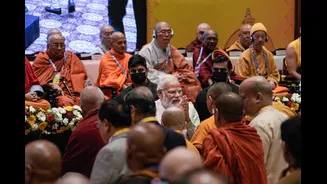








Delhi will host a two-day major geopolitical and civilisational gathering on January 24 and 25 as India convenes its second high-level Global Buddhist Summit (GBS), positioning itself at the centre of
an emerging Buddhist power axis globally. The summit is expected to be chaired by Prime Minister Narendra Modi like last time, and it will be attended by senior Union ministers, top bureaucrats, diplomats, and influential Buddhist spiritual leaders and scholars from across Asia and beyond.
The GBS, organised by the International Buddhist Confederation, is being projected by the government as more of a cultural than just a religious conclave. It is a calibrated soft power initiative that seeks to reaffirm India’s civilisational authority as the land of the Buddha while simultaneously asserting its role as a contemporary convenor of global Buddhist dialogue. The IBC receives its financial support as a grantee body of the Ministry of Culture while it operates under the patronage of the supreme Buddhist religious hierarchy.
A senior office bearer of the IBC described the event as part of a larger strategic effort to embed Buddhism into India’s diplomatic and Indo-Pacific outreach.
Delegates at the two-day summit will include eminent scholars, Sangha leaders, and traditional Buddhist practitioners engaging in structured deliberations on global and societal challenges through the lens of the Buddha Dhamma.
The emphasis, according to policy briefings, is on translating Buddhist philosophical wisdom into practical responses to present-day geopolitical crises, managing from social fragmentation to ethical governance and global cooperation.
Strategically, the summit aligns with India’s broader cultural diplomacy objectives. By foregrounding Buddhism as a bridge between civilisations, New Delhi aims to strengthen people-to-people ties across Asia, reinforce societal harmony, and foster a united Buddhist voice rooted in shared spiritual values, said the senior officer bearer.
He further added that such a platform can contribute to a more ethical and cooperative international order at a time of growing geopolitical churn.
The GBS will also focus on modes of disseminating and internalising universal values such as peace, compassion, harmony, and well-being.
There is broad agreement among participating countries that these fundamentals, drawn from the Buddha’s message, can offer guidance and a sustainable model for addressing both internal and global challenges. The international participation reflects the summit’s diplomatic breadth.
Bhutan will be represented by two Members of Parliament from both the ruling and opposition parties, signalling bipartisan engagement. Cambodia is sending the Secretary of State from its Ministry of Foreign Affairs and International Cooperation. Japan’s delegation includes the Director of International Affairs of the Japan Buddhist Federation, the Director of the All-Japan Buddhist Nuns’ Association, and the President of Gakurin Seminary, Tokyo. Mauritius will be represented by a senior consultant from its Ministry of Arts and Cultural Heritage and a former adviser to the Prime Minister.
Taken together, the summit is going to reflect India’s attempt to weave civilisational heritage into statecraft, quietly but deliberately anchoring diplomacy in Dharma.