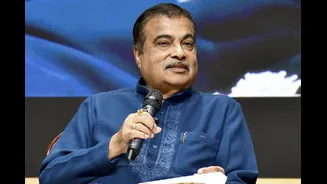

As Delhi continues to battle hazardous air quality, Union Minister for Road Transport and Highways Nitin Gadkari has acknowledged the transport sector’s role in worsening pollution. Speaking at a public
forum, Gadkari said prolonged exposure to Delhi’s polluted air affects him personally. “If I stay in Delhi for barely two days, I get a throat infection,” the minister said, underscoring the severity of the capital’s air quality crisis.
Gadkari openly accepted responsibility as the Union Transport Minister, stating that the sector he oversees is a major contributor to pollution. “I am the Transport Minister, and around 40 per cent of pollution happens because of us, mainly due to the use of fossil fuels,” he said. His remarks come at a time when toxic smog has once again enveloped Delhi, triggering health advisories and restrictions.
Linking environmental concerns with economic and national interest, Gadkari framed the issue as one of “true nationalism”. “If there is any true nationalism today, it is reducing imports and increasing exports,” he said, pointing to India’s heavy dependence on fossil fuels. According to the minister, the country spends nearly Rs 22 lakh crore every year on importing fossil fuels, a burden he described as both economically and environmentally unsustainable.
“What kind of nationalism is this,” Gadkari asked, questioning why India continues to rely on polluting energy sources despite clear alternatives. He stressed that fossil fuels are finite and that their continued use is driving pollution levels higher across urban centres.
Making a strong pitch for clean mobility, Gadkari called for accelerated adoption of alternative technologies. “Can’t we reduce the use of fossil fuels? Why can’t we promote electric vehicles and hydrogen-powered vehicles? These can lead to zero pollution,” he said, reiterating the government’s push towards greener transport solutions.
AAP Hits Out At Govt After Gadkari’s Remark
Meanwhile, the Aam Aadmi Party has hit out at the government over Gadkari’s remarks, highlighting how his remarks contradict the government’s response in Parliament earlier, which stated that there was no solid scientific evidence conclusively linking air pollution to lung-related diseases.
Speaking to India Today, Jha argued that the problem extends far beyond the national capital. “This is not just about Delhi, it concerns the entire North India,” he said. He also criticised what he described as poor coordination, asserting that the crisis cannot be addressed unless the Central government plays a guiding role.