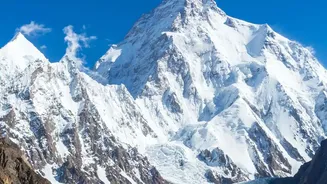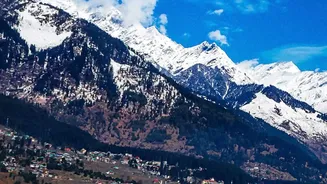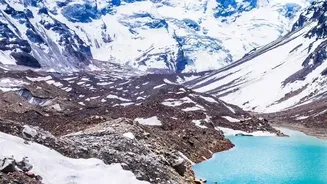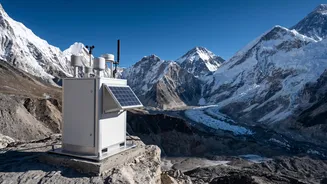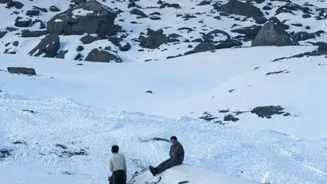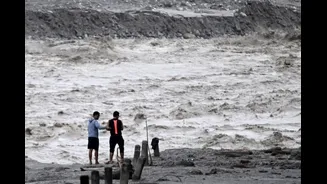







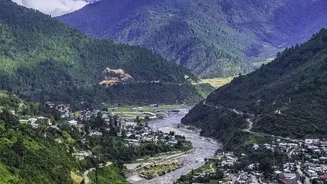
Sikkim is installing advanced sensors at its high-risk glacial lakes to protect against devastating Glacial Lake Outburst Floods (GLOFs), a threat re-emphasised by a catastrophic glacier-related disaster
and subsequent flash floods in neighbouring Nepal. Rising temperatures driven by climate change have accelerated glacier melting across the Himalayas. This creates fragile, naturally dammed reservoirs that are highly susceptible to sudden breaches from earthquakes, avalanches, or cloudbursts. Having experienced its own catastrophic GLOF at South Lhonak Lake in 2023, the recent disaster in Nepal served as an urgent wake-up call for the region.
WHAT SIKKIM IS DOING
The state is executing a proactive mitigation strategy through the Sikkim State Disaster Management Authority (SDMA) to manage these vulnerable locations:
Targeting High-Risk Sites: Out of more than 400 glacial lakes in the state, authorities have mapped 85 and designated 16 as highly vulnerable (13 in North Sikkim and 3 in West Sikkim).
Real-Time Data Tracking: The newly installed sensors, pressure probes, and night-vision cameras continuously track rapid changes in water volume, level, and sediment movement. Any unexpected deviation automatically relays information directly to disaster headquarters.
Early Warning Infrastructure: Alongside sensors, the state is building up a safety net of automated weather stations and early warning sirens to guarantee downstream communities have vital evacuation time if a natural moraine dam fails.
Sikkim has also deployed relief teams to aid Nepal and offered to share its technical expertise in managing GLOF risks to strengthen cross-border climate resilience.
LESSONS FROM THE PAST AND PRESENT: 2023 & NEPAL DISASTERS
On October 4, 2023, Sikkim suffered its worst disaster in over half a century when a Glacial Lake Outburst Flood(GLOF) shattered South Lhonak Lake.
A massive, 14.7-million-cubic-meter mass of rock, ice, and frozen moraine collapsed directly into the high-altitude lake, triggering a 20-metre-high “Himalayan tsunami”. This massive wave breached the lake’s natural moraine dam, instantly releasing 50 million cubic meters of water. The resulting torrent surged down the Teesta River valley, completely wiping out the 1,200 MW Teesta-III hydropower dam at Chungthang, destroying over 30 bridges, submerging towns, and claiming more than 100 lives.
The recent catastrophic flood along the Nepal-China border is starkly similar to Sikkim’s 2023 disaster in its origin, mechanics, and downstream impact.
Both disasters were not caused by standard heavy rainfall alone. They are classic examples of a cascading hazard. In Sikkim (2023), thawing permafrost and unstable slopes caused an ice/rock avalanche to fall into a lake, which then broke the dam. In Nepal, the disaster similarly began high up in the mountains when a massive section of a glacier/mountain collapsed. This falling ice and debris temporarily blocked a river, creating a fragile temporary lake that suddenly burst.
In both regions, the rapid down-valley torrentstargeted the same types of vulnerabilities. Sikkim lost its crown-jewel Teesta-III dam and saw its primary highway (NH-10) collapse. Similarly, the Nepal flood knocked out about a dozen major hydropower plants and transmission facilities, while completely sweeping away vital international trade infrastructure like the border gateways.
Neither event was just a water flood. Because the water originated from high altitudes, it scoured the valley walls as it rushed down. Sikkim’s flood mobilized a staggering 270 million cubic meters of sediment. Nepal’s disaster similarly turned into a dense, crushing wall of mud and massive boulders, which easily sheared bridges off their foundations and buried buildings in a heavy mass that slows down search-and-rescue operations.
Scientists have flagged both events as severe symptoms of accelerated Himalayan warming. Rising temperatures are simultaneously melting glaciers (creating more fragile lakes) and thawing the mountain permafrost—the “glue” that keeps these steep rock faces from collapsing in the first place.