







The Bharatiya Janata Party (BJP) has scripted history in the 2026 West Bengal assembly elections with massive victory, winning 206 seats out of 294, decisively ending the Trinamool Congress’s (TMC) 15-year
rule. This sweeping mandate, crossing the majority mark of 147 seats comfortably, signals a profound shift in a state long dominated by Left politics.
The BJP’s sweeping victory feels like a rupture in the state’s political history. The party once struggled to open its account in Bengal. It has now secured a decisive mandate, displacing forces that had dominated the state for decades. The scale of this shift makes the past look almost unrecognisable.
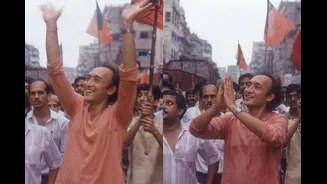
It takes one back to a quieter, almost improbable moment in 1991, when an acclaimed actor stepped into electoral politics and became one of the earliest faces of the BJP’s push in Bengal – Victor Banerjee.
Who Is Victor Banerjee?
Victor Banerjee was already a celebrated name in Indian and international cinema by the early 1990s, known for his work with directors like Satyajit Ray and David Lean and for his roles in international cinema like A Passage to India. His entry into politics came as a surprise. He was not shaped by party structures or long years of organisational work.
His decision to contest on a BJP ticket in 1991 placed him in a political landscape that offered little room for the party. West Bengal at the time was firmly under the influence of the Left Front led by Jyoti Basu, and the Congress remained the principal opposition. The BJP existed on the margins.
The 1991 Lok Sabha Contest
Banerjee was fielded from the Calcutta North West Lok Sabha constituency in the 1991 general election. It was an urban seat, politically aware and historically competitive, but still heavily tilted towards established parties.
He faced candidates backed by far stronger organisational networks. The Left and the Congress had deep roots in the constituency, built over years of cadre-based mobilisation. Against that backdrop, Banerjee’s campaign carried a different texture – more visibility than machinery, more curiosity than certainty.
Amid the Ram Janmabhoomi movement’s fervor, Banerjee’s campaign symbolised BJP’s nascent challenge to the entrenched Left Front in a Bengal where the party was virtually invisible.
Banerjee faced stiff competition from Congress’s Dr Debi Prasad Pal and Janata Dal’s Dilip Chakravartty, with the CPI(M)’s dominance looming large across the state. He polled an impressive 89,155 votes, capturing 21.08 per cent of the share and finishing a respectable third, trailing Pal’s 166,227 votes and Chakravartty’s 134,408 votes. Though he lost by 77,072 votes to the winner, Banerjee’s performance marked BJP’s bold emergence, securing over 21 per cent votes in a CPI(M) stronghold and foreshadowing the saffron wave decades later.
Why Victor Banerjee’s campaign mattered
Banerjee’s run did not alter the electoral outcome in 1991, yet it left a distinct imprint on the BJP’s trajectory in the state.
It demonstrated that the party could attract a recognisable Bengali face at a time when it was often seen as an outsider formation. It helped expand the BJP’s visibility beyond its limited pockets of support. It also coincided with a broader moment when the party’s vote share in Bengal began inching upwards, hinting at possibilities that would take decades to materialise.
For voters, his candidature offered a different kind of political choice, one that was still tentative, still forming, but no longer invisible.
The Eventual Breakthrough For BJP In Bengal
The BJP’s first Lok Sabha victory in West Bengal would come years later, in 1998, long after Banerjee’s attempt. The journey between that first win and the 2026 Assembly landslide has been uneven, marked by setbacks, alliances, and gradual consolidation.
Seen across that arc, Banerjee’s 1991 campaign sits at the very beginning of a long political experiment. It belonged to a phase when the party was testing the waters, building recall, and searching for a narrative that could resonate in Bengal.
The 2026 Verdict: Changing Political Landscape
The 2026 verdict in West Bengal reflects a dramatic realignment of political loyalties. It signals the collapse of older certainties and the rise of a new dominant force.
Moments like 1991 gain meaning in hindsight. Banerjee’s candidature captured an early stage of a process that would unfold over decades, slowly, unevenly, and often against the prevailing tide.
In 2026, with the BJP firmly in power in Bengal, that distant campaign reads less like an isolated episode and more like the opening scene of a much longer story.