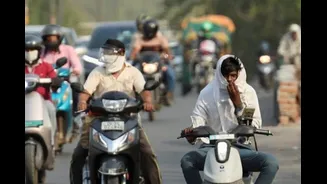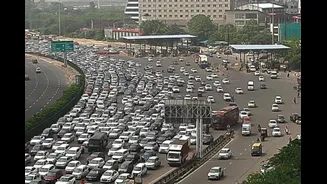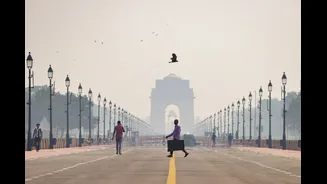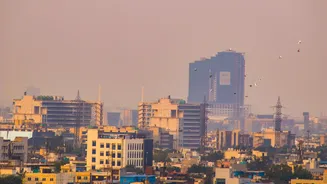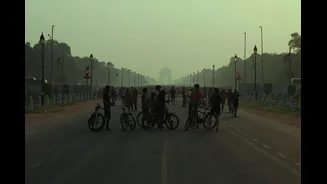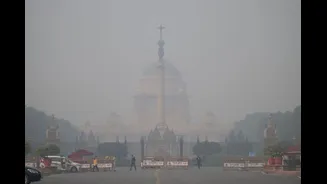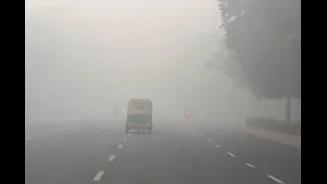




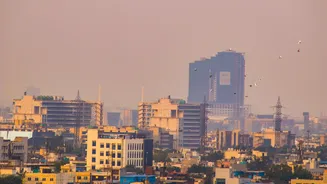


Delhi AQI Today: A thick blanket of smog engulfed the national capital on Monday, a day after Diwali, as air quality worsened across several parts of Delhi. The haze reduced visibility during the early
morning hours, with pollution levels reaching the ‘Severe’ category in some areas.
Data from the Central Pollution Control Board’s Sameer app showed Delhi’s overall AQI at 373 at 11:05 pm on November 8, placing it in the ‘Very Poor’ category.
Neighbouring cities also recorded high pollution levels at the same time. Noida reported an AQI of 319, while Ghaziabad stood at 360. Gurugram recorded 280, and Faridabad registered 297, with all four cities remaining in the ‘Very Poor’ category.
Several parts of Delhi, however, experienced ‘severe’ air quality, with AQI readings crossing 400. These included Alipur, Bawana, Burari, Chandni Chowk, Mundka, Punjabi Bagh, Rohini and Vivek Vihar, among other areas.
According to the Central Pollution Control Board (CPCB), the Air Quality Index (AQI) at ITO stood at 406 around 4.20 am, falling in the ‘Severe’ category. Inderlok was also covered in dense smog, making visibility poor.
#WATCH | Delhi: Air Quality Index (AQI) in the area around South Extension is 360, categorised as ‘Very Poor’, as per the CPCB (Central Pollution Control Board).
(Visuals shot at 04:00 am) https://t.co/MrnHwzd0Ok
— ANI (@ANI) November 8, 2026
Other parts of the city continued to record ‘Very Poor’ air quality. Rajiv Chowk reported an AQI of 381 at around 1.30 am, while South Extension recorded 360 at approximately 4 am.
#WATCH | Delhi: Air Quality Index (AQI) at ITO is 406, categorised as ‘Severe’, as per the CPCB (Central Pollution Control Board).
(Visuals shot at 04:20 am) https://t.co/dNLD5CGyVl
— ANI (@ANI) November 8, 2026
The worsening pollution situation has also triggered a political exchange, with opposition leaders questioning the government’s preparations and BJP leaders raising concerns over the criticism surrounding Diwali celebrations.
The deterioration comes a day after Diwali celebrations, when firecracker emissions added to the city’s existing pollution levels. Delhi’s average AQI stood at 376 on Sunday, compared with 369 a day earlier.
Of the 59 monitoring stations that recorded data on Sunday evening, 19 reported ‘Severe’ air quality, while 33 were in the ‘Very Poor’ category. Jahangirpuri recorded one of the highest readings, with an AQI of 460.
Why Is Delhi’s Air Quality Worsening?
Firecracker smoke, vehicle emissions and stubble burning in neighbouring states are among the factors contributing to the pollution. Weather conditions are also making it difficult for pollutants to disperse.
PM2.5 remained the main pollutant in Delhi on Sunday. These fine particles can enter deep into the lungs and pose health risks.
According to the Decision Support System for Delhi, the transport sector was expected to contribute 19 per cent of the city’s pollution on Sunday. Stubble burning was estimated to account for 3.5 per cent.
The Air Quality Early Warning System has forecast that Delhi’s air quality could remain in the ‘Severe’ category for several days from November 9. Low wind speeds and unfavourable ventilation conditions are expected to allow pollutants to accumulate over the city.
GRAP Stage III Restrictions In Force
Stage III of the Graded Response Action Plan (GRAP) is currently in force across Delhi-NCR to control rising pollution levels.
Under the CPCB’s classification, an AQI between 301 and 400 falls in the ‘Very Poor’ category, while readings between 401 and 500 are classified as ‘Severe’.