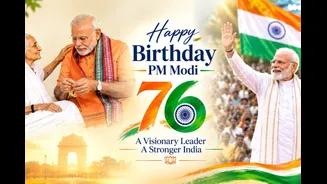



Happy Birthday Narendra Modi: Prime Minister Narendra Modi turns 76 on September 17, 2026. Born in Vadnagar, Gujarat, in 1950, Modi’s political journey has taken him from organisational work with the RSS
and BJP to more than 12 years as Gujarat Chief Minister and, since 2014, to the Prime Minister’s Office.
On his 76th birthday, here are 76 facts and milestones spanning his early life, political career, elections, government and international engagements.
Early life And Formative Years
- Narendra Damodardas Modi was born on September 17, 1950, in Vadnagar in present-day Gujarat.
- He was born three years after India’s Independence in 1947, making him the first Prime Minister of India to have been born in independent India.
- Vadnagar, where Modi was born and spent his early years, is located in Gujarat’s Mehsana district.
Read More: From Family Time To Public Service: How PM Modi Celebrated His Birthdays Since 2014
- His parents were Damodardas Modi and Hiraba Modi, and Narendra Modi was their third child.
- Modi grew up in a modest family and helped at his family’s tea stall during his childhood.
- At the age of 17, Modi left home and travelled across different parts of India for about two years before returning and beginning the next phase of his life.
- After returning from his travels, Modi went to Ahmedabad and joined the Rashtriya Swayamsevak Sangh (RSS).
- Modi became an RSS pracharak in Ahmedabad in 1972, beginning a period of full-time organisational work.
- During the Emergency of 1975–77, Modi participated in activities associated with the movement opposing the Emergency and seeking the restoration of democracy.
- Modi completed a master’s degree in political science from Gujarat University.
Rise Through The BJP
- Narendra Modi began working as the BJP’s General Secretary in Gujarat in 1987, marking his formal rise within the party organisation.
- One of his first major assignments in the BJP involved the Ahmedabad Municipal Corporation election, where the party recorded its first victory in the civic body.
- In the 1990 Gujarat Assembly election, the BJP emerged as the state’s second-largest party behind the Congress.
- The BJP won 121 seats in the Gujarat Assembly in the 1995 election, when Modi was working in the party’s organisational structure.
- Modi became a BJP national secretary in 1995 and was given responsibility for the party’s activities in Haryana and Himachal Pradesh.
- He subsequently became the BJP’s General Secretary (Organisation), one of the party’s senior organisational positions.
- Modi played an organisational role in the BJP’s preparations for the 1998 Lok Sabha election, when the party emerged as the largest constituent of the government formed under Atal Bihari Vajpayee.
Gujarat Chief Minister
- Narendra Modi became the Chief Minister of Gujarat on October 7, 2001.
- He took charge of Gujarat’s government several months after the devastating earthquake that struck the Kutch region on January 26, 2001.
- Modi entered electoral politics through the Rajkot II Assembly by-election held in February 2002, winning the seat with 45,298 votes.
- Modi subsequently moved to the Maninagar Assembly constituency, which he represented for several terms.
- He won the Maninagar seat in the 2002 Gujarat Assembly election and was sworn in for another term as Chief Minister.
- Modi retained Maninagar in the 2007 Gujarat Assembly election and continued as Chief Minister.
- He won Maninagar again in the 2012 Gujarat Assembly election, beginning his fourth consecutive term as Gujarat Chief Minister.
- Modi served as Gujarat Chief Minister from October 2001 until May 2014, a period of more than 12 years.
- His Gujarat administration placed significant emphasis on areas including infrastructure, electricity, agriculture and industrial development.
- The 2002 Gujarat riots became one of the most contested and debated episodes associated with Modi’s tenure as Chief Minister.
- In September 2013, the BJP announced Modi as its prime ministerial candidate for the 2014 Lok Sabha election.
2014: Entry Into The Prime Minister’s Office
- Modi contested the 2014 Lok Sabha election from both Varanasi in Uttar Pradesh and Vadodara in Gujarat.
- He won both seats in the 2014 election and subsequently retained Varanasi.
- The BJP won 282 Lok Sabha seats in the 2014 general election, giving it a majority on its own.
- Modi was sworn in as Prime Minister on May 26, 2014, with President Pranab Mukherjee administering the oath at Rashtrapati Bhavan.
- The 2014 swearing-in ceremony included leaders from across South Asia, with heads of government from neighbouring countries attending the event.
- The Pradhan Mantri Jan Dhan Yojana was launched in August 2014 as a financial-inclusion programme.
- The Swachh Bharat Mission was launched on October 2, 2014, with sanitation and cleanliness as its central focus.
- The Make in India initiative was launched in September 2014 to encourage manufacturing and investment.
- Modi’s monthly radio programme Mann Ki Baat began on October 3, 2014.
- The United Nations General Assembly adopted a resolution in December 2014 declaring June 21 as the International Day of Yoga following India’s initiative.
Second Term
- Modi contested Varanasi again in the 2019 Lok Sabha election and won the seat for a second consecutive time.
- The BJP won 303 Lok Sabha seats in the 2019 general election.
- Modi was sworn in for a second consecutive term as Prime Minister on May 30, 2019, with President Ram Nath Kovind administering the oath.
- Parliament passed legislation in August 2019 reorganising the former state of Jammu and Kashmir into the Union territories of Jammu and Kashmir and Ladakh following the government’s decision on the constitutional provisions associated with Article 370.
- Parliament passed the Citizenship (Amendment) Act, 2019, in December 2019.
- The COVID-19 pandemic became a major national challenge during Modi’s second term, including the nationwide lockdown announced in March 2020.
- India’s national COVID-19 vaccination programme began on January 16, 2021.
- India assumed the G20 presidency on December 1, 2022, beginning its year-long presidency of the grouping.
- India hosted the G20 Leaders’ Summit in New Delhi on September 9 and 10, 2023.
- The African Union was admitted as a permanent member of the G20 during the New Delhi summit.
- The new Parliament building was inaugurated on May 28, 2023, during Modi’s second term.
- India launched the Azadi Ka Amrit Mahotsav campaign in 2021 to commemorate 75 years of Independence.
2024 And The Third Term
- Modi contested the Varanasi Lok Sabha constituency for the third consecutive general election in 2024.
- He won Varanasi in the 2024 election and retained the constituency for a third consecutive term.
- The BJP won 240 Lok Sabha seats in the 2024 general election, below the 272 seats required for a majority on its own.
- The BJP-led National Democratic Alliance secured enough seats to form the Union government after the 2024 election.
- Modi was sworn in as Prime Minister for a third consecutive term on June 9, 2024.
- President Droupadi Murmu administered the oath at Rashtrapati Bhavan.
- Modi became the second Prime Minister after Jawaharlal Nehru to begin a third consecutive term following successive Lok Sabha election victories.
- The 2024 election was different from the previous two general elections because the BJP did not secure a majority on its own and formed the government with its NDA partners.
Global Reach And Public Life
- India and France launched the International Solar Alliance initiative in 2015, which subsequently developed into an international organisation focused on solar energy cooperation.
- Modi received the Seoul Peace Prize in 2018, becoming the 14th recipient of the award.
- During his years as Prime Minister, Modi has received national honours from several foreign governments, including France, Russia, the United Arab Emirates, Saudi Arabia, Egypt and Greece.
- Ghana conferred the Officer of the Order of the Star of Ghana on Modi in July 2025.
- Trinidad and Tobago conferred the Order of the Republic of Trinidad and Tobago on Modi in July 2025.
- Slovakia conferred the Order of the White Double Cross, First Class, on Modi in June 2026.
- Modi has addressed the United Nations General Assembly multiple times during his tenure as Prime Minister.
- His international engagements have included major multilateral forums such as the G20, BRICS and the United Nations.
- Pariksha Pe Charcha, an annual interaction involving students, teachers and parents, has been held since 2018.
- Modi authored Exam Warriors, a book focused on examinations, confidence and handling academic pressure.
Read More: ‘Welcome Modi Govt’s Efforts’: Trump Praises India’s Opium Crackdown, Slams China Over Drug Precursors
Modi At 76
- Modi has served continuously as India’s Prime Minister since May 26, 2014.
- His tenure as head of a government began earlier, when he became Gujarat Chief Minister on October 7, 2001.
- October 7, 2025 marked 24 years since Modi first became the head of a government.
- On June 10, 2026, Modi completed 4,399 days of continuous service as an elected Prime Minister.
- The 4,399-day figure surpassed Jawaharlal Nehru’s previous record of 4,398 continuous days as an elected Prime Minister.
- Modi has represented Varanasi in the Lok Sabha since winning the constituency in the 2014 general election.
- He is currently serving his third consecutive term as India’s Prime Minister.
- Narendra Modi turns 76 on September 17, 2026, more than five decades after he began his organisational political journey and nearly 25 years after becoming the head of a government.
From Vadnagar To The Prime Minister’s Office
Narendra Modi’s public career has passed through several distinct stages, from his early years in Vadnagar and organisational work with the RSS and BJP to more than 12 years as Gujarat Chief Minister and three consecutive terms as Prime Minister.
His 76th birthday comes in a year that has added another milestone to that timeline. On June 10, 2026, he crossed 4,399 days of continuous service as an elected Prime Minister, surpassing the previous record of 4,398 days attributed to Jawaharlal Nehru.