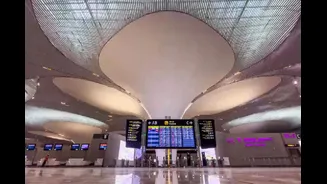






In less than 24 hours, the long-awaited Navi Mumbai International Airport (NMIA) will begin commercial operations , turning a long-held dream into reality for thousands of passengers. While many Mumbaikars
are excited about the modern new airport, there is also confusion and concern, especially about reaching the facility and avoiding booking mistakes between NMIA and Mumbai’s existing Chhatrapati Shivaji Maharaj International Airport (CSMIA).
Located at Ulwe in Panvel taluka, NMIA lies outside Mumbai’s main suburban rail network and will open without direct metro or express rail connectivity. In its initial phase, passengers will rely on trains, buses and road transport, each with its own challenges.
Reaching NMIA by train: Cheap but indirect
Suburban rail remains the most affordable option, but also the most complicated. There is no direct train service to the airport terminal. All rail passengers must change lines at least once and cover the final stretch by road.
Travellers from South and Central Mumbai usually take Harbour Line trains from CSMT towards Vashi, Nerul or Belapur CBD. From Belapur, they must switch to the Belapur-Uran line to reach Targhar station. Those coming from Thane and the central suburbs use Trans-Harbour services to Nerul before making the same change.
Targhar station, which opened recently, is about 1.8 to 5 km from the airport terminals. From there, passengers must take an auto-rickshaw, taxi or shuttle. In non-peak hours, the journey from CSMT to Targhar takes 75 to 90 minutes, but during rush hours it can exceed two hours. Rail fares are low, with second-class tickets under Rs 40 and first-class fares between Rs 95 and Rs 175.
However, crowding, luggage handling and multiple interchanges make this option difficult for many flyers.
Bus services: Low cost, high uncertainty
Public buses offer the cheapest surface travel but are also the least reliable. BEST and MSRTC buses run between Mumbai, Thane and Navi Mumbai, but none go directly to the airport.
Passengers must usually get down at Panvel, Belapur, Nerul or Ulwe and then take a taxi or auto. Fares range from Rs 50 to Rs 200, but multiple transfers are common. Congestion on the Sion-Panvel Highway and near Panvel junctions often causes delays. With limited luggage space and frequent stops, buses are not ideal for time-sensitive travel.
So far, no city transport body has announced a dedicated airport bus service.
Road travel: Fastest for most passengers
Road travel is expected to be the most popular choice, especially for those carrying luggage. Key routes include the Mumbai Trans Harbour Link (Atal Setu), Sion–Panvel Highway, Vashi Bridge, Palm Beach Road and Eastern Freeway.
Atal Setu has reduced harbour crossing time to around 20 minutes. Under moderate traffic, journeys from South Mumbai take 60 to 80 minutes, while trips from the western suburbs may take up to two hours. Taxi fares range from Rs 1,000 to Rs 2,500, excluding tolls.
Several major connectivity projects will not be ready at launch. Metro Line 8, linking CSMIA and NMIA, is expected around 2029. The Ulwe Coastal Road may open in early 2026. Dedicated airport rail or metro express services are yet to be announced.
For now, travellers will need careful planning to reach Navi Mumbai’s new airport on time.