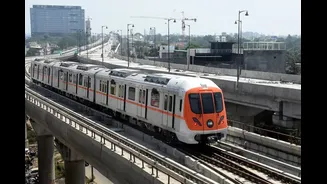

Bhopal steps into a new phase of urban mobility on Saturday with the inauguration of its first-ever metro service, a milestone that positions the Madhya Pradesh capital alongside India’s emerging modern
transit cities. The launch will take place at 5 pm at Subhash Nagar Metro Station, as per India Today, where Chief Minister Mohan Yadav and Union Housing and Urban Affairs Minister Manohar Lal Khattar will flag off the inaugural run before travelling up to AIIMS.
For the public, services will officially begin on December 21 from 9 am.
The opening of the Orange Line’s priority stretch marks the first operational segment of the wider 30.8-km Bhopal Metro project, an urban rail system designed to ease road congestion, improve travel reliability, and offer a cleaner, safer alternative to crowded city traffic.
With Bhopal’s population expanding and road density rising, the launch of this first corridor is being seen as the starting point of a long-awaited transformation in how the city moves.
What Is The Bhopal Metro Project, And How Big Will The Network Be?
The Bhopal Metro project spans 30.8 km across two main corridors, supported by a common depot at Subhash Nagar. The design connects key residential zones, commercial hubs and major transit points to enable faster east–west and north–south movement.
The two corridors are:
- Orange Line: 16.74 km from Karond to AIIMS
- Blue Line: 14.16 km from Bhadbhada to Ratnagiri
Which Stretch Will Open Today?
The priority corridor has been built at a cost of Rs 2,225 crore and is part of the larger Rs 10,033-crore project. Passing through high-density areas like MP Nagar, the route is expected to significantly ease daily movement across central Bhopal.
How Often Will Trains Run?
Public operations will begin at 9 am on December 21. A total of 17 trips will run each day, nine from AIIMS to Subhash Nagar and eight in the opposite direction.
According to the operational plan:
- First train from AIIMS: 9 am (reaches Subhash Nagar in about 40 minutes)
- Last train from AIIMS: 5 pm (reaches at 6:25 pm)
- One full cycle takes around 75 minutes
Between stations, the metro takes about 2–3 minutes, with a two-minute halt at each stop for boarding and deboarding.
How Much Will It Cost To Travel On Bhopal Metro?
The fare system is divided into three slabs:
- Up to two stations: Rs 20
- Three to five stations: Rs 30
- Six to eight stations: Rs 40
These rates make Bhopal’s minimum fare higher than several Indian metro cities, where entry fares begin at Rs 10, Rs 11 or Rs 15. Once the full Orange Line becomes operational, the maximum fare will remain in the Rs 40–70 bracket, depending on distance.
What Facilities And Systems Do The New Trains Have?
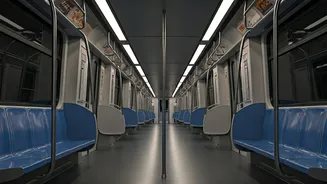
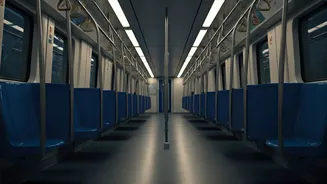
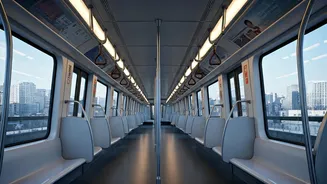
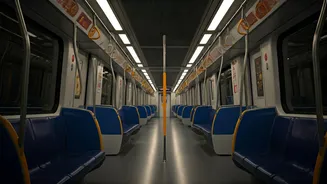
The metro’s three-coach trains are designed with modern safety and passenger-friendly systems. Key features include:
- Stainless steel, rust-free coaches
- Face-to-face seating and wide standing areas
- Automatic doors and platform screen doors
- Digital route maps and LED displays
- Mobile charging points
- AC coaches with a total capacity of about 980 passengers per train (approximately 330 per coach, including standing space)
- Two dedicated wheelchair spaces in specific coaches with a long-stop request button
The first and third coaches function as driving units, enabling the train to reverse direction from either end. A total of 81 coaches will eventually arrive in Bhopal, forming 27 trains; eight trains are already in place.
Though the system is equipped for future driverless operations, trains will run with drivers for now. Emergency intercom buttons are available for passengers to communicate with the driver, who can alert the emergency team at the next station if needed.
How Safe And Accessible Are The Stations?
All eight stations on the priority stretch are equipped with:
- CCTV cameras
- Fire-fighting systems
- Lifts and escalators
- Braille signage and tactile tiles for visually impaired passengers
- Audio announcements and digital displays for station updates
Passenger movement has been designed to be straightforward, from ticketing to platform access to exit. Platform screen doors open about 10 seconds after the metro arrives, with simultaneous operation of train and platform gates.
For disabled passengers, the extended stop request allows additional time for safe boarding and exit.
Why Does The Launch Matter For Bhopal?
The introduction of the Bhopal Metro marks a major shift in how the city approaches mobility and public transport. The project aims to:
- Reduce congestion on major arterial roads
- Offer a faster and more dependable commute
- Lower pollution through a shift to public transport
- Improve urban connectivity for work, education and healthcare
The Bhopal Metro project was first conceived in 2009, with instructions to prepare the Detailed Project Report issued in 2011. But progress moved slowly, and the first major work order was awarded only in 2018. Although the project was taken up around the same time as the Indore Metro, Bhopal’s implementation lagged, while Indore became operational roughly seven months earlier.
With today’s launch of the priority corridor, Bhopal finally enters its operational phase, and as the remaining stretches of the Orange and Blue Lines are completed, the wider network is expected to ease congestion and provide a cleaner, more reliable transport system for the city.