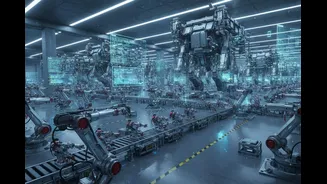






On October 21, during Tesla’s third-quarter earnings call, Elon Musk described a factory floor that builds itself. In Fremont, California, the space previously used to manufacture the Model S and Model X
now houses a production line for the Optimus humanoid robot, designed to produce one million robots a year.
Musk wants the line to reach a production rate of 20,000 robots a week in about a year.
These numbers may seem exaggerated, raising questions about where so many robots would be deployed. However, they point to a growing trend: the increasing capabilities of robots on factory floors. The projected numbers may not be accurate, but the broader pattern is becoming clear.
Robots are becoming more capable because of advances in their underlying architecture, including rapidly evolving AI algorithms, AI chips and visual learning. They use neural networks trained in ways similar to modern AI models. One of the main architectures is the vision-language-action model, which uses visual inputs and language instructions to generate motor commands.
These models build on the same large vision-language models that power chatbots. As a result, robots can inherit general knowledge about objects, instructions and surroundings from training data collected across the internet.
Musk’s timelines have often invited scepticism, and he has acknowledged some of the limitations himself. In January, he admitted that no Optimus robots were performing useful work in Tesla’s factories, despite the company having claimed otherwise in 2024. In October, he conceded that Tesla was “building robots that do not have perfected hands” and that outside customers would receive Optimus only around the end of 2027.
The first 10,000 to 20,000 robots will be sent to what Musk calls an Optimus Academy, where they will practise tasks and generate training data, similar to the data Tesla’s cars collected on roads.
However, the idea cannot be dismissed simply because Musk is promoting it. Other companies are already developing similar systems.
The Robots Already On The Line
Figure AI announced its BotQ plant in California in 2025, with an explicit plan to use its own humanoid robots to help manufacture more robots. The company says its production line increased output from one Figure 03 robot a day to one an hour in about four months. It reportedly built its 1,000th unit in July.
At BMW’s Spartanburg plant in South Carolina, a Figure 02 robot worked on the X3 production line for 11 months and contributed to the manufacturing of more than 30,000 vehicles. Figure 03 took over parts sequencing there in June. A BMW logistics executive told The New York Times that the robots are “still slower than humans”. Despite this limitation, BMW has continued with the deployment.
China is also moving ahead with humanoid robots. UBTech says it has orders worth more than 800 million yuan for its Walker S2 humanoids, which it has placed with carmakers including BYD, Geely and FAW-Volkswagen. The company is targeting production of 5,000 units in 2026.
Xiaomi’s “dark factory” in Beijing’s Changping district can manufacture up to 10 million phones a year on production lines that require no lighting because no humans work there. Hyundai, which owns Boston Dynamics, plans to deploy more than 25,000 Atlas humanoid robots across its plants by 2030.
Amazon, meanwhile, already operates around one million robots. Internal documents reported by The New York Times last year showed that its automation team expected to avoid hiring more than 600,000 American workers by 2033, even as sales doubled. Amazon disputed the framing, but the figures in the documents highlight the scale of its automation plans.
Why This Cycle Is Different
Traditional factory robots were largely blind arms fixed to the floor and programmed movement by movement to perform a single task. Over the past 18 months, however, advances in AI have changed how robots process information and perform tasks.
Vision-language-action models allow robots to use general knowledge about objects and instructions learned through internet-scale training. Nvidia’s Jetson Thor brings data-centre-class AI computing inside a robot’s body, reducing its dependence on cloud processing.
Figure’s Helix 02 architecture separates slower reasoning from faster reflexes. One layer plans actions while another adjusts balance and contact a thousand times a second. Touch is also being converted into visual information by placing cameras behind soft gel pads, allowing neural networks trained to process images to learn how to sense physical contact.
Google has also reported that skills learned by one robot can be transferred to a different robot body without retraining.
Together, these developments mean that a skill learned once can be shared across an entire fleet of robots. This creates another important cycle: every deployed robot can collect data that helps improve the capabilities of other robots.
The Economics Are Still Uncertain, But The Range Is Narrowing
JPMorgan estimates that around two humanoid robots are currently required to match the output of one human worker. It expects this figure to fall to about 1.2–1.3 robots by 2030.
Goldman Sachs estimated the manufacturing cost of a humanoid robot at $30,000–150,000 in 2024, following a 40 per cent decline in a single year. Bank of America puts the bill of materials at around $35,000 and expects it to fall to $13,000–17,000 within a decade.
Forecasts for the humanoid robot market in 2035 range from $38 billion to $138 billion. Goldman Sachs published both estimates, in 2024 and again this year. These are projections by market participants, not established data.
The available installation figures, however, indicate the scale of industrial automation. According to the International Federation of Robotics, China installed 354,000 industrial robots in 2025, accounting for 59 per cent of the global total. India installed around 10,500. China’s long-term state fund for the sector is reportedly worth $138 billion.
India’s False Comfort
The usual argument in India is that cheap labour will protect the country from automation. For now, labour costs remain a significant advantage.
A figure says its robots cost about $25 per robot-hour at BMW, although this is the vendor’s own estimate. At an exchange rate of roughly ₹95 to the dollar, this works out to around ₹2,400 an hour. Data from the Annual Survey of Industries puts the average annual wage of a formal factory worker at around ₹2.2 lakh, which works out to well under ₹100 an hour.
Addverb, the Reliance-controlled robot maker that has launched India’s first wheeled industrial humanoid, says a good Chinese humanoid costs ₹50–75 lakh. This is equivalent to more than two decades of a worker’s wages.
However, two factors challenge the assumption that low labour costs will protect Indian factories.
The first is that Indian factories are increasingly adopting automation to improve quality, rather than simply to reduce wage expenses. At Hyundai’s plant in Pune, which was previously a General Motors factory, 204 robots now carry out all the welding, compared with six under GM. Hyundai says manual welding resulted in positioning errors and inconsistent quality.
Ola’s Krishnagiri plant was designed around 3,000 robots, while Maruti was already operating around 5,000 robots across its Manesar and Gurugram facilities nearly a decade ago.
The second factor is the declining cost of automation. If the cost of materials for a humanoid robot falls towards $15,000 and one robot can cover two shifts, the payback period could shrink to a few years, even when compared with Indian wages. This is an extrapolation rather than a published forecast and does not account for integration and maintenance costs. However, the direction of the cost trend is clear.
The danger for India is not the mass replacement of workers next year. Instead, the concern is that the jobs the country is counting on — low-skill assembly and logistics work expected to absorb millions entering the workforce every year — could be automated before India gets the opportunity to create them.
A crore of capital invested in a robot-heavy factory today creates far fewer jobs than the same investment would have a decade ago. As machines take over more tasks, workers could also lose bargaining power.
Musk’s vision of a self-reinforcing production cycle may take longer to materialise than he predicts. However, a policy approach that assumes India has another decade of advantage from low labour costs risks planning for a factory model that is already changing.