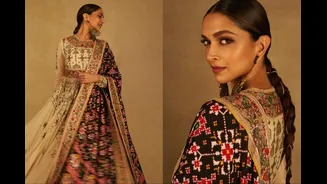

Some looks do more than catch the eye. They tell a story. At the Swadesh event, Deepika Padukone arrived in a creation that felt less like an outfit and more like a moving archive of India’s textile legacy.
In an age where fashion increasingly seeks meaning, her ensemble offered a reminder that heritage isn’t static; it lives, breathes, and evolves with every artisan who continues its lineage.
A Patola Reinvented For The Present
At the heart of her look was a handwoven Navratan Patan Patola, crafted by master artisan Bhawar Singh. The textile, one of India’s most complex weaving traditions, was reinterpreted through Anamika Khanna’s contemporary lens. Instead of presenting the patola as a museum-like relic, Anamika introduced mulmul florals that softened the geometry, allowing the fabric to feel airy, fluid, and unexpectedly modern.
View this post on Instagram
The interplay of precision and poetry gave the ensemble its soul. The patola spoke of skill refined over centuries; the mulmul blooms brought in movement, femininity, and that signature Khanna romance.
Finishing the silhouette was a handmade Banaras border, anchoring the fluidity with structure and old-world richness. On Deepika, the detailing became a quiet but powerful homage – not just to one craft cluster, but to the interconnected tapestry of Indian artisanship.
Her braided hair, statement elongated earrings, and minimal styling allowed the textiles to take centre stage. There was intention in the restraint; nothing distracted from the fabric’s story or the labour behind it.
A Look That Celebrates The Hands Behind The Heritage
What made this appearance stand out was not extravagance. It was reverence. In a fashion landscape accustomed to speed, Deepika championed slowness: slow weaving, slow craft, slow beauty. Her look reminded us that India’s greatest luxury isn’t embellishment; it’s the mastery of artisans who pass down skills through generations, often anonymously.
Deepika Padukone’s ensemble was proof that heritage is most powerful when worn with intention. This was not nostalgia. It was evolution. A patola reborn through mulmul, anchored with Banaras, interpreted for today’s woman. A look that held history, yet stepped forward with confidence.