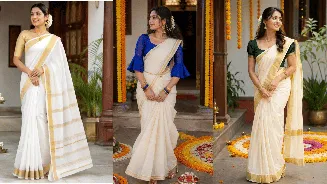




The timeless white-and-gold Kasavu saree is almost synonymous with South Indian elegance and, of course, Onam. But with handloom and machine-made versions available side by side, knowing what you are actually
buying can get tricky.
A genuine handloom Kasavu saree is not defined simply by how white the fabric is or how shiny the border looks. When it comes to picking your Kasavu drape, every detail matters, from the weave and construction to its provenance and certification.
So, before you spend on that classic Kerala saree, here are a few things worth checking.
What Is “Kasavu”?
There is an important distinction to make before talking about authenticity. Kasavu refers to the zari or metallic border. The sarees are woven on traditional handlooms with pure cotton yarns for the body and actual zari or imitation gold yarns of high quality for the borders. Kerala’s traditional Kasavu sarees are generally recognised by their white or off-white body and gold-toned border. Kerala Tourism describes the saree as a traditional single-piece drape, commonly made from fine cotton or silk-cotton blends.
So, a saree can have a Kasavu-style border without necessarily being a handwoven Kerala saree. If what you specifically want is an authentic handloom Kasavu, you need to check the weaving as well.
1. Look For The Handloom Mark
This is one of the most useful checks you can make. The Government of India’s Handloom Mark scheme was introduced to give buyers assurance that a product is genuinely handwoven rather than powerloom- or mill-made.
Don’t simply take a seller’s word for it. Look for the official Handloom Mark label and, where applicable, use the information or QR code associated with the label to verify it. Government material says the consumer system was designed to allow buyers to check the veracity of Handloom Mark labels.
However, a missing Handloom Mark does not automatically prove that a saree is fake. It does, however, mean you should ask more questions.
2. Check The Weave Up Close
Don’t judge the saree only from a distance. Get your hands on it. Handwoven fabric can show small variations or irregularities in the weave because it has been made by hand. These aren’t necessarily defects, they can be a natural result of the weaving process. Machine-made fabric tends to have a more uniform, highly consistent appearance.
3. Don’t Fall For An Overly Shiny Border
A Kasavu border is supposed to have a beautiful metallic sheen, but more shine does not necessarily mean better quality. According to Haradhi’s guide, handloom zari tends to have a more subtle sheen, while machine-made borders can appear excessively glossy and may wear away over time.
Also, don’t assume that every authentic Kasavu saree has to contain pure gold. Historically, gold was used in zari, but contemporary Kasavu weaving can use other metallic yarns, including high-quality imitation zari. Kerala Tourism notes that Balaramapuram Kasavu traditionally uses silver threads coated with gold.
4. Examine How The Border Is Made
This is where you need to look beyond the overall appearance. The gold border should be woven into the saree, rather than printed on or stuck onto the fabric. Check the edges and the reverse side carefully. A border that looks like a separate strip sitting on top of the fabric is a reason to ask questions.
And don’t automatically dismiss a saree because its border has a motif. Traditional Kerala handlooms can feature motifs and decorative borders, and different weaving centres have their own characteristics. Kuthampully, for instance, is known for traditional Kasavu fabrics as well as sarees with decorative motifs.
5. Check Where It Was Woven
Provenance matters. Kerala has several recognised handloom centres, with Balaramapuram, Kuthampully and Chendamangalam being among the state’s major weaving traditions. Kerala Tourism identifies these as important centres of Kerala handloom production.
Balaramapuram in Thiruvananthapuram is particularly known for its traditional cotton handlooms, while Kuthampully in Thrissur has a long-established Kasavu weaving tradition. Chendamangalam in Ernakulam is also known for handloom sarees and has GI recognition.
6. Be Suspicious Of A Price That Seems Too Good To Be True
Handloom weaving involves time, skill and manual labour. So if a seller is offering a supposedly premium handwoven Kasavu at an unusually low price, don’t immediately assume you’ve found a bargain. Ask what you’re actually paying for. A low price alone does not prove a saree is fake, but it is a good reason to investigate the product before buying.
What About The GI Tag?
This is another detail that can cause confusion. Some Kerala handloom products have Geographical Indication (GI) recognition, including Balaramapuram, Chendamangalam and Kuthampully products. Kerala Tourism notes that these weaving clusters have distinct traditions and recognised GI products.
But a GI tag and the Handloom Mark are not the same thing. GI recognition identifies products associated with a particular geographical origin and characteristics, while the Handloom Mark is specifically intended to assure consumers that a product is handwoven. Government handloom material also treats GI and Handloom Mark as separate authenticity tools.
So if you’re buying a Kasavu saree this Onam, don’t let a bright gold border or a bargain price make the decision for you.