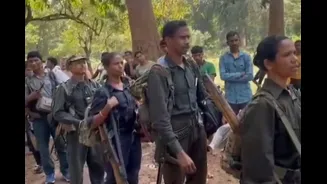







With Union Home Minister Amit Shah setting a March 31, 2026, deadline for Naxal-free Bharat, Chhattisgarh, followed by Jharkhand and Odisha, is where the last significant remnants of the country’s Maoist
insurgency are now concentrated. Taken together, security agencies estimate approximately around 400 senior Maoist cadres still remain active across these three states.
Even as Chhattisgarh continues to have the largest residual presence, with approximately 200 senior armed cadre operating in dense forested pockets, the numbers are declining in every counter-measure taken by the government and security forces through anti-Naxal operations and surrenders. Jharkhand has around 100, while Odisha accounts for nearly 75, according to reports reviewed by News18 from anti-Naxal operations forces.
“The majority of the MMC (Madhya Pradesh-Maharashtra-Chhattisgarh) zone and the Andhra-Telangana region are now almost Naxal-free,” said a senior police officer involved in anti-Naxal operations across the Madhya Pradesh-Maharashtra-Chhattisgarh border zones. “What remains today is not a Maoist corridor anymore, but a residue,” he added.
For almost four decades, the Maoist movement thrived on territorial contiguity and ideological mobilisation across India’s forested tribal belt. That red fort has now collapsed. What exists instead are fragmented clusters, nervous and shaky cadres, operating under constant surveillance and pressure, with severely weakened command-and-control structures.
According to the intelligence assessments, the senior police officer added, the organisational backbone of insurgency has thinned dramatically.
“Across Chhattisgarh, Jharkhand and Odisha, barely a dozen Central Committee and Politburo-level leaders are believed to be active. At least four of them are old and almost immobile. Several of them are ageing, increasingly isolated, and forced into frequent movement to evade security forces. Their ability to coordinate large-scale operations has been sharply curtailed. In addition, their support bases are drying up,” the officer further said.
Total Control To Total Uncertainty
Officers of the anti-Naxal force also note that Maoist units have shifted from holding ground to merely surviving. Large armed formations have given way to smaller, and mobile groups, primarily focused on evasion rather than expansion. Static camps, once the nerve centres of operations in Dantewada region, Balaghat and Gadchiroli belts, have become untenable for them.
“This contraction of Naxal bases is the result of sustained multi-agency operations, improved intelligence sharing amongst agencies, drone-based surveillance, and deep-area domination by central and state forces,” said another senior officer posted in the same unit. However, the officers stress that force alone does not explain the rollback.
A critical differentiator in the current phase has been the alignment of security operations with governance delivery to the interior region. Surrender and rehabilitation policies have been redesigned to move beyond one-time incentives. The focus is now on long-term reintegration like housing, skill development, education, healthcare, and livelihood support for surrendered cadres and their families.
At the village level, roads, mobile connectivity, ration delivery, healthcare outreach, and administrative presence have steadily expanded into areas once considered Maoist strongholds. This has weakened the insurgency’s recruitment base, particularly among tribal youth who now see alternatives beyond armed struggle.
Endgame for Maoists?
Surrenders with weapons have risen in numbers, especially among lower- and mid-level cadres, many of whom joined young and stayed on due to fear rather than ideological commitment. The recruitment pipelines have dried up, and morale within remaining units is visibly low, added the senior officer.
However, the security agencies remain cautious. A shrinking insurgency can still be dangerous. Small, desperate units retain the capacity for IED attacks and targeted ambushes, even if their strategic reach has diminished, he further said.
For the first time in decades, however, momentum lies decisively with the state. The Maoists are reacting, not shaping events. Whether Shah’s March 2026 deadline becomes a definitive closure will depend on how firmly military gains are consolidated through governance and trust on the ground. The Red Corridor is no longer a belt. It now looks like a narrowing margin.