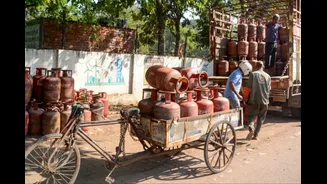






A government order has stated that the supply of LPG cylinders to households will be discontinued after three months if consumers do not switch to piped natural gas (PNG) in areas where such connectivity
is available.
The order is aimed at accelerating the expansion of the gas pipeline network and reducing reliance on a single fuel source.
LIVE Updates On The US-Israel-Iran War
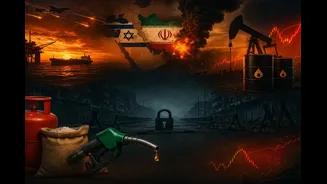
The move comes at a time when India is grappling with supply disruptions triggered by the war in West Asia, which has impacted shipments of liquefied petroleum gas (LPG) from key sources.
The government is encouraging households and commercial establishments to adopt PNG, which is supplied continuously through pipelines directly to kitchen burners and eliminates the need for booking refills.
The Ministry of Petroleum and Natural Gas has notified the Natural Gas and Petroleum Products Distribution (Through Laying, Building, Operation and Expansion of Pipelines and Other Facilities) Order, 2026, with the objective of accelerating pipeline infrastructure, easing approvals and promoting a transition from LPG to PNG to strengthen energy security.
As per the order issued, LPG supply “shall cease after three months” if households fail to opt for PNG despite the availability of pipeline connectivity.
The provision, however, allows continuation of LPG supply in cases where it is “technically infeasible” to provide a piped connection, subject to issuance of a no-objection certificate (NOC) by the authorised entity.
ORDER SEEKS TO FREE UP LPG FOR AREAS WITHOUT PIPELINES
The government’s move is aimed at freeing up LPG supplies in regions where pipeline connectivity already exists and diverting those supplies to areas lacking such infrastructure, while also promoting “fuel diversification” amid global supply disruptions, including damage to liquefaction facilities in the Gulf and continued blockage of the Strait of Hormuz.
The order has been issued under the Essential Commodities Act and seeks to fast-track pipeline development by simplifying approvals, standardising charges and ensuring time-bound permissions.
Public authorities have been directed to grant right of way and other approvals within prescribed timelines, failing which permissions will be deemed granted.
Authorities are also barred from imposing charges beyond those specified under the order.
TIME-BOUND APPROVALS AND DISPUTE RESOLUTION MECHANISM
According to the order, entities controlling access to housing complexes must grant permissions within three working days, while last-mile PNG connectivity is to be provided within 48 hours.
Applications seeking pipeline connectivity in housing areas cannot be rejected.
The order also provides for intervention by designated officers, who will have powers similar to those of a civil court to resolve disputes related to land access and grant the right of way where required.
Authorised entities are required to begin laying pipelines within four months of receiving approvals, failing which penalties, including potential loss of exclusivity, may be imposed.
The Petroleum and Natural Gas Regulatory Board (PNGRB) has been designated as the nodal agency responsible for monitoring implementation, including tracking approvals, rejections and compliance.
The order further states that if permission for pipeline access is not granted by entities controlling entry to housing complexes, a notice will be issued, and LPG supply will be stopped after three months.
Listing the “consequences of households not applying for and obtaining PNG connection when notified by authorised entity”, the order states, “The LPG supply to such an address shall cease after three months from the date of the communication.”
However, LPG supply will continue where the authorised entity issues an NOC stating that it is technically infeasible to provide piped gas connectivity.
The authorised entity will maintain records explaining such infeasibility and may withdraw the NOC once connectivity becomes possible.
STORY | LPG supply to be cut off if households refuse PNG switch where available: Govt order
The government has mandated that cooking gas LPG supply to households will be discontinued if consumers fail to switch to piped natural gas where such connectivity is available, under a… pic.twitter.com/RTMR7Okcci
— Press Trust of India (@PTI_News) March 25, 2026
NO CHANGE IN LPG REFILL BOOKING RULES, GOVT CLARIFIES
Separately, the government has dismissed reports suggesting changes in LPG refill booking timelines, calling such claims misleading and unfounded.
The Ministry of Petroleum and Natural Gas clarified that no revisions have been made to existing refill booking norms for LPG consumers, including beneficiaries of the Pradhan Mantri Ujjwala Yojana (PMUY).
The Ministry said certain media reports and social media posts had claimed that refill booking timelines had been revised to 45 days for PMUY beneficiaries, 25 days for non-PMUY single-cylinder users and 35 days for non-PMUY double-cylinder consumers.
“No such changes have been made,” the government said, adding that the existing timelines remain unchanged.
As per current norms, LPG refills can be booked after 25 days in urban areas and 45 days in rural areas, irrespective of the type of connection.
The government also urged citizens not to believe or circulate misinformation and to avoid unnecessary or panic booking of LPG refills, assuring that adequate LPG stocks are available across the country.
State-owned Bharat Petroleum Corporation Ltd (BPCL) also said that rumours regarding shortages of petrol and diesel in certain areas are completely unfounded and reiterated that India is a net exporter of these fuels.
The Centre has also constituted seven empowered groups of officials and experts to address the impact of the Iran conflict on sectors such as oil, gas, fertilisers, supply chains and inflation.
ALSO READ | India Buys 60 Million Barrels Of Russian Oil As Strait Of Hormuz Disruptions Strain Supply