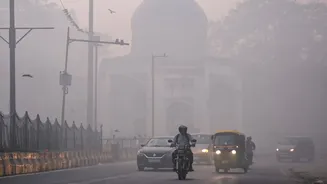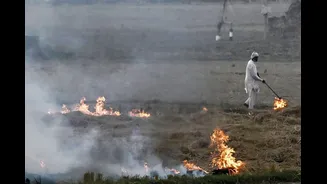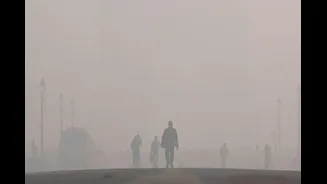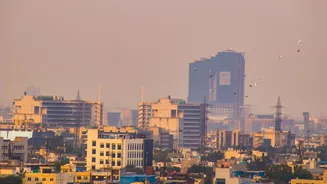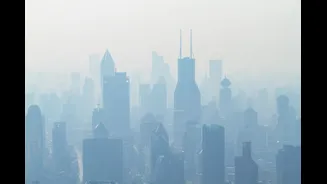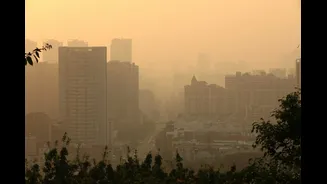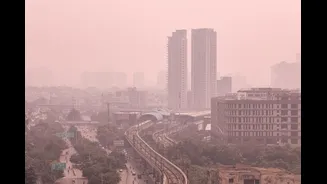






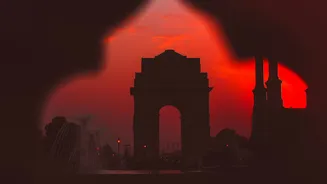
With Delhi continuing to battle toxic air, a political war of words has erupted between the governments of Delhi and Punjab over stubble burning, with the BJP accusing the Aam Aadmi Party (AAP) of failing
to curb farm fires in Punjab.
While the BJP has targeted the AAP government over the rising incidents of stubble burning in Punjab, state minister Harpal Singh Cheema has accused the saffron party of deliberately defaming Punjab’s farmers and ignoring similar concerns in BJP-ruled Haryana and Uttar Pradesh.
The political exchange comes after Punjab recorded 1,152 fresh farm fires on Diwali, marking the sharpest single-day spike in stubble-burning incidents in the state this season. Pollution levels soared toalarming levels on Diwali night, with firecracker emissions, stubble burning and other contributing factors worsening the air quality.
Also Read | ‘Take Responsibility, Present True AQI’: AAP Alleges Delhi Pollution Data Manipulation
AAP’s Harpal Cheema Accuses BJP Of Targeting Punjab Farmers
Reacting to the BJP’s allegations, Punjab Finance Minister Harpal Singh Cheema defended the state government’s efforts to tackle stubble burning and accused the BJP of selectively targeting Punjab.
“Punjab farmers do not indulge in any illegal activity. In the last five years, the AAP government has distributed equipment and new machinery among farmers. Incidents of stubble burning have reduced,” Cheema said.
He further alleged that the BJP was deliberately defaming Punjab and its farmers while ignoring Haryana and Uttar Pradesh because both states are governed by the party.
“There is Haryana between Punjab and Delhi. But they forget Haryana because there is a BJP government there. They forget UP too because there is a BJP government there. They see only the farmers of Punjab,” he said.
Cheema also linked the BJP’s allegations to the farmers’ protest against the Centre’s three farm laws, claiming that the party was seeking revenge against Punjab’s farmers for opposing the legislation.
What Did Delhi Minister Kapil Mishra Say?
Delhi MinisterKapil Mishra, meanwhile, alleged that a large number of stubble-burning incidents were deliberately reported in Punjab on Diwali and called for an investigation into the matter.
Claiming that his government had received calls from Punjab about fields being set on fire, Mishra said farmers had alleged that their crops were being burnt while they were celebrating Diwali at home.
He said the government subsequently checked satellite data, which revealed a sharp rise in reported farm fires.
“On the 5th, 6th and 7th, incidents of stubble burning were reported at 100-125 locations. But on the 8th, the evening of Diwali, 1,200 locations were reported with incidents of stubble burning,” Mishra said.
Alleging that the fires were part of a deliberate campaign to defame Diwali and Sanatana Dharma, he accused people associated with the AAP of orchestrating the incidents.
Mishra also claimed that Delhi recorded a 1% decline in pre-Diwali and post-Diwali AQI levels for the first time, compared with previous years when pollution levels typically increased by nearly 50% until 2022.
Stubble Burning In Punjab: 1,152 Farm Fires On Diwali
Punjab recorded 1,152 fresh farm fires on Diwali, the sharpest single-day increase in stubble-burning incidents this season, taking the cumulative count to 4,459 from 3,307 on November 7, according to official data.
The figure marks a significant increase compared with last year, when Punjab recorded just 45 farm fires on Diwali, which fell on October 20.
However, the comparison comes with an important difference in the harvesting cycle. Only 32% of the total paddy sown in Punjab had been harvested by October 20 last year, compared with nearly 92% by November 8 this year.
Till November 30 last year, Punjab had recorded a total of 5,114 farm fires. On November 8, 2025, the cumulative number of incidents stood at 3,622.
The annual farm-fire monitoring period begins on September 15, around two weeks before paddy procurement starts on October 1, and continues until the end of November.
The latest figures point to a rise in crop-residue burning despite government advisories, enforcement measures and financial penalties aimed at discouraging the practice.
How Much Does Stubble Burning Contribute To Delhi’s Pollution?
While stubble burning is one of the contributors to Delhi-NCR’s air pollution, it is not the only source responsible for the deteriorating air quality.
According to a report by experts from IITs, academic institutions, research institutes, NGOs and other reputed organisations, the contribution of different sources to PM2.5 pollution varies between winter and summer.
During winter, secondary particulates account for 27% of PM2.5 pollution. These are formed through the transformation of gaseous emissions from sources such as transport, industries, power plants and biomass burning.
Transport contributes 23%, followed by biomass (stubble) burning at 20%, dust at 15% and industries, including thermal power plants, at 9%.
During summer, dust emerges as the biggest contributor, accounting for 27% of PM2.5 pollution. Transport contributes 19%, followed by secondary particulates at 17%, industries at 14% and biomass burning at 12%.