






Tu Meri Main Tera Main Tera Tu Meri Movie Review: “Hook-up culture mein 90s jaisa love story dhund rahi hoon,” says Ananya Panday’s Rumi. To quite an extent, that’s what Tu Meri Main Tera Main Tera Tu Meri (TMMTMTTM)
can be best described as. But the road to the finale of this love story infused with dollops of family drama is a bumpy and meandering one. In fact, be ready and patient enough to sit through multiple detours before you finally arrive to the destination.
This one-liner paper-thin plot could’ve been wrapped up way faster than 2 hours 25 minutes. But instead, director Sameer Vidwans decides to create a recipe by borrowing ingredients from too many cuisines. At times, it will remind you of the pre-interval chunk of Tu Jhoothi Main Makkaar. Here too, two good-looking people meet and their romance begins with tiff, friction and playful hostility. This banter-driven tension and emotional push-and-pull, sometimes bordering on the classic ‘I can’t stand you’ template, slowly turns into love. And then comes the melodramatic Indian family trope.
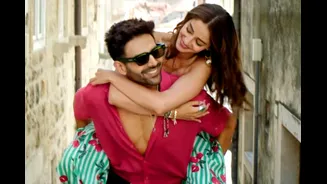
The first half of TMMTMTTM will also take you back to Ved and Tara’s colourful Croatia getaway in Tamasha. And then in the second half when Rumi is seen hitting back at Kartik Aaryan’s Rehaan’s mother Pinky, you’ll also be thinking about Rocky Aur Rani Kii Prem Kahaani. And much like this Karan Johar directorial, TMMTMTTM stays true to the classic Dharma Productions’ descriptor. There are big sets, chic costumes, grand song-and-dance sequences, stunning foreign locations and a helicopter. While all of that renders the film loads of sheen, it robs it off its novelty.
TMMTMTTM revolves around Rehaan and Rumi. Rehaan, who randomly flashing his washboard abs, lives in the US with his mother Pinky and they run a big and lucrative wedding planning company. They fly down to Delhi for one of their assignments. Before jetting off to the US and moving into their dream mansion, Rehaan decides to take a solo trip to Croatia. At the airport, he bumps into Rumi, a writer, whose recently released novel has bombed. What follows is a squabble where she accuses him of mansplaining. He, on the other hand, gives her lessons on how chivalry and feminism are antithetical.
As luck and a quintessential Bollywood screwball romance would have it, they end up being co-passengers on the same flight. Serendipitously, they also end up taking the same yacht and are even given the same chamber to share, because why not? Over the next few days, there’s a lot of flirting, teasing and verbal sparring that fuel the attraction and sexual tension between them. One day, when Rumi explains Rehaan the seven stages of love, he realises that he has already reached the third stage.
They decide to spend time together until the very last day of their trip when Rehaan blurts out an ‘I love you’ to Rumi. While he’s hell-bent on taking this relationship to the wedding mandap, she backtracks and tells him that she isn’t okay with leaving his widower father alone in Agra. Then begins Rehaan and his mother’s journey of pleasing Rumi’s family, leading to chaotic situations and some high-octane drama that can even give television soap operas a run for their money.
Much like Sameer’s previous directorial outing, Satyaprem Ki Katha, here too, family values run deep. Like Dilwale Dulhaniya Le Jaayenge’s Raj, Rehaan too doesn’t want to marry his lady love and take her to the US without the consent of the patriarch of her family. He wants to be in Rumi’s retired colonel father’s good books because he believes that you don’t just marry a girl, you marry her family. And interestingly, both leads – Rehaan and Rumi – are placed on equal footing. Both are strong-willed, stubborn, alpha personalities.
What 2 hours 25 minutes of TMMTMTTM finally manages to convey is what warms your heart. The maker decides to flip rigid gender roles and the societal narrative of a woman having to leave her family behind, uproot herself and begin a new life from the scratch post marriage. Sameer not just questions it but makes it happen. The notion of a ‘ghar jamaai’, who’s also a ‘mamma’s boy’, doesn’t emasculate a man. The true sign of masculinity is when a man decides to sacrifice everything he loves – a country that’s his home and workplace in this case – for his ‘pasandida aurat’.
At a time when aggressive love stories are ruling the box office, Rehaan is a breath of fresh air. In Rumi’s words, he maybe ‘stereotypically annoying’, but he truly is a green flag. His vulnerability is his biggest strength. Sameer reiterates that nothing is more attractive than consent. Rumi, on the other hand, is a strong and practical modern-day woman. She’s ready to let go of a once-in-a-lifetime kind of a love story if that means it will pull her away from her father. At one point, Rehaan describes her as a ‘faltu ki feminist’. But it’s refreshing to see a woman like Rumi who’s rooted, emotional, progressive and unyielding all at once.
But TMMTMTTM’s weakest link remains its bumpy screenplay. At any given point, there are too many things happening in the film. And then there’s the Luv Ranjan-esque verbosity! It’s conspicuously talkative with scenes driven more by punchlines and dialogues as its primary engine, often privileging verbal excess over subtexts and visual storytelling. In fact, it’s humourous overtones often meddle with the plot. In a scene, Rehaan while pulling out a book for Rumi from the top shelf says that his hands have always been long, so much so that his mother wanted to name him ‘Kaanoon’.
Most of these one-liners fail to evoke any reaction. While the first half hardly sees any real plot progression, the post-interval chunk is crammed to capacity. And these two halves are rather incoherently tied. Eventually, the pace of the narrative dips. For a rom-com, music remains its biggest driver. The same, unfortunately, can’t be said about TMMTMTTM. The film starts off with Raat Akeli Hai and throughout its length, there’s a bunch of other retro tracks to evoke nostalgia – Pehla Nasha, Saajanji Ghar Aaye, Mehndi Laga Ke Rakhna and Saat Samandar Paar.
But nostalgia alone isn’t enough to lift a jarring screenplay. The wedding sequence and the flashback scene that unfolds in 1970 laced with Raat Akeli Hai at the very beginning of the film further stretch the plot. Some characters like the middle-aged woman lusting after Rehaan or the sudden emergence of Rumi’s sister’s ex-flame doesn’t really add anything substantial to the narrative. In fact, by the end of it, you may even wonder if the conflict in the film can really be called a conflict at all?
However, credit lies where its due. Ananya delivers an impressive performance given the material at hand. She brings an easy confidence to the role, displaying a comfortable screen presence. She plays to her strengths, using timing and attitude to create a character that feels breezy. In the emotionally heavier scenes, she displays a nuanced restraint that prevents her Rumi from turning shrill. As for Kartik, his Rehaan seems like an extension of the persona he carries in real life. Having said that, he does come across as overbearing in parts. His volume sometimes outweighs his nuance.
He plays to the gallery, often portraying an act that’s pitched too high. The verbal overdrive overwhelms the character. But he shares a sizzling chemistry with Ananya. Neena Gupta as Pinky is at her stylish best. However, in a scene, she almost reprimands her son for taking Rumi’s no as a no and advises him to convince her for a yes even if that means parking outside her home for days. So, yes, a better and more nuanced character sketch could’ve done more justice to the actor that she is. Jackie Shroff as Rumi’s father brings about a much-needed balance in this story that turns too loud, too chaotic on more occasions than one.
TMMTMTTM has its heart in the right place and its intent is earnest but it seldom knows when to pull back. It has its moments and even a surface-level charm. It entertains briefly, offers sporadic humour, overstays occasionally. It gestures at progressiveness but retreats into safe, noisy comedy. But truth be told, it’s watchable – also because of the beautiful Croatia with its cobbled alleyways and turquoise waters – before it evaporates. And as Rumi and Rehaan serenade through the length and breadth of this coastal land, you’ll hold out hope for romance in your heart.