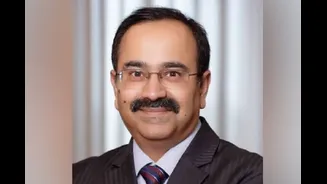








Anup Bagchi takes charge as HDFC Bank’s managing director and chief executive officer (MD & CEO) on Tuesday, October 27, at a crucial juncture for the country’s largest private-sector lender. After more
than three decades with the ICICI Group, Bagchi takes over from Sashidhar Jagdishan with the task of restoring investor confidence, stabilising senior management and improving the bank’s growth and profitability.
His three-year tenure begins after HDFC Bank reported a 4.7% year-on-year increase in standalone net profit to Rs 19,510 crore for the July-September quarter of FY27. Net interest income (NII) rose 9.7% to Rs 34,620 crore, supported by healthy loan growth. However, lower treasury gains and higher operating expenses limited the improvement in earnings.
Here are five key challenges that will shape Bagchi’s tenure at HDFC Bank.
1. Rebuilding Investor Confidence And Strengthening Governance
Restoring confidence among investors and other stakeholders will be among Bagchi’s priorities. HDFC Bank has faced heightened scrutiny following the March 2026 resignation of its then part-time chairman, Atanu Chakraborty. In his resignation letter, Chakraborty referred to certain happenings and practices that he said were inconsistent with his personal values and ethics.
For Bagchi, the challenge will be to ensure that the bank’s governance framework, internal controls and communication with stakeholders remain robust. Clear communication from the management and board, alongside consistent execution, will be important in rebuilding confidence.
The external appointment also offers an opportunity to reassess existing practices and bring a fresh perspective to the institution. However, investors will ultimately judge the new chief executive by the bank’s performance and the effectiveness of its governance standards.
2. Managing Senior Leadership Changes And Retaining Talent
Bagchi’s arrival coincides with a significant transition in HDFC Bank’s senior management, making leadership continuity another key challenge. Jagdishan’s tenure ended on October 26, with Bagchi taking over the following day. The bank is also set to see the departure of Deputy Managing Director Kaizad Bharucha at the end of December 2026.
Bharucha, who joined HDFC Bank in 1995 and became deputy managing director in 2023, was among the internal candidates considered during the CEO succession process. His exit adds another layer to the leadership transition at the bank.
The finance function is also undergoing a change, with Puneet Sharma scheduled to take over as chief financial officer from December 1, 2026, succeeding Srinivasa Vaidyanathan.
These changes mean Bagchi will have to establish working relationships with the existing leadership team while ensuring continuity in decision-making, risk management and business execution.
Bagchi’s ability to build consensus across the organisation and establish clarity on responsibilities and strategic priorities will be closely watched. A smooth transition will be essential to prevent leadership changes from distracting the bank from its business objectives.
3. Reviving Growth Engines And Improving Returns
HDFC Bank’s ability to convert its scale into stronger earnings growth will be another major test for the new chief executive. The bank’s September-quarter results showed healthy underlying business momentum. Gross advances rose 16.3% year-on-year to Rs 32.20 lakh crore as of September 30, 2026, while total deposits increased 18.8% to Rs 33.27 lakh crore.
Retail loans grew 11.7%, while lending to small and mid-market enterprises expanded 23.5%. Corporate and other wholesale advances increased 16.4%. Despite this growth, standalone net profit rose by a comparatively modest 4.7% to Rs 19,510 crore.
The gap between loan growth and profit growth highlights the importance of improving the profitability of the bank’s enlarged balance sheet. Bagchi will need to identify opportunities to increase earnings across retail banking, business banking and corporate lending while maintaining disciplined underwriting standards.
Fee income and cross-selling will also be important. HDFC Bank can seek to generate more revenue by deepening relationships with existing customers and expanding the range of products used by them.
The challenge is to improve revenue quality and returns without relying excessively on balance-sheet expansion. Investors will look for a clearer medium-term growth strategy and evidence that the bank can deliver sustainable improvements in return on assets and return on equity.
4. Strengthening Low-Cost Deposits And Managing Funding Costs
Deposit mobilisation will remain a central operating priority as Bagchi takes charge. Although HDFC Bank’s total deposits grew 18.8% year-on-year to Rs 33.27 lakh crore in the September quarter, growth in its low-cost current account and savings account (CASA) deposits was slower.
CASA deposits increased 10.8% year-on-year, while time deposits rose 22.8% to Rs 22.76 lakh crore. CASA deposits accounted for 31.6% of total deposits at the end of September.
This divergence matters because a stronger low-cost deposit base can help banks manage funding expenses and protect net interest margins. Faster growth in term deposits, particularly when offered at relatively high rates, can increase the overall cost of funds.
HDFC Bank’s merger with HDFC also changed the composition and scale of its balance sheet, making liability management an important part of its post-merger strategy.
Bagchi will have to strengthen the bank’s deposit franchise, improve CASA mobilisation and ensure that deposit growth keeps pace with lending opportunities. The bank must also compete effectively for household savings while maintaining an appropriate balance between deposit pricing and profitability.
Its credit-to-deposit ratio, which stood at around 96% at the end of September 2026, will remain an important indicator of how effectively it manages the relationship between lending and funding. The task will be to sustain healthy loan growth without allowing funding costs to erode profitability.
5. Reviving Margins And Sustaining Profit Growth
Improving net interest margins will be another immediate priority for Bagchi. HDFC Bank’s net interest margin (NIM) declined to 3.16% of total assets in the September 2026 quarter, compared with 3.46% in the corresponding period last year and 3.26% in the June quarter.
NII rose 9.7% year-on-year to Rs 34,620 crore, reflecting growth in the bank’s interest-earning business. However, the improvement in core interest income was partly offset by a sharp decline in treasury trading gains and higher operating expenses.
Treasury trading gains fell to Rs 780 crore in the September quarter from Rs 2,390 crore a year earlier. Operating expenses increased to Rs 18,970 crore from Rs 17,980 crore. The result was a slower increase in net profit despite strong loan growth.
Who Is Anup Bagchi?
Bagchi brings experience across banking, capital markets, wealth management and insurance. He joined the ICICI Group in 1992 and has held several senior positions during his career. Before moving to ICICI Prudential Life Insurance, Bagchi served as an executive director at ICICI Bank from 2017 to 2023. His responsibilities included retail, business and rural banking before he moved to oversee wholesale banking.
He also served as managing director and CEO of ICICI Securities and was chairman of ICICI Prudential Asset Management Company until May 2023. These roles gave him experience across multiple financial services businesses, including lending, investment banking, securities and asset management.
At ICICI Prudential Life Insurance, where he took charge in June 2023, the company recorded annualised premium equivalent (APE) of Rs 10,407 crore in FY25, up 15% year-on-year. Its profit after tax increased nearly 40% to Rs 1,189 crore during the same period.
Bagchi holds an engineering degree from the Indian Institute of Technology Kanpur and a management degree from the Indian Institute of Management Bangalore.