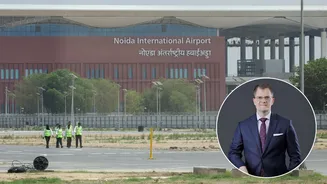



Less than a month after its high-profile inauguration by Prime Minister Narendra Modi, the Noida International Airport in Jewar finds itself facing an unexpected hurdle — one that has nothing to do with
construction delays or passenger readiness, but with who sits in the CEO’s chair.
At the centre of the issue is Swiss national Christoph Schnellmann, who has been leading the project for years. Now, as multiple reports suggest, he may have to step aside before the airport can begin commercial operations.
Who is Christoph Schnellmann?
Schnellmann isn’t an outsider parachuted in late. He has been associated with the Noida International Airport (NIA) project since its early days, representing concessionaire Zurich Airport International AG. Industry insiders describe him as an “old India hand”, having previously played a role in the development of Bengaluru airport.
His long involvement is precisely why the current situation feels awkward. The airport has been built under his watch, but may open under someone else.
What’s The Rule That’s Causing The Problem?
The roadblock comes from an aviation security regulation issued by the Bureau of Civil Aviation Security (BCAS) back in 2011.
In simple terms, the rule mandates that the CEO of any greenfield airport in India must be an Indian national. The logic is tied to security: the CEO is designated as the security coordinator responsible for implementing aviation safety protocols.
According to Hindustan Times, the BCAS had sought an amendment to this rule, especially given the evolving nature of airport operations and foreign investment in infrastructure. But the Union Home Ministry reportedly rejected the proposal.
That rejection has now effectively boxed the airport into a corner.
Why Does This Matter Right Now?
Because this isn’t just a technicality — it’s the final clearance standing between the airport and takeoff.
The Noida airport has already received its aerodrome licence. What remains pending is approval of the Aerodrome Security Programme (ASP), a crucial clearance without which passenger operations cannot begin.
And here’s where the CEO issue becomes critical.
As per officials quoted by Hindustan Times, Schnellmann has not received mandatory security clearance from the Home Ministry. Without that — and without compliance with the nationality rule — the airport cannot fully secure its operational approvals.
In fact, one official told the publication that this is now “the only factor delaying the commencement of flight operations”.
Why Can’t The Rule Be Relaxed?
That’s where things get more contentious.
Aviation insiders, quoted by The Times of India, describe the rule as “archaic”, arguing that it dates back to a time when most Indian airports were controlled by the military with limited civilian access.
Today, they say, the ecosystem has changed — private operators, global investors, and international best practices are all part of the mix.
What’s more, there is no such restriction for airline CEOs. Foreign nationals have led major Indian carriers, including IndiGo and Air India, without similar objections.
Despite this, the Home Ministry has chosen not to dilute the rule — at least for now — citing security considerations.
What Happens Next?
The airport authorities have not publicly confirmed whether a search for a new CEO is underway. But the direction is becoming clear.
If the rule remains unchanged, NIA will have to appoint an Indian CEO to meet regulatory requirements and unlock the final approvals.
That could mean a last-minute leadership transition for a project already running behind schedule due to earlier construction delays.
For now, the airport says it is working closely with the BCAS to secure the pending clearance and align all systems for launch.
The Bigger Picture
The episode raises a larger question about India’s regulatory balance.
On one hand, the country is actively courting global investment in infrastructure. On the other, legacy rules — especially those tied to security — continue to shape how far that openness can go.
For Noida International Airport, that tension is no longer abstract. It’s playing out in real time, with a leadership reshuffle now looking less like a possibility and more like a prerequisite for takeoff.