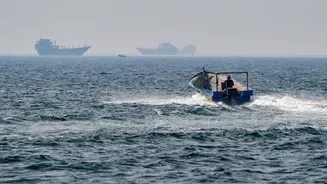








A blockade in the Strait of Hormuz by the United States is now forcing Iran into unusually desperate oil strategies. Since mid-April, the United States has effectively enforced a naval blockade targeting
vessels linked to Iran, turning back tankers and sharply reducing traffic through one of the world’s most critical energy routes. At one point, daily ship movement through the strait collapsed from over 100 vessels to single digits, with multiple Iranian oil tankers forced to return without unloading cargo.
Read More: ‘Economic Nuclear Weapon’: Iran Uses Hormuz As Bargaining Chip In High-Stakes US Standoff
For Iran, the consequences are immediate and severe. The country continues to pump millions of barrels of crude every day, but exports — its economic lifeline — are being throttled. With oil unable to leave and storage facilities filling up fast, Iran is now reportedly running out of space.
That is why it has turned to an unconventional solution: pulling a decades-old “ghost ship” — M/T Nasha — out of retirement to store crude at sea.
What Is M/T Nasha?
M/T Nasha is a very large crude carrier built in 1996, stretching roughly 332 metres in length and about 58 metres in width, with a deadweight tonnage close to 298,700 tonnes. When fully loaded, it sits deep in the water with a draft of around 22 metres and has a gross tonnage of about 156,000 GT. Vessels of this class are designed to carry — or in this case store — enormous volumes of crude, and Nasha’s capacity is estimated at roughly 1.8 to 2 million barrels. That effectively makes it a floating oil storage unit on the scale of a small terminal, capable of holding just a couple of days’ worth of Iran’s excess crude buildup when exports are constrained.
The ship had reportedly been inactive for years. It is now being repurposed as a floating storage facility rather than a transport vessel.
Such ships are often dubbed “ghost ships” because older tankers are frequently used in opaque oil networks, sometimes switching off tracking systems or operating under flags of convenience.
In this case, however, the role is more direct: M/T Nasha is being used as an offshore storage tank to absorb excess crude that Iran cannot export.
Why Iran Is Bringing M/T Nasha Back
The Hormuz blockade
The US naval blockade is preventing or delaying Iranian oil shipments, with dozens of vessels intercepted or turned back. This has effectively severed Iran’s main export route.
Storage Nearing Capacity
Iran’s key oil terminal at Kharg Island, which handles the bulk of exports, is filling up rapidly as unsold crude accumulates.
Iran Can’t Just Stop Production
Oil wells cannot be turned off without risk. Experts warn that halting production can cause permanent reservoir damage, making it difficult and costly to restart.
Stopgap Arrangement
Using tankers like M/T Nasha allows Iran to keep pumping oil while temporarily storing it offshore, buying time in a worsening crisis.
Iran’s Broad Strategy
Iran has long relied on a “shadow fleet” of ageing tankers to navigate sanctions. Repurposing an old vessel fits this pattern of adapting under pressure.
What Comes Next For Iran
M/T Nasha may offer temporary relief, but it also underscores how tight the situation has become.
With the Strait of Hormuz partially choked and exports blocked, Iran is improvising to keep its oil industry alive — even if it means bringing ghost ships back from the dead. However, a long term solution would need to be worked before the crisis blows out or, like Donald Trump said, “before pipelines explode.”