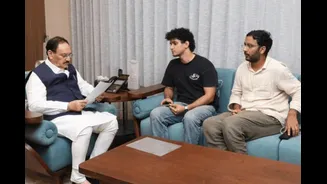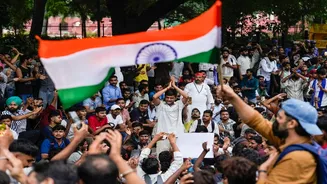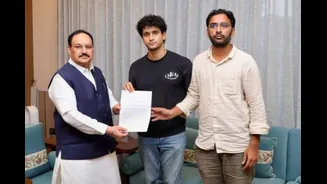




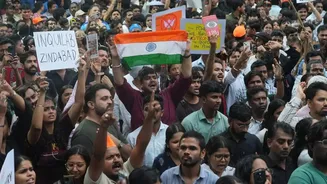


A day after two representatives of the Cockroach Janta Party (CJP) met Union minister and former BJP president JP Nadda at his official residence in the Centre’s first formal outreach since the agitation
began at Jantar Mantar, the obvious question is—why was Nadda chosen to open the dialogue?
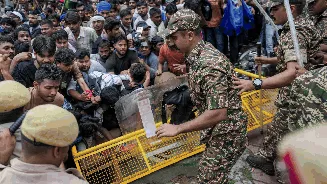
The government has several senior ministers handling political negotiations. Yet, it was Nadda who met the delegation, assured them that their demands would be discussed internally and appealed for an end to the agitation. The meeting marked the first formal engagement between the Centre and the protesters after days of confrontation.
According to political observers, the choice was far from accidental. Nadda brings a combination of political stature, organisational experience and a reputation as a consensus-builder in the party.
ALSO READ | Delhi Police Say They Won’t Stop Jantar Mantar Protest, Trying To Shift Protesters To Burari Ground
Here’s why the BJP believes he was the right person for the job.
1. He Is Seen As A Consensus Builder, Not A Confrontational Face
Within the BJP, Nadda has long cultivated the image of a low-key organiser rather than an aggressive leader.
Unlike leaders who are closely associated with ideological battles or sharp political messaging, Nadda is often deployed when the party wants to lower the political temperature. Colleagues describe him as accessible, patient and willing to hear out opposing viewpoints before responding.
That makes him a natural choice when the objective is to open a dialogue rather than score political points.
His appeal to the CJP delegation reflected that approach. Instead of rejecting the demands outright, he assured them that the government leadership would deliberate on the issues raised and urged protesters to help restore normalcy.
2. Has Direct Access To BJP’s Top Decision-Makers
Negotiations are only meaningful if the person across the table can take the message to those making the final decisions.
ALSO READ | Special CP, Joint CP Among Over 118 Police Personnel Injured During CJP Protest: Delhi Police
As a former BJP national president and a senior Cabinet minister, Nadda enjoys direct access to Prime Minister Narendra Modi, Home Minister Amit Shah and the BJP’s top leadership.
For protesters, that matters.
Any assurance coming from Nadda carries greater credibility because he is seen as someone who can communicate directly with the party’s highest decision-making forum, rather than merely acting as an intermediary.
According to reports, Nadda told the delegation he would place their demands before the government leadership for internal discussions.
3. Seniority Commands Respect Across The Political Spectrum
Nadda’s political standing extends beyond his current ministerial role.
Having served as BJP national president between 2020 and 2024, he remains one of the party’s most senior leaders. His long organisational career, coupled with his Cabinet position, gives him the stature to engage with political, social and civil society groups on behalf of the government.
For delegations seeking dialogue with the Centre, meeting a leader of Nadda’s rank signals that the government is taking the conversation seriously, even if no immediate concessions are on offer. It also avoids the optics of sending a junior functionary to handle a politically sensitive issue.
4. Experience Engaging With Protest Movements
This is not the first time Nadda has been involved in politically sensitive outreach.
During the farmers’ protest against the three farm laws, Nadda repeatedly defended the government’s position while simultaneously appealing for dialogue. He was among the senior BJP leaders tasked with communicating the party’s stand and maintaining channels of engagement with farmer organisations, even as negotiations continued between the Centre and union representatives. He also met farmer leaders on multiple occasions as the party sought to reduce tensions.
That experience is likely to have weighed in his favour.
Unlike ministers whose primary role is administration, Nadda has handled politically charged negotiations where public messaging and back-channel communication had to go hand in hand.
A Carefully Chosen Messenger
The decision to send Nadda also came as the government balanced dialogue with firmness. Even as he met the CJP delegation, senior ministers, including Home Minister Amit Shah, were holding high-level meetings on the evolving situation, indicating that the issue was being monitored at the highest levels.
By choosing one of its most senior and least confrontational leaders as the first point of contact, the BJP appears to have signalled that it wanted to open a channel for dialogue without appearing to yield under pressure.