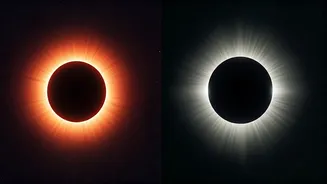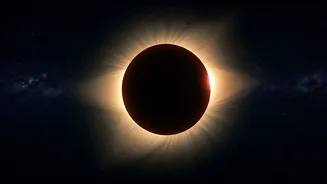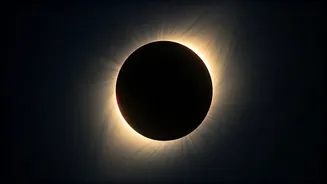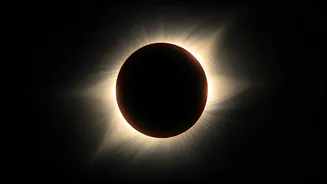








Mark your calendars. The first solar eclipse of 2026 is set to take place on Tuesday, February 17, and it is not just any eclipse. This one is an annular solar eclipse, popularly known as the “Ring of Fire.”
Ahead of the rare celestial event, skywatchers across the world are preparing to witness it using special viewing equipment.
To give you some context, a solar eclipse occurs when the Sun, Moon and Earth align in a straight line. During this alignment, the Moon passes between the Sun and Earth, casting its shadow on our planet. Depending on distances and positioning, the Sun may be fully or partially covered. In this case, it creates a glowing ring in the sky, which is referred to as the dramatic “Ring of Fire.”
What Exactly Is The ‘Ring of Fire’
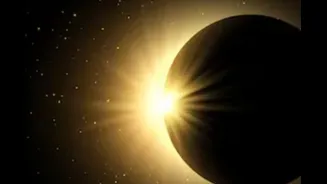
According to NASA, the “Ring of Fire” happens when the Moon is at or near its farthest point from Earth in its orbit. Because it is farther away, the Moon appears slightly smaller in the sky and cannot completely block the Sun.
Instead of total darkness, observers witness a dark circular silhouette of the Moon sitting in front of the Sun, with a thin, bright ring of sunlight visible around its edges. The glowing outline resembles a fiery ring or even a diamond ring. That’s how it earned its popular nickname. Unlike a total solar eclipse, daylight does not disappear completely during an annular eclipse as the Sun never gets fully covered.
Solar Eclipse 2026: Date And Key Timings
As reported by Forbes, the eclipse will begin on February 17 at 07:01 UTC (12:31 PM). The phase, when the “Ring of Fire” becomes visible, will start at 11:42 UTC (5:12 PM IST).
The eclipse will reach its peak at 12:12 UTC (5:42 PM IST), when the ring effect will be at its most prominent. However, this peak phase will last for only about 2 minutes and 20 seconds, making timing crucial for viewers in visible regions. The entire eclipse event will conclude at 14:27 UTC (7:57 PM IST).
Will India Be Able To See It
Unfortunately, no. The February 17 solar eclipse will not be visible from India. The event will occur primarily in the Southern Hemisphere at a time when the Sun will be below the horizon in India. As a result, skywatchers in the country will not be able to witness the eclipse directly.
Countries That Will Witness The Eclipse
The annular solar eclipse will be visible in parts of Antarctica, Argentina, Botswana, the British Indian Ocean Territory, Chile, Comoros, Eswatini (Swaziland), the French Southern Territories, Lesotho, Madagascar, Malawi, Mauritius, Mayotte, Mozambique, Namibia, Réunion Islands, South Africa, South Georgia/Sandwich Islands, Tanzania, Zambia and Zimbabwe. Observers in these regions will be able to experience either the full celestial view or a partial eclipse, depending on their exact location.
How And Where To Watch It Live
Several space agencies will broadcast the eclipse live. NASA will stream the event through its official platforms, and the feed is expected to be transmitted by multiple astronomy websites worldwide. This allows viewers everywhere to safely experience the “Ring of Fire” without specialised viewing equipment.