
India is currently moving through one of its most ambitious infrastructure-led growth phases. Big infrastructure projects are changing how people travel, work and plan their lives. In western India, they
are also reshaping how Ahmedabad’s future is being viewed alongside Mumbai.
This changing dynamic was recently explored on Vishal Bhargava’s podcast where Jaxay Shah, CMD of Savvy Group, spoke about how large-scale projects like the Mumbai–Ahmedabad High-Speed Rail corridor and the Delhi–Mumbai Industrial Corridor (DMIC) could redefine Ahmedabad’s role in India’s commercial ecosystem.
“With the Mumbai-Ahmedabad Corridor and DMIC, Ahmedabad can be a commercial suburb of Mumbai,” Shah said during the conversation.
He went on to explain how faster travel could bring the two cities closer.
“In 2 and half hours or three hours, you can reach there while working so it will perfectly complement that. And Mumbai wants to become Shanghai, then Ahmedabad can be it’s younger brother or I would say a commercial suburb – you can work there and come back on same day also. Isse jyada complementing kya chaiye aapko (What more could you ask for in terms of complementing each other?).”
Vishal summed up the idea simply: “So, it is like work in Mumbai, stay in Ahmedabad.”
What Is The Mumbai–Ahmedabad High-Speed Rail Project And Why Does It Matter?
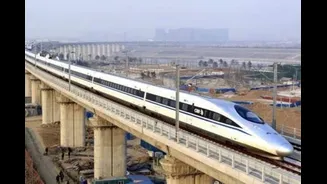
The Mumbai–Ahmedabad High-Speed Rail (MAHSR) corridor is India’s first bullet train project. It is designed to dramatically cut travel time between the two cities.
The project is planned to become operational in phases. The first operational section (a 100-kilometre stretch between Surat and Vapi in Gujarat) is scheduled to be inaugurated first. Full end-to-end operations for the entire corridor are currently targeted for December 2029 while partial operations are expected to begin earlier with August 15, 2027 often cited as a key milestone.
Once operational, the corridor will allow passengers to travel between Mumbai and Ahmedabad in just a few hours.
How Does GIFT City Fit Into Ahmedabad’s Larger Growth Story?
Gujarat International Finance Tec-City, widely known as GIFT City, is positioned as the backbone of Ahmedabad’s financial future. Located strategically between Ahmedabad and Gandhinagar, GIFT City is India’s first International Financial Services Centre (IFSC).
It has been designed as a global financial and IT hub with modern infrastructure, tax benefits and easier regulations. The aim is to allow global financial services to operate from India and compete with major financial centres abroad.
Can GIFT City Compete With Mumbai’s BKC?
During the podcast, Vishal and Jaxay discussed whether GIFT City has the potential to rival Mumbai’s Bandra-Kurla Complex (BKC), India’s most established financial district.
Shah pointed out that while BKC grew organically over time, GIFT City benefits from being planned from the ground up. He also noted that Ahmedabad offers a relatively easier business environment compared to larger metros.
Why Is Ahmedabad Emerging As A Major Event And Sports Destination?
Jaxay also highlighted how Ahmedabad is also positioning itself as a global events and sports hub. He cited Coldplay’s concert at the Narendra Modi Stadium in January last year which drew record-breaking crowds of over 1 lakh people each night which is the largest shows the band has ever performed.
The city’s vast land availability was also discussed as a major advantage, particularly when compared to space-constrained metros. This makes Ahmedabad a strong contender for hosting large-scale international events. It should be noted that Ahmedabad has officially secured the rights to host the 2030 Commonwealth Games, which will also mark the centenary edition of the event.
How Strong Is Ahmedabad’s Real Estate And Urban Identity?
Ahmedabad’s real estate market was described as mature and fundamentally strong, though it is often perceived as having “less style” compared to cities like Mumbai or Delhi. But the city has substance with the presence of renowned architects and significant architectural landmarks.
The discussion also touched upon how GIFT City initially struggled with adoption due to limited social infrastructure but efforts are now underway to improve social life to attract more residents and professionals.
What Challenges Does Ahmedabad Still Need To Address?
Despite the optimism, the conversation did not shy away from challenges. Issues such as poor traffic sense, weak civic behaviour and inadequate footpath infrastructure were highlighted as areas that need urgent attention.
Hosting international events and becoming a global commercial hub requires not just infrastructure but also better civic discipline.
What Does The Next Decade Look Like For Ahmedabad?
Looking ahead, Ahmedabad is expected to grow as a multi-dimensional city, not just as a commercial hub but also a sports destination. With projects like the bullet train corridor, DMIC and GIFT City, Ahmedabad is slowly taking on a bigger role among India’s cities. may soon function not in competition with Mumbai but as its strongest complement, as pointed out by Jaxay.