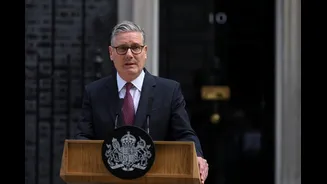






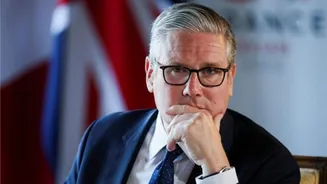


Keir Starmer resigned as Britain’s prime minister and Labour leader on Monday, setting in motion a party leadership process that will determine who takes over in Downing Street.
Starmer said he would remain
in office until Labour chooses his successor. The party’s National Executive Committee, or NEC, is expected to open nominations on July 9.
Britain now faces two possible routes to its next prime minister: a rapid handover if only one candidate qualifies, or a longer process if Labour holds a full leadership contest.
Andy Burnham has emerged as the clear frontrunner, but other senior Labour figures could still enter the race.
What Timetable Has Starmer Announced?
Starmer said he would ask Labour’s governing body, the National Executive Committee, to open nominations for the party’s next leader on July 9.
He said that the nomination process should be completed by the start of Parliament’s summer recess on July 16.
If only one candidate is nominated, that person could be confirmed as Labour leader once nominations close. If more than one candidate enters the race, Labour would hold a full leadership contest.
Starmer said the party should complete that process before Parliament returns from its summer break on September 1.
Who Could Replace Keir Starmer?
Andy Burnham
The Makerfield MP and former mayor of Greater Manchester is currently the frontrunner. He is popular among Labour MPs, while recent polling suggests he is also the party’s most popular senior politician among the wider public.
Burnham previously represented Leigh, a constituency in Greater Manchester, in Parliament from 2001 to 2017 and held senior government posts under Tony Blair and Gordon Brown, including health secretary and culture secretary.
His return to the Commons after winning the Makerfield by-election removed the most important practical obstacle to a leadership bid. If he secures the required nominations and no rival qualifies, he could be confirmed as Labour leader without a membership ballot.
Wes Streeting
Wes Streeting could still prevent an uncontested Burnham succession.
Streeting resigned from Starmer’s Cabinet in May, accusing the government of lacking the political vision needed to revive Labour. He had served as health secretary since 2024 and was regarded as one of the government’s strongest media performers.
He is generally associated with Labour’s centre-right and has significant support among the party’s MPs. That positioning could, however, make it harder for him to defeat Burnham in a ballot of Labour members, among whom candidates from the party’s left have often enjoyed stronger support.
Streeting has previously said that he would stand in a leadership contest, although some Labour figures believe he could withdraw or be offered a senior position under Burnham.
Angela Rayner
Former deputy prime minister Angela Rayner could also emerge as a candidate.
She resigned as deputy prime minister, deputy Labour leader and housing secretary in 2025 after acknowledging that she had not paid enough tax on a property transaction.
Rayner has since said that HM Revenue and Customs cleared her of wrongdoing, potentially opening the way for a political comeback.
Could Another Candidate Emerge?
Some Labour MPs have discussed the possibility of Energy Secretary Ed Miliband returning to the leadership, although the former party leader previously dismissed suggestions that he wanted the job.
Home Secretary Shabana Mahmood has also been mentioned. Her handling of immigration policy has raised her profile but could prove divisive among Labour members and the wider electorate.
An unexpected candidate could still emerge once the NEC publishes the formal timetable and nomination rules.
Could Britain Have A New PM By Next Month?
The fastest route would be an uncontested leadership process.
If only one candidate secures the nominations required under Labour’s rules, there would be no ballot of party members. That candidate could be declared Labour leader soon after nominations close.
Two members of Labour’s NEC told The Guardian that, in such a scenario, the new leader could become prime minister as early as July 17, the day after the Commons rises for its summer recess.
The formal handover could instead take place the following Monday if it cannot be arranged immediately.
If Burnham is the only candidate to qualify, he could therefore enter Downing Street around the middle of July. But that outcome is not yet guaranteed.
What Happens If There Is A Leadership Contest?
If two or more candidates qualify, Labour would hold a full leadership election.
Starmer has said the process would be completed before Parliament returns on September 1, meaning the winner would be expected to take office by the end of August.
The NEC will decide the exact timetable, including the nomination deadlines and voting period.
Under Labour’s current rules, a candidate must receive nominations from 20 per cent of Labour MPs. They must also secure support from either at least 5 per cent of constituency Labour parties or at least three affiliated organisations, including two trade unions, representing at least 5 per cent of affiliated membership.
If more than one candidate clears those hurdles, eligible Labour members will vote to choose the new leader.
Who Runs Britain Until Then?
Starmer will remain prime minister until the handover is formally completed. He will continue to chair the Cabinet, oversee government business and represent Britain internationally until his successor takes office.
That means Starmer is likely to attend the Nato summit scheduled for July 7, two days before Labour nominations are expected to open.
If an uncontested candidate takes office around July 17, Britain could have a new prime minister in place for the UK-EU summit in Brussels on July 22.
If Labour holds a full contest, Starmer could remain in office through that meeting and for most of the summer.