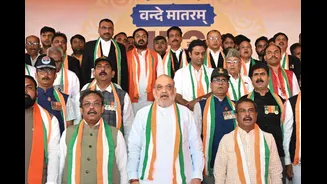

The year 2025 marks 150 years of Vande Mataram, India’s National Song. Composed by Bankim Chandra Chattopadhyay on the auspicious occasion of Akshaya Navami, on 7 November 1875, Vande Mataram emerged not
merely as a literary creation but as a civilisational call. It became the song of India’s freedom movement. Recognising the song’s historic significance, Prime Minister Narendra Modi inaugurated the year-long commemoration of Vande Mataram on 7 November. As part of this commemoration, a special debate was organised in Parliament, offering the nation an opportunity to reflect on the song’s legacy, its role in India’s freedom movement, and its place in contemporary India. A dominant theme of the parliamentary debate was the acknowledgement of Vande Mataram as a song of national consciousness. Another important, and more contentious, strand of the debate focused on the historical choices made in independent India regarding national symbols. Several speakers pointed to how the personal preferences and ideological inclinations of Jawaharlal Nehru, India’s first Prime Minister, influenced the selection of Jana Gana Mana, composed by Rabindranath Tagore, as the National Anthem, while Vande Mataram, despite its immense popularity and emotional resonance, was relegated to the status of National Song. A cursory reading of the debate may give the impression that India’s two great songs—Vande Mataram and Jana Gana Mana—were being pitched against each other. However, such an interpretation would be both superficial and misleading. As Defence Minister Rajnath Singh clarified in Parliament, the intent of the commemoration and the debate was not to create a hierarchy or a conflict between the two. He cautioned against attempts to construct a divisive narrative. In his words, the nation holds equal respect for both the National Anthem and the National Song. He pointed out that Jana Gana Mana and Vande Mataram are not rivals; they are complementary expressions of India’s national soul. Congress leader and Rajya Sabha member Jairam Ramesh had urged participants in the debate to engage more deeply with the subject by reading two scholarly works on India’s national songs. The first was Vande Mataram: The Biography of a Song by historian Sabyasachi Bhattacharya, published in 2003, which traces the complex historical, political, and cultural journey of Vande Mataram. The second was Song of India: A Study of the National Anthem by Rudrangshu Mukherjee, published earlier this year by Aleph as part of its ‘Essential India Editions’. Mukherjee’s book is a concise volume, running to just about 60 pages, and offers a focused examination of Jana Gana Mana and its author’s life. Apart from being a succinct examination of the National Anthem, the book also offers valuable insights and context to the arguments that surfaced during the Vande Mataram debate, which can help readers better understand the historical nuances and intellectual foundations of the positions articulated in Parliament. In the final chapter of the book, titled “Notes of Dissonance”, Mukherjee draws attention to a significant and often overlooked fact: Jawaharlal Nehru had requested Rabindranath Tagore to compose a national anthem for India, and at the time of making this request, Jana Gana Mana was not in Nehru’s mind. From this point, Mukherjee poses a crucial question: why did Tagore not immediately suggest that Jana Gana Mana be adopted as the national anthem? Mukherjee offers a compelling possible explanation. He writes: “One possible answer is that Tagore possibly did not see Jana Gana Mana as a song that upheld nationalism. The song was, of course, about India—its geography, its people, its religious faiths, and its unity. But it was more importantly a paean to the dispenser of India’s destiny, Bharata bhagya bidhata. The stirring refrain ‘Jaye hey’ is to that bidhata. In this sense, the song is a hymn to divinity. It will be recalled that when Tagore published the text of the song in January 1912 on the pages of Tattvabodhini Patrika, he described it as Brahmo sangeet.” He further adds, “It is possible to speculate this because from around the second decade of the twentieth century, Tagore’s views on nationalism had undergone a radical transformation. He had been arguing in a series of essays and speeches across the world that nationalism was too restrictive, too inadequate—even corrosive—an ideology and emotion. His thinking had veered towards a comprehensive humanism.” The importance of Mukherjee’s book also lies in the fact that it authoritatively dispels several long-standing misconceptions surrounding the composition of Jana Gana Mana, most notably the claim that Rabindranath Tagore wrote the song in praise of the British monarch. Describing this allegation as a “canard,” the author carefully reconstructs the historical context in which the song was written and explains how this erroneous perception came to take root. Mukherjee notes that in 1937, Pulinbihari Sen, a close associate of Tagore, wrote to him seeking clarification about the circumstances in which Jana Gana Mana had been composed. Tagore’s response, which deserves to be quoted at length, leaves little room for ambiguity. He recalled that someone “well placed in government circles,” and a personal acquaintance, had specifically requested him to compose a song in praise of the Emperor, George V. Tagore wrote that he was astonished by the request, and that his astonishment was “laced with anger.” It was precisely as a strong reaction of opposition to this demand, he explained, that he composed Janaganamana adhinayaka. Tagore went on to clarify that the “champion of India’s destiny” invoked in the song was not a temporal ruler but the Bharata Bhagya Bidhata—the eternal charioteer who guides humanity through the perilous journey of rise and fall, who resides in the hearts of the people and leads them from within. Such an eternal guide of human destiny, Tagore emphatically asserted, could never be George V, George VI, or any other “George”. In placing this statement within its proper historical frame, Mukherjee decisively punctures the myth of imperial flattery and restores the song to its intended spiritual and philosophical meaning. Apart from providing context to contested historical narratives and setting the record straight, the book’s significance also lies in the way it opens with a deep and sensitive insight into the mind of Rabindranath Tagore—the poet, painter, philosopher, and humanist. In its opening chapter, Mukherjee vividly weaves together Tagore’s many social and cultural encounters, tracing how these experiences brought him closer to nature and to people living on the margins of society. For readers not well acquainted with Tagore’s life, this section is particularly rewarding. It illuminates the background to several of his greatest and most enduring compositions, from Amar Sonar Bangla to the iconic Ekla Chalo Re, showing how these songs were shaped by the turmoil and moral churning of the Bengal Partition period. More importantly, the book brings out the transformative episodes that reshaped Tagore’s understanding of nationalism itself and how he conceptualised the idea of universal humanism—an idea rooted in empathy, moral responsibility, and the dignity of the individual. Over the years, Sabyasachi Bhattacharya’s book has become an authoritative reference for anyone seeking to understand Vande Mataram in all its historical and political complexity. Rudrangshu Mukherjee’s book, though far slimmer in comparison, is likely to achieve a similar stature in its own domain. It offers an unbiased prism through which the National Anthem can be viewed—understood in its proper context, appreciated for its depth, adored for its spirit, and embraced with a sense of informed pride. Pragati Pandey is a Noida-based freelance writer who writes on books, pop culture, and ideas. Views expressed in the above piece are personal and solely those of the author. They do not necessarily reflect News18’s views.