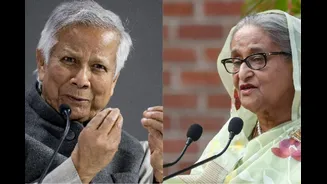

Ousted Bangladesh Prime Minister Sheikh Hasina has said that violence has become the new normal in Bangladesh, warning that irate mobs have increasingly rendered law enforcement agencies ineffective during
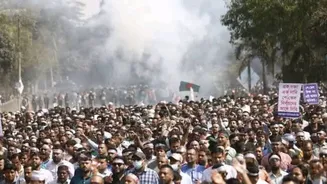
episodes of unrest. Her remarks came amid violent protests following the assassination of Sharif Osman Hadi, the convenor of Inqilab Moncho.
Hadi, an outspoken anti-India voice, was shot dead by unidentified gunmen. He was preparing to contest elections from a prominent constituency in Dhaka. His killing galvanised anti-Hasina and anti-Awami League protesters, who went on to torch the offices of leading newspapers Prothom Alo and The Daily Star, along with cultural institutions such as Chhayanaut (ছায়ানট) and Udichi (উদীচী).
“This tragic killing reflects the lawlessness that uprooted my government and has multiplied under Yunus. Violence has become the norm while the interim government either denies it or is powerless to stop it. Such incidents destabilise Bangladesh internally but also our relationships with neighbours who are watching with justified alarm,” Hasina was quoted as saying by news agency ANI.
Hasina further said that New Delhi “sees the chaos” unfolding in Bangladesh and raised alarm over the persecution of minorities in the country.
“India sees the chaos, the persecution of minorities, and the erosion of everything we built together. When you cannot maintain basic order within your borders, your credibility on the international stage collapses. This is the reality of Yunus’s Bangladesh,” she added.
Hadi was one of the key organisers of the so-called July 2024 uprising, a protest movement that initially centred on reform demands and opposition to a law passed by the then Hasina government but was later overtaken by Islamist groups, according to critics.
Following the unrest, Hasina fled to India after mobs attacked Gonobhobon, the prime ministerial residence, and set ablaze the residence of Bangladesh’s founding father Sheikh Mujibur Rahman.
After Hasina’s ouster, a tribunal later sentenced her to death and sought her extradition from India, a move New Delhi has not acted upon.
In the aftermath of the protests, several Islamist leaders, including hardline figures, were released from jail. The interim government also lifted the ban on Jamaat-e-Islami, the country’s largest Islamist political party, allowing it to resume activities that were prohibited under Hasina’s administration, while banning the Awami League.
Sheikh Hasina warned that institutions invested in “South Asian stability” should be alarmed by the deteriorating law-and-order situation in the country.
Sharif Osman Hadi, a young activist and prominent figure associated with last year’s July uprising, was shot at close range on December 12 while travelling in a rickshaw in Dhaka’s Bijoynagar area. He suffered a gunshot wound to the head and was later airlifted to Singapore for advanced treatment, but succumbed to his injuries on December 18.
Following Hadi’s death, protests and unrest erupted in Dhaka, with activists gathering at the Shahbagh intersection to demand justice for the slain leader.
“The secular character of Bangladeshi politics was one of our greatest strengths, and we cannot allow it to be sacrificed at the whim of a few idiotic extremists. Once democracy is restored and responsible governance returns, such reckless talk will end,” Hasina told news agency ANI.
Hasina also expressed concern over growing diplomatic strain in India–Bangladesh relations, citing anti-India protests and the killing of 27-year-old Hindu youth Dipu Chandra Das. She held interim chief adviser Muhammad Yunus responsible, alleging that the interim government had issued hostile statements against New Delhi and failed to protect religious minorities.
“The strain you are witnessing is entirely of Yunus’s making. His government issues hostile statements against India, fails to protect religious minorities, and allows extremists to dictate foreign policy, then expresses surprise when tensions rise. India has been Bangladesh’s most steadfast friend and partner for decades. The ties between our nations are deep and fundamental; they will outlast any temporary government,” she said.
Her remarks came days after Das was beaten to death by a mob over alleged blasphemy on December 18, following which his body was set on fire. The killing triggered widespread outrage and condemnation, leading to the arrest of at least 12 accused in the case.
“This is the reality of Yunus’s Bangladesh,” Hasina outlined.
“I share this concern, as do the millions of Bangladeshis who prefer the safe, secular state we once were. Yunus has placed extremists in cabinet positions, released convicted terrorists from prison, and allowed groups linked to international terrorist organisations to take roles in public life. He is not a politician and has no experience governing a complex nation. My fear is that radicals are using him to project an acceptable face to the international community while they systematically radicalise our institutions from within,” she further added.