








Matka King Review: In 1960’s Mumbai, Ratan Khatri, a small-time Sindhi cotton trader noticed how people were easily tempted to gamble on their fates to earn some extra income. From cotton mill workers
indulging in betting linked to the opening and closing rates of the New York Cotton Exchange, to housewives in chawls picking chits from a pot and to the elites who would bet on race horses- informal forms of gambling existed in all bylanes of the city.
Ratan had an idea: why not integrate gambling into one system? He simplified the betting process and made it accessible to anyone willing to test their fate. His ‘matka’ involved him picking cards from an Earthen pot, and if your number was drawn, your bet amount would be multiplied. Unlike his rivals, Ratan promised transparency and access. Thus, the matka gambling system was popularised in Mumbai.
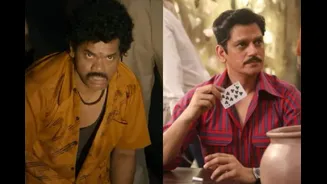
In Amazon Prime Video’s Matka King, Vijay Varma plays Brij Bhatti, an enterprising cotton trader with little more than hope and hunger. What begins as a desperate attempt to carve out a respectable life gradually turns into the birth of a gambling phenomenon that grips the city and eventually the nation.
Matka King is noticeably (but informally) inspired by Ratan Khatri’s life. The series charts Brij’s evolution from an underdog to a kingpin, exploring how luck, risk, and power reshape not just his fortunes but his relationships and moral compass. Set in the restless, rapidly transforming Bombay of the 1960s, the show takes us deep into the shadowy underworld of matka gambling.
Vijay Varma ably shoulders Brij and plays him with a restraint that is both confusing at first and interesting. It keeps you hooked to his character, whose peculiarities make sense towards the end of the show. Director Nagraj Manjule does a fine job setting up the retro world and drawing a unique performance out of Vijay.
However, despite a capable headliner, it is Siddharth Jadhav who steals the show. Siddharth plays Dagudu Vichare, a former army officer who was wronged by his senior officer. His circumstances lead him to become a mill worker who eventually helps Brij run his empire. Dagudu is also the narrator of the show, and, considering the setting, it was refreshing to hear a Hindi-based show narrated in a Marathi accent.
Siddharth brings an electric screen presence that instantly commands attention. Known widely for his impeccable comic timing, he once again proves that his talent goes far beyond humour. He commendably inhabits the world of the series, making his character feel rooted in the streets, chaos, and pulse of old Bombay. Even in his scenes with Vijay Varma, Siddharth easily outshines.
His presence makes the scenes memorable. Even in a crime drama, he manages to bring emotional grounding without breaking the tone of the series. It is a reminder of why he remains such a beloved performer across Marathi and Hindi cinema. His chemistry with Jamie Lever felt natural, and they deserve to headline their own show. Dagudu’s was perhaps the best explored arc on the show.
Gulshan Grover, Girish Kulkarni, Jamie Lever, Bhupendra Jadawat and Bharat Jadhav also perform well. However, what doesn’t work for the show is its deceitful pace. The first episode does a great job of world-building and introducing us to the key characters. It feels perfectly paced and leaves you with the promise of being hooked throughout.
However, after that, the show takes too long to pick up pace. There are barely any stakes till the 5th episode. It becomes almost frustrating, and then, when Brij’s empire becomes too large and lucrative, and the story finally reaches an interesting point of tension, the show ends a few episodes later.
But the real point of frustration is how Kritika Kamra and Sai Tamhankar’s characters are treated. Kritika Kamra plays Gulrukh, whose chance encounter with Brij leads her to become the ‘Matka Queen’ by his side. Sai Tamhankar plays Barkha, Brij’s wife, who bears the brunt of her husband’s schemes.
Kritika recently revealed that she tested for the show twice, as director Nagraj was not convinced she could play a Parsi woman. Two tests for barely any substance? Gulrukh’s introduction is promising, but unfortunately, this gamble was lost after the first episode. While she first came off as an independent, strong woman, her character becomes vague and, at times, even unnecessary.
Almost all of Gulrukh’s dialogues and plot lines revolve around the men in her life. When an attempt is made to explore her personal ambitions beyond Brij’s matka, it is in vain. Kritika is a delight on screen, but her potential is wasted here. Even if her character wasn’t a part of the show, it wouldn’t make much difference. Gulrukh and Brij’s relationship arc also adds nothing of substance.
Instead, it makes even Sai Tamhankar’s Barkha seem confusing. Barkha, almost too quietly, lets Brij’s decisions dictate her life. She visibly seems uncomfortable, but barely ever voices her desires. When she does try to build a life outside her house, her only aid is also a man. Barkha’s character is that of an opinionated woman who lets her husband guide her life. This doesn’t make sense.
This, however, is not the problem. It cannot be discarded that women like Barkha exist. However, the problem lies in the fact that there is no attempt made to make us understand why a woman like Barkha behaves the way that she does. Sai Tamhankar is a force on screen, and she plays Barkha convincingly. Unfortunately, the character deserved more.
It is not until the very end of the show that both Gulrukh and Barkha confront Brij. But even that confrontation seems unsatisfactory. One could argue that Matka King is centred around Brij’s life and, as such, supporting characters may not require much attention. But this would be an invalid argument given how the male supporting characters are treated. Matka King could have been a great addition to the genre, given its able cast and crew. However, it is a one-time watch at best.