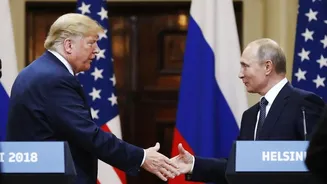






US President Donald Trump expressed confidence that the ongoing war with Iran will end “very quickly”, claiming that fuel prices in the United States will fall below pre-war levels once the conflict concludes.
He also reiterated that US military strikes had destroyed Iran’s nuclear capacity, defending the operation as necessary to prevent Tehran from acquiring a nuclear weapon.
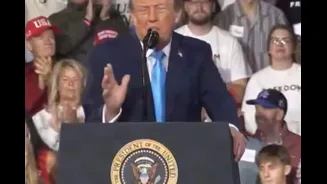
Addressing supporters at a campaign rally in Kentucky on Saturday (local time), Trump linked the outcome of the conflict to energy costs faced by American consumers, promising a decline in petrol prices after hostilities end.
“It’s going to end very quickly. When it ends, your gas prices are going to be lower than what they were before,” Trump said.
The US President also revisited the military strikes against Iranian targets, describing the operation as an “excursion” and claiming that it had successfully neutralised Iran’s nuclear capabilities.
“When I did that excursion, we knocked out their nuclear capacity,” he said, using an expletive to describe the extent of the damage inflicted on Iran.
Defending the military action, Trump said preventing Iran from developing a nuclear weapon remained a critical national security objective.
“Somebody said, ‘Oh, well, was it worth it?’ I said, ‘They cannot have a nuclear weapon; they can’t, because they’ll use it,’” he told the gathering.
Iran Says Lasting Peace Requires End To Fighting Across All Fronts
Meanwhile, Iran maintained that a lasting resolution to the conflict requires an end to hostilities across the region, including Israel’s military campaign in Lebanon. Iranian Deputy Foreign Minister Saeed Khatibzadeh said Tehran remained committed to ending the war in Lebanon and that the issue had featured prominently in discussions between Iran and the United States.
Khatibzadeh said the objective was included in an Islamabad memorandum of understanding signed by Iran and the US in mid-June. He accused Washington and Tel Aviv of violating the Islamabad memorandum by launching strikes against Iran and Lebanon. He also argued that the United States bore responsibility for ensuring that Israel halted its military campaign.
Khatibzadeh also rejected the suggestion that the US-led military campaign had eliminated Iran’s ability to defend itself, saying Tehran had retained its capacity to deter attacks and would continue protecting its sovereignty and territorial integrity. He described the US war against Iran as unlawful under international law and said the country had withstood what he characterised as an existential conflict.
On the nuclear issue, the Iranian deputy foreign minister said Tehran was prepared to address questions raised by the International Atomic Energy Agency (IAEA) and the United States regarding its nuclear programme, which Iran maintains is peaceful. He referred to previous IAEA reports as evidence of Iranian compliance, while reiterating Tehran’s willingness to engage on outstanding concerns.
Khatibzadeh also said Iran had offered to reopen the Strait of Hormuz within seven days, while insisting that the country did not seek war but would respond to any conflict imposed upon it.