
Sometimes, dried traces of water are found on Mars, and sometimes, human-like figures appear. But this time, the European Space Agency’s (ESA) Mars Express mission has discovered something that has surprised
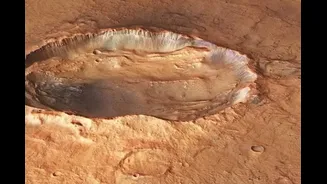
everyone. A giant ‘butterfly’ has appeared on the rugged terrain of the Red Planet. This is no small figure; its radius extends up to 20 kilometres. At first glance, it appears as if some huge creature is stuck to the Martian surface. When scientists saw its high-resolution images, they were stunned.
This figure was found in the Idaeus Fossae region of Mars. How did this ‘butterfly’ get there, and is it evidence of alien activity? Scientists have now revealed this mystery.
How Did This Figure Form On The Martian soil?
Scientists have clarified that it is not a real insect or alien. This is actually a crater formed by the impact of a massive rock. However, it’s not round like a typical crater. According to ESA, this is a rare occurrence. This happens when a space rock or asteroid hits the surface of Mars at a very low angle. This impact wasn’t straight, but oblique.
Just like a stone thrown across water, it bounces off. This caused the rock to hit Mars. This created two large ‘wings’ and a deep crater in the middle. This is why it resembles a butterfly when viewed from above.
Studying this crater has revealed another surprising finding: the butterfly-like wing debris is quite smooth and round. Scientists believe this is evidence that ice or water was present beneath the ground at the time of the impact. When the rock struck at a tremendous speed, heat was generated, which melted the ice hidden beneath the ground.
The melting of the ice caused the soil and rocks to flow like fluidised material. This is why the debris around the crater resembles frozen mud, not hard rocks. This discovery suggests that this area of Mars may have once contained a large reservoir of water or ice.
A Massive 20-Kilometer Radius
This ‘Butterfly Crater’ is enormous. It stretches approximately 20 kilometers from east to west and 15 kilometers from north to south. The central portion, where the impact occurred, is deep and long. This region is called the ‘Idios Fossae’ region, located in the northern part of Mars.
Large cracks are visible in many places on the ground here, indicating a turbulent history.
What Kind Of Mark Is This On The Martian Surface?
The images show much more than just a butterfly. Near the crater are some flat, raised hills called mesas. Wrinkle Ridges are also visible. These form when lava flows cool and the ground shrinks. This suggests that this area was once active volcanoes millions of years ago.
The soil here contains high amounts of magnesium and iron, which come from volcanic ash.
Mars Express Has Been Spying For 20 years
These stunning images were sent by the European Space Agency’s Mars Express spacecraft. Launched in 2003, it has been orbiting Mars since 2004. It carries a High Resolution Stereo Camera (HRSC) that can take 3D images. Over the past two decades, it has played a key role in mapping Mars.
It has observed not only the Martian surface but also its atmosphere and moons.