




Central Assam’s West Karbi Anglong district saw days of violent unrest earlier this week that left two people dead, at least 45 injured, shops and markets torched, and internet services suspended across
both Karbi Anglong and West Karbi Anglong.
The clashes, centred in the Kheroni–Phelangpi belt, erupted from a prolonged hunger strike over tribal land rights, but the anger sits atop decades of tension involving Sixth Schedule protections, demographic anxieties, unresolved eviction disputes and insurgency-era grievances.
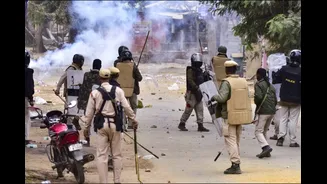
The violence had spiralled to such an extent that security forces had to fire tear gas and rubber bullets, protesters used stones, arrows and crude bombs, the ancestral home of Karbi Anglong Autonomous Council (KAAC) Chief Executive Member Tuliram Ronghang was set ablaze, and the Army had to be deployed to stabilise the situation.
What began as a local land agitation flared into one of the region’s most serious crises in years.
What Triggered The Outbreak Of Violence?
The immediate trigger was the police action on hunger strikers who had been sitting for more than two weeks at Phelangpi in West Karbi Anglong. Members of the indigenous Karbi community and other tribal groups had launched a fast unto death demanding the eviction of settlers from the Village Grazing Reserve (VGR) and Professional Grazing Reserve (PGR) lands. These lands, set aside since the British era to ensure livestock grazing, fall under the KAAC’s jurisdiction and are protected under the Sixth Schedule.
Nine people were on the fast. On Monday night, authorities removed them from the protest site. The police said they were being taken to Guwahati for medical treatment because their health was deteriorating after more than 15 days of fasting. But locals believed they had been arrested, and this assumption spread rapidly. Rumours fed anger through the surrounding villages, and within hours, there were road blockades, stone-pelting, arson and vandalism.
By Tuesday, the unrest had moved into Kheroni, where clashes intensified. Protesters attacked police using stones, gas cylinders, arrows and crude bombs. Several shops, market stalls and houses were set on fire. Police used tear gas, rubber bullets and blank firing to disperse crowds, but violence continued to escalate.
One of the most explosive moments came when protesters set fire to KAAC Chief Executive Member Tuliram Ronghang’s ancestral residence in Donkamokam, a politically charged act, given that Ronghang is a key BJP leader and seen as close to Assam Chief Minister Himanta Biswa Sarma.
How Severe Was The Violence?
The scale of violence was far more intense than previous flare-ups in the area. Over 45 people were injured, including 38 police personnel. Senior IPS officers and the state DGP were also reported to have suffered injuries during the clashes.
A Bengali man, identified as Suresh Dey, who was disabled, was charred to death after being trapped inside a building set ablaze during the arson in Kheroni market. A protester from the Karbi community also died during police action. These two deaths hardened positions and deepened the communal faultline.
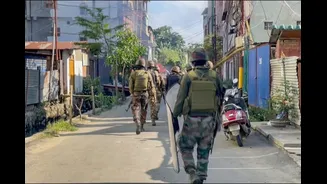
Authorities imposed prohibitory orders, suspended mobile internet and data services in both districts, and deployed additional security forces across sensitive areas. The state DGP confirmed that the Army had to be deployed on Wednesday to maintain law and order, underscoring the severity of the situation.
By Wednesday morning, officials said the district was tense but under control, though no fresh violence was reported during the night. PTI noted that prohibitory orders remained in force and security forces continued to guard vulnerable pockets.
What Is The Dispute Over VGR And PGR Lands?
The core dispute concerns encroachment on PGR and VGR lands, grazing reserves created in the British period to ensure fodder for livestock and livelihood security for local communities. These lands are protected under the Sixth Schedule, which grants special autonomy to tribal-majority districts like Karbi Anglong and West Karbi Anglong.
Tribal groups allege that large areas of these reserves have been illegally occupied by non-tribal settlers, including Bihari, Bengali and Nepali communities. Protesters say the encroachment spans over 7,184 acres of protected land, eroding tribal rights and threatening the demographic balance.
In February 2024, after days of agitation by Karbi organisations, Ronghang publicly announced planned eviction drives. He said 1,983 families of “illegal settlers” were living on grazing lands in the Hawaipur mouza under the Donkamokam circle, and 103 families were encroaching upon grazing lands in the Phuloni circle. This announcement came shortly after a Bihari Nonia community outfit submitted a memorandum to President Droupadi Murmu demanding the legalisation of settlers living on these reserves.
However, the evictions never happened because settlers moved the Gauhati High Court, which issued an interim stay. Ronghang explained that the council could not carry out evictions without violating the court’s order. This legal freeze left the issue unresolved, frustrating tribal groups who felt their demands were being indefinitely sidelined.
Why Did This Clash Turn So Volatile?
West Karbi Anglong has long been vulnerable to flare-ups because its social, political and demographic landscape is extremely sensitive.
The district is overwhelmingly tribal. Over 55 per cent of Karbi Anglong’s population and more than 65 per cent of West Karbi Anglong’s population belong to the Scheduled Tribes. Multiple tribal communities live here, including Karbis, Dimasas, Kukis and Garos. For decades, land, identity and self-governance have been inseparable concerns.
Insurgency has played a defining role: Karbi groups have a history of militancy dating back to the late 1980s, rooted in demands for a separate state. While most factions later settled for greater autonomy under KAAC, the memories of killings, ethnic violence, taxation and abductions still shape political mobilisation and rhetoric.
The Sixth Schedule adds another layer of sensitivity because any perceived weakening of tribal land protections is treated as an existential threat. The long-pending question of evictions, amplified by the High Court stay, created a situation in which tribal bodies felt trapped between constitutional safeguards and judicial delays.
Political tensions further aggravated matters. When Assam Education Minister Ranoj Pegu on Tuesday visited Kheroni and urged residents to maintain peace, locals shouted slogans demanding development and expressing anger at the role of the autonomous council leadership, especially Ronghang, whose house was burnt the previous day.
All of this meant that when the hunger strikers were moved, even on medical grounds, it was interpreted as a hostile act, a spark that fell on dry ground.
Although calm has been restored for now, the underlying tensions remain unresolved. Christmas, which is widely observed across the district, has been markedly subdued this year. The United Christian Forum (UCF) of Karbi Anglong has urged churches and congregations to scale down festivities in view of the prohibitory orders still in place and the lingering sense of unease. The forum advised against night-time carol rounds or programmes outside church premises, noting that many residents remain anxious in the aftermath of the clashes.
With over 300 churches spread across the two districts, the advisory asked congregations to limit gatherings to daytime services and avoid unnecessary travel after dark. The appeal also called on communities in both Karbi Anglong and West Karbi Anglong to maintain peace and ensure the situation does not deteriorate again.