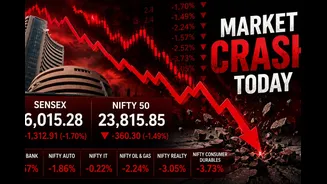









Indian equity markets ended sharply lower on Monday as rising geopolitical tensions in West Asia and surging crude oil prices triggered broad-based selling across sectors. The BSE Sensex closed down 1,312
points, or 1.70 per cent, at 76,015, while the Nifty 50 slipped 360 points, or 1.49 per cent, to settle at 23,815. The benchmark index closed below the crucial 23,850 mark amid heightened volatility and weak investor sentiment.
Market volatility remained elevated throughout the session, with India VIX surging nearly 10 per cent to 18.51, reflecting increased nervousness among traders.
Analysts said markets were rattled after hopes of a near-term resolution in the West Asia crisis faded following US President Donald Trump’s rejection of Iran’s proposal, leading to a spike in Brent crude prices toward the $105-per-barrel mark.
The selloff was broad-based, with all major market segments ending in the red. Broader indices also witnessed sharp cuts as the Nifty Midcap 100 declined 1.05 per cent, Smallcap 100 fell 1.13 per cent and the Microcap 250 index dropped 1.42 per cent.
Financial stocks remained among the biggest laggards. Nifty Bank ended down 1.57 per cent, while PSU Bank stocks fell over 2.5 per cent. SBI tumbled more than 4 per cent, while HDFC Bank, Bajaj Finance, Bajaj Finserv and Kotak Mahindra Bank also ended significantly lower.
Consumption-linked sectors witnessed heavy selling pressure after Prime Minister Narendra Modi’s call to curb fuel consumption, avoid unnecessary foreign travel and reduce dependence on imported commodities raised concerns over FY27 demand growth.
The Nifty Consumer Durables index plunged 3.7 per cent, emerging as the worst-performing sector of the day. Titan crashed over 7 per cent, while Trent, Asian Paints and Whirlpool-linked consumer plays remained under pressure.
Auto and oil-linked stocks also remained weak amid fears that rising crude prices could worsen inflation and hurt discretionary spending. The Nifty Auto index fell 1.86 per cent, while the Oil & Gas index dropped over 2.2 per cent. Reliance Industries declined more than 3.5 per cent, adding significant pressure on benchmark indices.
Realty and media shares also saw sharp cuts, with the Nifty Realty and Media indices falling over 3 per cent and 2.4 per cent, respectively.
Defensive sectors, however, outperformed the broader market. Pharma stocks attracted buying interest as investors rotated toward defensives amid uncertainty. The Nifty Pharma index closed 0.25 per cent higher, while the Healthcare index gained 0.45 per cent. Sun Pharma emerged as one of the top Sensex gainers, rising over 1.3 per cent.
IT stocks also showed relative resilience. Although the Nifty IT index ended marginally lower, losses remained limited compared to the broader market, supported by gains in select large-cap names such as TCS.
Vinod Nair, Head of Research, Geojit Investments Ltd, said, “The benchmark index slipped below the 24,000 mark as renewed Gulf tensions, following Trump’s rejection of Iran’s peace proposal, weighed on investor sentiment. The cautious mood deepened after the PM’s appeal to conserve energy and avoid non-essential foreign travel, prompting investors to reassess the economic impact of higher crude prices, rupee weakness, and pressure on the current account deficit.”
Currently, India’s strong fiscal position and healthy forex reserves are helping the government to absorb the impact of elevated crude prices. However, prolonged geopolitical tensions could increase macroeconomic stress. Meanwhile, rising bond yields and persistent FII outflows are likely to keep markets range-bound in the near term, he added.
Technical View
Rupak De, senior technical analyst at LKP Securities, said, “The index has given a consolidation breakdown on the daily chart, suggesting a heightened risk of a larger bearish phase. The index has slipped below both the 50 EMA and 20 EMA, confirming a weakening trend. The RSI, a momentum oscillator, is in a bearish crossover and indicates increasing downside pressure.”
Overall, the index appears vulnerable in the short term. Immediate support is placed at 23,700, below which the decline may accelerate further. On the upside, resistance is placed at 24,000, above which sentiment could improve, he added.