





OM – Operation Mole Movie Review: There’s something inherently fascinating about undercover crime thrillers. They thrive on the thin line between deception and truth, the psychological toll of living a double
life and the moral compromises that come with infiltrating dangerous criminal networks. At their best, they’re as much about the people caught inside the system as they are about the crime.
Rajkumar Periasamy’s OM: Operation Mole attempts to explore precisely that territory. Rather than relying entirely on twists, high-octane action and conventional hero elevations, it tries to examine the emotional cost of duty, loss and sacrifice. The result is an ambitious, occasionally affecting thriller. It has its share of narrative shortcomings but benefits considerably from its formidable cast.
Set against the backdrop of the red sandalwood smuggling network operating across Andhra Pradesh and Tamil Nadu, OM: Operation Mole follows an undercover mission to dismantle an organised criminal syndicate. Nithya Reddy, an officer heading the Special Task Force, recruits Pazhani for an operation targeting Burma Karthikeyan, aka Siya, a powerful local figure controlling the trade.
Also Read:OM X Review: Fans Impressed By Dhanush’s Entry, Mammootty’s Subtle Act; Courtroom Scene Steals The Show
Pazhani assumes a new identity and infiltrates Siya’s network, hoping to get closer to the people orchestrating the operation. However, as the mission progresses, professional obligations begin to collide with personal losses, forcing the three central characters to confront their own emotional vulnerabilities.
One of the film’s biggest strengths is its attempt to look beyond the mechanics of an undercover operation to the red sandalwood trade and the exploitation of economically vulnerable tribal communities. The world-building lends the film a certain authenticity, even if the narrative occasionally struggles to accommodate all the information it wants to communicate.
The emotional undercurrent is another major asset. Rajkumar makes an interesting choice by refusing to turn his protagonist into an invincible action hero. Instead, he allows Pazhani to be vulnerable, conflicted and emotionally overwhelmed. The interval sequence, in particular, marks a turning point, shifting the film’s focus from the mechanics of the investigation to the psychological consequences of the mission.
It is arguably the film’s biggest dramatic high point. Pazhani’s emotional breakdown at this juncture subverts the conventional hero-elevation moment and gives the narrative an unexpected emotional turn. This also marks a striking departure from the familiar grammar of commercial action thrillers, where the interval is often reserved for a spectacular reveal — an elaborate fight and an assertion of power.
The second half finds greater footing as the relationships between Pazhani, Nithya and Siya become more central to the narrative. The film’s emphasis on trust, sacrifice and personal loss gives it an emotional dimension that distinguishes it from a conventional spy thriller. There are a bunch of other scenes that stand out as well.
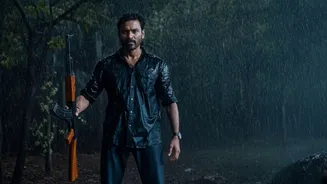
Dhanush’s single-shot introduction sequence, for instance, is among the film’s most striking action passages. And then there’s the jailbreak sequence in the second half. As Nithya, Sai Pallavi brings forth physical aggression with emotional intensity. She brings considerable conviction to the sequence, making it one of the more memorable stretches of the film.
But for a film that has so much going for it on paper, OM: Operation Mole, with a runtime of 2 hours and 58 minutes, takes an unexpectedly long time to find its rhythm. The first half is weighed down by verbose exposition, elaborate character introductions and information-heavy sequences that could’ve been handled with greater economy.
The screenplay occasionally confuses detailing with depth, making the proceedings feel more cumbersome. The portions involving Pazhani’s marital discord, in particular, do little to advance the larger narrative. The other problem is the film’s reluctance to fully commit to the more uncomfortable questions it raises.
The exploitation of tribal communities, which forms the foundation of the red sandalwood trade, deserved a more incisive examination. Similarly, its references to police brutality and illegal encounters could’ve offered a sharper commentary on institutional power and accountability. There’s also a sense that Rajkumar is attempting to accommodate too many films within one narrative.
The undercover operation, the emotional conflicts, the exploitation of labourers and the eventual saviour-like trajectory of Pazhani don’t always come together seamlessly. The second half is more emotionally engaging, but the screenplay could have benefited from tighter editing and a more uncompromising approach.
But what makes up for these flaws are the performances. If there’s one actor who emerges as the film’s biggest winner, it’s Pallavi. As Nithya, she brings a certain authority and emotional intelligence to a character that could easily have become another conventional police officer. She makes Nithya’s vulnerability and determination coexist without allowing either to overwhelm the other.
Dhanush, meanwhile, gets a character that plays to his strengths as a performer. Pazhani is neither an out-and-out action hero nor an uncomplicated righteous cop. There are several layers to his personality, and Dhanush brings out the psychological complexity through his expressions, body language and emotional restraint without resorting to theatrical excess.
Mammootty brings an understated gravitas to Siya, a character who’s far more layered than his criminal identity initially suggests. He’s ruthless when it comes to protecting his empire, but there’s an unexpected tenderness to him that occasionally surfaces. It’s these contradictions that make Siya an interesting character to watch.
His evolving equation with Pazhani also lends the narrative an emotional complication. Mammootty makes the most of these nuances, particularly in the courtroom sequences, where his screen presence does much of the heavy lifting. However, given the actor’s extraordinary range, one can’t help but wish the writing had explored his character’s complexities more deeply.
Sreeleela has limited scope as Pazhani’s wife, Roja. This is a considerably less-developed character. Much of her characterisation revolves around her marriage to Pazhani and the emotional toll of his absence. While their domestic exchanges lend the film some relatability, one wishes the writing had afforded her a little more agency beyond her identity as a wife and mother.
Naseeruddin Shah is considerably underutilised, with his character lacking the depth one would expect from an actor of his calibre. He plays Abdul Hameed, the mastermind behind the red sandalwood smuggling network. The writing gives him the importance of a central antagonist but doesn’t give his character the depth or screen presence that such a position demands.
As for the music, Sai Abhyankkar’s Veezha Veera track stands out. In the action-heavy jungle sequence, it adds an interesting devotional dimension. Ezhil Arasu’s cinematography lends the film a distinct visual texture, particularly in the forest portions and the depiction of the smuggling network. The locations contribute significantly to the film’s atmosphere.
Ultimately, OM: Operation Mole is an ambitious attempt at marrying an undercover crime thriller with an emotionally driven police procedural. Its screenplay occasionally loses steam under the weight of its own subplots. It’s not always taut, and its sociopolitical commentary doesn’t go as deep as it promises. But the film finds its footing in its performances and emotionally charged second half.