








Pati Patni Aur Woh Do Movie Review: A chaotic caper. One pati. One patni. Two women for anti-climactic reasons. A garrulous aunt. A couple of characters that don’t make sense. Some jokes that land. Some mentions
of homophobia, casteism and a social message about how rumours often get perceived as truth if repeated often enough. A leopard. A wolf. That, in essence, is Pati Patni Aur Woh Do.
It’s entertaining in some parts and utterly bizarre in others. Now, this is a world that doesn’t make sense. Why would an old classmate suddenly reappear in a married man’s life and seek his help to survive the next one week before she can flee overseas with her boyfriend? Why would that same man lie to his rather cool, understanding and liberal wife and pretend to be the classmate’s husband?
And when chaos inevitably ensues, why does he not confide in his co-worker who he also calls his best friend? How do this man and his make-believe girlfriend manage to survive a journey alongside a man-eating, wolf who accidentally lands up in his car? And why is there an effeminate office boy, who speaks with the theatrical flourish of Anarkali from Mughal-e-Azam? Well, this is Mudassar Aziz’s world.
You feel like he’s taking it too far with each passing twist in Pati Patni Aur Woh Do. But what helps this self-proclaimed comedy of errors stay afloat is the film’s unapologetic commitment to its own madness. It works best when you surrender to its wild, logic-defying energy and simply go along for the ride. Switch off your brains and embrace the chaos and you may not leave entirely disappointed.
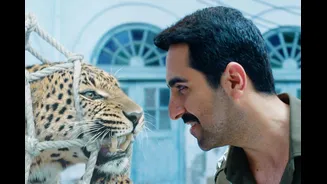
Set in Prayagraj, Pati Patni Aur Woh Do opens with a hero-style entry for Prajapati Pandey, who’s introduced while attempting to capture a leopard that has strayed into town. Prajapati is a forest in-charge officer, who eventually traps the animal and dramatically tells him to ‘calm down’. His best friend, Nilofer, an animal tranquilisation expert, works alongside him.
At home, he shares a comfortable life with his wife Aparna, a journalist. Life in Prayagraj appears perfectly sorted until Chanchal enters the picture. An old classmate of Prajapati’s, she’s caught in the middle of a personal crisis. Wearing a burqa, she gets spotted crossing the road with her boyfriend, Sunny. His father, Gajaraj, is a politician, who staunchly opposes their union due to caste differences.
As Gajraj instructs his henchmen to identify the mysterious woman in the burqa, it’s revealed that Aparna’s the journalist behind leaking the photo. Gajraj promises Aparna that if she helps track the girl down, he’ll fund her own news channel. Meanwhile, Prajapati agrees to pose as Chanchal’s boyfriend to ensure that no suspicion falls upon her.
Naturally, confusion follows. Aparna begins suspecting that he’s involved in extramarital affairs with both Chanchal and Nilofer, who she also considers to be a close friend. Misunderstandings escalate to the point where Prajapati is believed to be a bisexual man engaged in another illicit relationship with Sunny. Thrown into this mix is Chanchal’s aunt, who can’t keep her lips sealed, and Dharamveer, a cop, determined to track Prajapati down.
At 1 hour and 57 minutes, Pati Patni Aur Woh Do is a like a ride at a local fare – nothing too snazzy and expensive but still fun, for the most part. And then there are the histrionics. This is a film that thrives on excess – excess pandemonium, excess coincidences, excess screaming, excess melodrama and, at times, excess confidence in its own absurdity.
Nothing here is subtle. Characters don’t merely enter scenes, they burst into them. Emotions aren’t expressed, they’re announced at full volume. But it revels in its maximalism. Still, the film’s biggest strength is also its biggest weakness. It never knows when to stop. Every joke is stretched, every set-piece escalated and every emotion underlined twice over.
But perhaps that’s precisely the point. Pati Patni Aur Woh Do is the cinematic equivalent of a buffet plate piled dangerously high. It’s massy, messy, overwhelming, occasionally ridiculous but not entirely without flavour. The narrative embraces an old-school Bollywood sensibility with unabashed song-and-dance routines, elaborate dream sequences and larger-than-life physical comedy.
But along with the nostalgia also comes some outdated baggage, particularly in its stereotypical portrayal of a gay character, which feels disappointingly dated and reductive. But it’s a breezy affair, more or less, managing to keep you hooked after you take your own sweet time to become a part of Prajapati’s bizarre world. Having said that, this one’s not meant for all.
If you’re in the mood to let your hair down and blow off steam after biting your nails deciphering one too many tense whodunits, Pati Patni Aur Woh Do with all its airtight rationale may be a decent option. And credit lies where it’s due. Ayushmann Khurrana after Thamma is back to where he always belonged – a small-town simpleton dealing with a bunch of idiosyncratic characters – and he impresses.
He carries the film on his able shoulders, playing to the gallery with impressive abandon. At times helpless and at times hapless, he remains the man desperately trying to save the day while landing himself in greater trouble. The film proves that slapstick, ratting comedies are as much his forte as character-driven humour.
Wamiqa Gabbi thankfully gets significant screen time unlike her previous outing, Bhooth Bangla. She understands the assignment and is likeable as the loving and eventually frustrated wife. Mudassar appears fully aware of Sara Ali Khan’s penchant for exaggerated performances and crafts a character that allows her to operate comfortably within that space.
Rakul Preet Singh, however, stands out as a spinster, who through absolutely no fault of her own becomes entangled in Prajapati’s increasingly topsy-turvy existence. But the real show stealer is Ayesha Raza, who plays bua-ji with exaggerated quirks. She plays the chatterbox with an endearing lack of self-awareness. She’s loud and gloriously animated and plays the part with such conviction and odd charm that humour emerges effortlessly.
Vishal Vashishtha, Tigmanshu Dhulia and Vijay Raaz also deserve a mention. Pati Patni Aur Woh Do isn’t a flawless film but then again, it never pretends to be one. The makers commit to the madness with enough conviction to make much of it oddly enjoyable. At the heart of it is crackling chemistry between its ensemble, who collectively keeps the film buoyant even when the screenplay fumbles.
And mercifully, the wolf and the leopard here don’t look like patchy CGI inserts. Basically, on its own eccentric terms, Pati Patni Aur Woh Do largely succeeds in being delightfully entertaining, massy and frothy.