
In the vast theatre of Indian democracy, leadership positions carry both symbolic gravitas and practical power. Yet few roles in public life command the significance that comes with being national president
of the Bharatiya Janata Party (BJP)—the world’s largest political party, with more than 13 crore official members. This is not merely an organisational post, it is a historic responsibility, a role that shapes national political discourse, drives ideological direction, and energises the cadre-based machinery that has redefined electoral politics in modern India.
The BJP is not a party constructed around a family, a surname, or a hereditary entitlement. Its core ideology is rooted in the nationalist principles of Syama Prasad Mookerjee and Pandit Deen Dayal Upadhyaya—leaders who anchored India’s political thought in Nation First and Antodaya, the uplifting of the last person in the line. These principles are not ornamental slogans, they are the guiding philosophy that has steadily transformed the BJP from a marginal force into the most dominant political movement India has witnessed in decades. And perhaps most importantly, the BJP stands as the country’s clearest ideological alternative to dynastic politics.
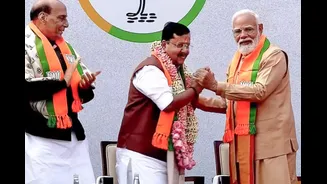
In contrast to the Congress party’s family-centric leadership model, the BJP has always taken pride in the fact that every one of its party presidents has risen from the ground—through hard work, organisational commitment, lived connection with karyakartas, and relentless dedication to the nation. In that context, the election of Nitin Nabin as BJP National President is not just a routine leadership transition. It represents a watershed moment—an emphatic reaffirmation of the BJP’s cadre-first identity and a powerful signal of generational shift in Indian politics.
The Monumental Legacy of BJP Party Presidents
To understand the significance of Nitin Nabin’s ascent, one must first appreciate the legacy he inherits. The BJP presidency is not a ceremonial throne, it is a demanding institution shaped by extraordinary personalities, each leaving an indelible mark on the party and the nation.
The earlier era carries the towering imprint of Atal Bihari Vajpayee and Lal Krishna Advani, both founding pillars of the BJP. Vajpayee was an orator par excellence—an individual who could disarm opponents with civility while firmly advancing nationalist conviction. His unique gift was what many called the art of principled flexibility: the ability to form coalitions without surrendering ideological clarity. He led the NDA government for six crucial years between 1998 and 2004 as Prime Minister, proving that governance rooted in nationalism could be both stable and inclusive.
If Vajpayee embodied statesmanship, LK Advani represented mobilisation of civilisational consciousness. His Rath Yatra became a defining inflection point in India’s national psyche. It marked the awakening of cultural assertion and national identity, shifting public discourse in ways that continue to influence Indian politics today. Advani’s ideological clarity and organisational strength established the BJP as a national force.
Then came Murli Manohar Joshi, known for his deep erudition, intellectual discipline, and unwavering nationalism. His leadership is inseparable from the legendary Ekta Yatra of 1992—from Kanyakumari to Kashmir—an unprecedented symbol of national unity at a time when the nation was confronting internal turbulence. Importantly, one of the defining participants and organising pillars of that yatra was Narendra Modi, then a young and committed organisational worker, foreshadowing the next historic chapter in the party’s rise.
In the aftermath of the BJP’s 2004 Lok Sabha setback, when political fortunes appeared uncertain and media narratives turned sceptical, leaders like Rajnath Singh and Nitin Gadkari played decisive roles. They strengthened the party’s internal resilience, revitalised cadre confidence, and ensured that temporary electoral setbacks did not derail long-term political momentum. They steered the organisation through a phase of introspection and revival—setting the stage for the BJP’s return to power.
But the most transformative leap came in the Modi era, when the BJP’s presidency turned into a high-velocity engine of expansion, precision strategy and cadre mobilisation that made winning a habit.
Amit Shah, as party president, expanded the BJP into regions once considered politically distant. His leadership saw bold breakthroughs in the North East, rapid consolidation in Uttar Pradesh, and an unprecedented organisational reach in states like West Bengal. The BJP’s historic UP Assembly victory in 2017 was the outcome of Shah’s meticulous emphasis on booth-level structure. He institutionalised booth management as the central philosophy of electoral dominance: every booth worker mattered, every booth became a battlefield, and every karyakarta became an organisational asset.
JP Nadda inherited an already formidable machine—and carried it forward with quiet competence and strategic consistency. Under his stewardship, the BJP achieved landmark wins, including forming the government in Odisha for the first time, along with spectacular performances in Maharashtra and Bihar assembly elections, even after the minor hiccup of the 2024 Lok Sabha polls. Nadda’s tenure reaffirmed that the BJP is not dependent on one individual; it is a self-renewing institution of leadership.
The Challenges Ahead
Against this backdrop, Nitin Nabin inherits not only glory but also responsibility. The BJP today is the dominant political force in India, but dominance brings fresh tests.
The party’s next frontier is clear: deeper expansion in the South—particularly Tamil Nadu and Kerala—and the strategic political conquest of West Bengal, a state where the BJP has already emerged as the principal challenger but still seeks final electoral victory. These are not routine tasks. They demand long-term organisational investment, cultural sensitivity, ideological communication, and relentless groundwork.
West Bengal requires consistent cadre protection, booth consolidation, and a narrative battle against entrenched political ecosystems. Tamil Nadu demands breaking through a long-standing duopoly by building trust from the grassroots. Kerala needs organisational patience to overcome historically resistant political structures. Each state presents distinct challenges—and together, they define the BJP’s next national mission.
What Sets Nitin Nabin Apart
Every leader brings his own temperament to a position. What sets Nitin Nabin apart is not flamboyance or theatrical politics, but something arguably far more valuable in an organisation like the BJP: a low-profile, diligent, laborious, hands-on working style.
Nitin Nabin is seen as a leader who believes in silent execution. Not one who seeks headlines, but one who creates results. His organisational track record speaks for itself. His role in helping the BJP consolidate its position in Bihar and his pivotal contribution as State Sah Prabhari in delivering the Chhattisgarh Assembly victory in 2023, demonstrate a rare ability: translating strategy into ground-level conversion.
He understands booth structures. He understands cadre morale. He understands that elections are won in lanes, mohallas, panchayats, and booths, where trust is built and maintained through persistent presence.
Another advantage is age. Unlike many who assume leadership after decades in public life, Nitin Nabin has youth on his side. This gives the BJP something rare: the ability to plan long-term leadership stability. Under the guidance of Prime Minister Narendra Modi and Home Minister Amit Shah, he has the opportunity to carve out a distinct stature for himself—not merely as a successor in line, but as a new architect of BJP’s future.
In short, Nitin Nabin embodies the BJP’s defining model: leadership produced through organisational labour, not political entitlement.
A Generational Message to the Karyakarta
Perhaps the most profound implication of Nitin Nabin’s elevation is what it signals internally. The BJP has sent an unmistakably sharp message to its karyakartas: the party is best geared up for a generational shift. No other party in India comes even close to this level of institutional future planning.
The BJP is not just preparing for the next election cycle—it is preparing the next generation of leadership. It is telling its workers: keep working, keep delivering, your effort is being noticed. In the BJP ecosystem, silent workers are not invisible. Their contribution is recorded—organisationally and politically. They need not be impatient. They need not chase limelight. The party rewards commitment.
This message matters because India is entering a decisive national transformation phase. The vision of Viksit Bharat—a developed India—requires not only policy, infrastructure and growth, but also young political leadership that can support the broader objectives of the nation for decades, not just years.
By electing Nitin Nabin, the BJP has essentially institutionalised this next-generation leadership transition.
A Befitting Tribute to Foundational Ideals
Finally, the rise of Nitin Nabin as BJP president marks something deeper than strategy: it is a reaffirmation of the party’s original moral compass.
It is a befitting tribute to Syama Prasad Mookerjee and Deen Dayal Upadhyaya, because it reinforces the foundational principle that leadership is earned through service. That the party exists not for individual ambition, but for national purpose. That personal gain must remain subordinate to collective duty.
The BJP’s philosophical ethic has long been captured in its timeless organisational creed: “Nation First, Party Second and Self Last.” The election of a grounded, hardworking, cadre-oriented leader like Nitin Nabin reinforces that this is not mere rhetoric. It is a living culture.
In a democracy where many parties are shaped by dynasties and personality cults, the BJP continues to stand apart as an organisation that manufactures leadership through discipline, sacrifice and commitment. Nitin Nabin’s ascent to the presidency is thus not just about one man. It is about the BJP’s institutional strength. It is about generational readiness. It is about the steady march of a party that thinks in decades, not headlines.
His tasks are formidable: expanding in the South, winning West Bengal, deepening ideological outreach, and preparing the BJP for the evolving demands of the Viksit Bharat era. Yet his profile—low-key, hardworking, hands-on—and his organisational credibility position him uniquely for this defining role.
That is why Nitin Nabin as BJP president marks a watershed moment in Indian politics: it symbolises continuity with a glorious legacy, and simultaneously signals the dawn of a new generational horizon. A party built on the ideals of nationhood and Antodaya is now preparing its next leadership chapter—quietly, strategically, and with relentless confidence in its cadre.
The writer is a national spokesperson of BJP, besides being an acclaimed author. Views expressed in the above piece are personal and solely those of the author. They do not necessarily reflect News18’s views.