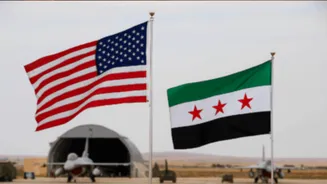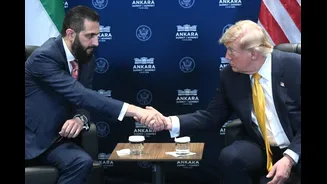



The United States has removed Syria from its list of State Sponsors of Terrorism, ending a designation that had been in place since 1979 and marking another major shift in Washington’s relationship with
Damascus after the fall of Bashar al-Assad.
The decision took effect after a 45-day congressional review, following US President Donald Trump’s announcement in July that Syria would be taken off the list
.“Today, Syria shakes off a dark stain and tears away a painful chapter of its past to embark on a path of development, reconstruction and rebuilding,” Syrian President Ahmed al-Sharaa said in a speech on Tuesday.
Syria’s removal leaves only three countries — Iran, Cuba and North Korea — on the US State Sponsors of Terrorism, or SSOT, list.
What Does The US ‘State Sponsor Of Terrorism’ Label Mean?
The US State Sponsors of Terrorism designation carries a range of legal and economic restrictions. These include limits on foreign assistance, defence exports, certain financial transactions and the transfer of some dual-use goods that can also have military applications.
The impact can extend beyond those formal restrictions.
Banks and companies may also be reluctant to deal with a designated country because of legal and compliance risks, making it more difficult for that country to access the global financial system or attract investment.
Syrian political analyst Ruslan Trad, a non-resident fellow at the Atlantic Council, told Al Jazeera that the designation can also serve a broader foreign-policy purpose.
He said the Trump administration’s “embrace” of al-Sharaa “underscores that SSOT status functions as much as a lever of bilateral relations and strategic signalling as a counterterrorism assessment”.
Why Was Syria Removed From The List?
Syria had been designated a State Sponsor of Terrorism since 1979, when Washington accused the government of Hafez al-Assad of supporting armed groups opposed to Israel.
The designation remained in place after Bashar al-Assad succeeded his father in 2000 and continued throughout his rule. That changed after Assad was overthrown in December 2024 by rebel groups led by al-Sharaa.
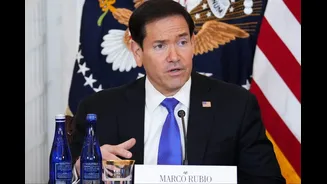
In July, US Secretary of State Marco Rubio said Washington had received “formal assurances” from the Syrian president that the country would not “support acts of international terrorism in the future”.
Washington has also praised cooperation between al-Sharaa’s government and the US against ISIL, or ISIS, according to Al Jazeera.
Al-Sharaa previously led the al-Nusra Front, an al-Qaeda affiliate, before breaking ties with the group in 2016. The terrorism designation had remained a major hurdle for investors even after Washington dismantled its broader Syria sanctions programme in 2025.
Rubio has said removing Syria from the list would “unlock international trade and investment” and give the country an opportunity to rebuild.
Sina Azodi, assistant professor of Middle East Politics at George Washington University, told Al Jazeera that removal from the list brings “many benefits”.
“It will make access to the US-dominated international financial and banking system easier,” Azodi said.
Iran: On The List Since 1984
Iran has been designated a State Sponsor of Terrorism by the US since 1984, following the 1979 Islamic Revolution and the deterioration of relations between Tehran and Washington.
The US continues to accuse Iran of supporting armed groups across the Middle East, including Hezbollah in Lebanon, Yemen’s Houthi group and groups in Iraq and Syria.
Iran is also subject to a much wider US sanctions regime targeting its government, financial system, military and oil industry.
Washington on Monday announced sweeping new economic sanctions on Tehran and entities in other countries that the US says facilitate trade with Iran. The measures are part of an effort to further isolate Iran economically amid the current US-Israeli war on the country and a diplomatic deadlock.
Cuba: Removed Once, Then Restored
Cuba was first placed on the US list in 1982, with Washington accusing Havana of supporting armed revolutionary groups.
Relations between the two countries have remained strained since the 1959 Cuban Revolution, when Fidel Castro overthrew US-friendly President Fulgencio Batista.
Then-US President Barack Obama removed Cuba from the list in 2015 during a diplomatic thaw between Washington and Havana. Trump restored the designation in January 2021, towards the end of his first term.
The Biden administration moved to remove Cuba from the list in January 2025, saying there was no information supporting the SSOT designation. Trump reversed the move after returning to office.
Independent UN experts had also criticised Cuba’s return to the list, saying it “constitutes a regressive step not only for bilateral relations between these two countries, but most importantly for the human rights and well-being of the people in Cuba, with the most devastating impact on vulnerable groups, including women, children, older persons, and persons with disabilities”.
The Trump administration has also imposed a fuel blockade against Cuba and threatened tariffs against countries exporting fuel to the island.
North Korea: Back On The List Since 2017
North Korea was first designated a State Sponsor of Terrorism in 1988, largely because of its role in the 1987 bombing of Korean Air Flight 858, which killed all 115 people on board.
Washington removed North Korea from the list in 2008 as part of efforts to negotiate over its nuclear programme. The designation was restored in 2017 during Trump’s first term.
North Korea has also remained subject to extensive US sanctions over its nuclear and missile programmes, weapons proliferation and other security concerns.
Are All US-Sanctioned Countries On The Terror List?
No. The State Sponsors of Terrorism list is a specific US designation. Washington also maintains separate sanctions programmes against countries, companies and individuals that are not on the SSOT list.
Russia, for example, is heavily sanctioned by the US over its war in Ukraine but has not been designated a State Sponsor of Terrorism, despite calls from some US lawmakers since the war began in 2022.
Venezuela has also faced extensive US sanctions without being placed on the SSOT list.
With Syria now removed, Iran, Cuba and North Korea remain the only three countries formally designated by Washington as State Sponsors of Terrorism.