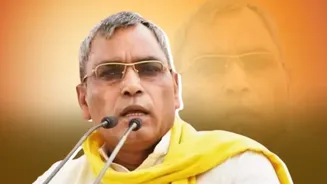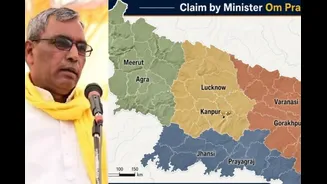





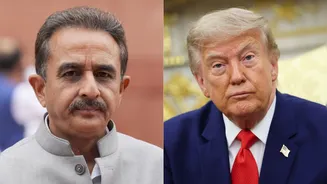

Uttar Pradesh Minister Om Prakash Rajbhar has revived a decades-old demand to break the state into four parts, claiming Prime Minister Narendra Modi assured him the split would follow the caste census.
He also promised Purvanchal’s first Chief Minister would come from his own Rajbhar community.
The claim, made at a rally in Ambedkarnagar has reopened a debate that goes back to Dr B.R. Ambedkar’s 1955 proposal for smaller, more administrable states, and was formally attempted once before — when the Mayawati-led Bahujan Samaj Party government pushed a four-way division resolution through the UP Assembly in November 2011.
That resolution never got central government approval and has sat dormant since. Rajbhar’s SBSP is currently allied with the BJP in the state, and his renewed push comes ahead of the 2027 Assembly elections — a timing that has drawn attention given the caste arithmetic embedded in his pitch.
Who First Proposed Splitting UP, And What Are The Four Parts?
The idea isn’t new. Ambedkar floated the case for smaller states in 1955, and Mayawati’s government formalised a four-way split proposal in 2011. The regions most commonly named are:
• Purvanchal (Eastern UP)
• Paschim Pradesh / Harit Pradesh (Western UP)
• Bundelkhand (Southern UP)
• Awadh Pradesh / Madhyanchal (Central UP)
Is The Split Actually Close To Happening?
No. There is no bill before Parliament and no formal central government decision. What exists is a 15-year-old state resolution that was never taken up, plus a fresh round of political statements.
Rajbhar’s account of a private conversation with the Prime Minister is, at this stage, his own characterisation and hasn’t been independently confirmed.
What’s The Actual Procedure — And Is It Easy Or Hard?
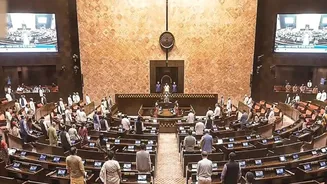
Creating a new state is governed by Article 3 of the Constitution, which gives Parliament — not the state assembly — the final say.
| Step | What happens |
|---|---|
| 1. Presidential reference | A reorganisation bill can be introduced in Parliament only on the President’s recommendation |
| 2. State’s view sought | The President refers the bill to the UP Assembly for its opinion, within a set time |
| 3. Parliament votes | Parliament isn’t bound by the state’s view; the bill needs a simple majority in both Houses |
| 4. Presidential assent | Once passed and signed, the new states come into existence |
Constitutionally, that’s a low bar — a simple majority, not the two-thirds required for a constitutional amendment.
Legal experts summarise Article 3’s scope as the power to form, enlarge, reduce, or rename any state, sometimes shortened to the acronym FIDA.
It’s also cited as evidence of India’s “unitary tilt” — states have no guaranteed territorial integrity, which is why India is sometimes called an indestructible Union of destructible states.
Administratively, though, it’s a different story. Splitting UP means dividing revenue, debt, electricity and water rights, and standing up four new bureaucracies, police cadres and possibly high courts from scratch — the kind of friction that turned the 2011 resolution into a dead letter.
Would Each New State Get Its Own Chief Minister?
Yes. If the split went through, each resulting state would be a full-fledged entity with its own Governor, CM, Council of Ministers and Assembly — which is what makes Rajbhar’s “Purvanchal CM” pitch politically loaded rather than just administrative commentary.
What Would Each Region Gain — And Risk?
| Proposed state | Advantage | Challenge |
|---|---|---|
|
Paschim Pradesh |
Industrial base, NCR proximity |
Takes the state’s strongest tax base with it |
| Purvanchal | Focused attention on a dense, underserved region | Weak industrial base, dependent on central funds |
| Bundelkhand | First dedicated political voice | Drought-prone, chronic water and revenue stress |
| Awadh Pradesh | Ready-made capitals: Lucknow, Kanpur | Bears the brunt of dividing existing assets |
Beyond the individual regions, the broader trade-off is scale versus reach: smaller states could mean easier governance and shorter trips to the capital for ordinary grievances, but the costs of building four capitals, secretariats and courts are steep, and a divided UP would lose the outsized leverage a unified 80-Lok-Sabha-seat state carries in national politics.