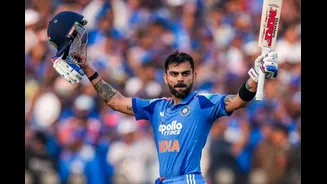








Virat Kohli’s intensity has long divided opinion. While his passion and aggression have earned him admiration from fans around the world, they have also attracted criticism in equal measure. Although Kohli has mellowed
with experience over the course of his career, the trademark aggression that has defined his approach remains an integral part of his game.
For former international umpire Anil Chaudhary, that competitive edge is precisely the kind of energy cricket needs to retain its charm.
Chaudhary, who has officiated Kohli‘s matches from his early days, said the former India captain’s on-field reactions come from his competitive nature rather than any intention to disrespect opponents. Kohli, who featured in India’s recent 2-1 ODI series defeat against England, is set to return to action in the September series against the West Indies.
“Actually, my advantage with Virat was that I had officiated his matches since childhood, so I have known him for a long time. He doesn’t have any malice.
“He reacts aggressively sometimes, but if you’re right, he’ll give you a thumbs up too. Between overs, he’ll come over and put a hand around your waist. But he is lively throughout. Players like him should be there; otherwise, the game will get boring,” Chaudhary said on JioHotstar.
Chaudhary also opened up on the heated moments involving Kohli during the IPL, including his much-discussed confrontation with Gautam Gambhir in 2013.
he felt such intensity is part of the competitive identity of many northern players and adds character to the sport, as long as boundaries are respected.
“I knew something like that would happen because all of them from the North play with aggression. I have played local cricket too, and our players have always played like this. If they don’t play with that aggression, their performances won’t come out as well. The flavour of the game won’t be there if you put too many restrictions on the players. But there’s a limit, and it shouldn’t be crossed,” he said.
Chaudhary also shared his views on the ongoing discussion around run-outs at the non-striker’s end, backing the dismissal while suggesting cricket could introduce a warning-based system to discourage batters from gaining an unfair advantage.
“The dismissal is fair in cricket. The batter at the non-striker’s end is running so far ahead that the advantage he gets is that he has only a few more steps to cover to reach the other end, which is unfair.
“I think very soon, in a year or two, a rule will come in with a warning system, one warning, two warnings, and then a run penalty. Because it’s unfair. Many times, on the last ball, the non-striker starts running early, and the striker does the same. So, what’s left for the bowler?” he added.