








If Pakistan’s troubled history reveals anything, it is that military power rarely announces itself with a bang. It creeps, consolidates, and then, suddenly, becomes irreversible. The year 2025 will be remembered
as precisely such a moment, when Pakistan Field Marshal Asim Munir led the military establishment, stopped pretending to rule from behind the curtain, and instead rewrote the rules of the state to formalise its dominance.
While Munir’s consolidation of power did not begin in 2025, which started unfolding steadily since his appointment as army chief in 2022, the past year marked a decisive shift in speed, scale, and ambition. What had once been an incremental expansion of influence hardened into an overt military power grab, carried out through constitutional engineering, foreign policy usurpation, and the systematic erosion of civilian and judicial authority. By the end of 2025, Pakistan had crossed an institutional Rubicon: democracy remained in form, but not in substance.
The most visible marker of this dynamic has been Munir’s assumption of an overt role in shaping Pakistan’s regional policy, where the military has held dominance for decades. India’s Operation Sindoor in early May 2025, which exposed Pakistan’s strategic vulnerabilities and heightened regional tensions, can be described as its turning point. In its aftermath, it was the army chief who emerged as Pakistan’s principal broker with its major allies rather than the Shehbaz Sharif-led civilian government.
This was demonstrated by Munir’s multiple high-profile visits to the United States, China, and Saudi Arabia, which are Pakistan’s three most consequential external partners. During his first US visit in June, he was hosted at an official luncheon by President Donald Trump, an honour traditionally reserved for heads of state or government. The symbolism of this meeting reflected Trump’s recognition of Pakistan’s real centre of power at the General Headquarters in Rawalpindi rather than the prime minister’s office in Islamabad. It rendered civilian leaders as spectators, particularly when the Shehbaz Sharif government nominated Trump for the Nobel Peace Prize 2025 within two days of Munir’s visit.
This external validation only emboldened Munir’s domestic ambitions. In July 2025, the Shehbaz Sharif government, which remains beholden to the military for power, especially after the controversial 2024 elections, conferred upon Munir the title of Field Marshal. He became the second Pakistani military general after General Ayub Khan, who awarded himself the Field Marshal rank in 1959 following a military coup a year earlier in 1958. Although framed as a ceremonial honour, the Field Marshal rank brings lifetime “prestige, ceremonial recognition, and symbolic seniority”.
If the Field Marshal title was a warning sign, the constitutional overhaul that followed was a full-scale institutional rupture. In November 2025, the government passed the 27th Constitutional Amendment Act, building upon changes introduced by the 26th Amendment a year earlier. Together, these amendments amounted to what can only be described as a constitutional coup, and one carried out not by tanks in the streets but through the country’s parliament itself.
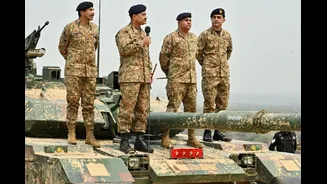
At the heart of the 27th Amendment was a radical restructuring of Pakistan’s military command. The amendment abolished the tri-service Joint Chiefs of Staff Committee (JCSC), replacing it with a new office of Commander of Defence Forces (CDF). It consolidated command over the Army, Navy and Air Force within the Pakistan Army only, as it is to be held concurrently by the army chief alone. As such, in one stroke, it paved the way for Munir to become the supreme commander of all armed forces, which he did formally on December 4, thereby eliminating even the modest inter-service checks that previously existed.
The amendment went further still. It granted official Field Marshal rank and the President of Pakistan lifelong legal immunity, which effectively foreclosed any future accountability for actions taken during military service. In a country whose history is replete with transgressions by military generals, including dismantling constitutions, this provision is a recipe for Munir to use any means available to extend his hold over power.
Perhaps the most alarming development was giving the Pakistan Army Chief increased authority over Pakistan’s Strategic Command, which oversees the country’s nuclear arsenal, thereby further weakening the already tenuous civilian oversight. This control over nuclear weapons, which represent the ultimate instrument of state power, gives Asim Munir further bandwidth to adopt power consolidation measures.
Yet the military’s ambitions did not stop at the executive or security domains. The final and most consequential blow of 2025 was directed at the judiciary, the last institution that had, at times, pushed back against military overreach. Through the same constitutional amendment, the Supreme Court’s authority was effectively fractured by the creation of a Federal Constitutional Court. This new body assumed many of the Supreme Court’s core constitutional functions, reducing the apex court to a subordinate status.
For decades, Pakistan’s judiciary has been inconsistent, often pliant, and occasionally complicit. But it has also been the sole institution capable of questioning military actions, invalidating unconstitutional measures, or delaying authoritarian consolidation. By bifurcating judicial power, the military establishment neutralised this threat.
Taken together, these measures make 2025 not merely another year of political instability, but a watershed in Pakistan’s democratic decline, with power centralised, personalised, and shielded from scrutiny. As such, the tactics adopted by Munir to consolidate power represent the most sophisticated iteration of power concentration. Unlike past coups, it relied not on abrogating the Constitution but on weaponising it. The result is a hybrid regime where legality masks authoritarianism, and where the military governs without the inconvenience of direct rule.
History will likely judge 2025 as the year Pakistan’s democratic experiment was decisively rolled back—not by force alone, but by law. And once democracy is dismantled clause by clause, restoring it becomes far harder than losing it ever was.
The writer is an author and columnist. His X handle is @ArunAnandLive. Views expressed are personal and solely those of the author, and do not necessarily reflect News18’s views.