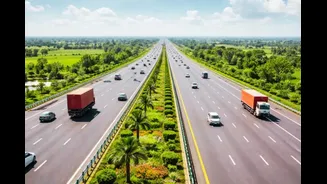







The Bengaluru-Vijayawada greenfield national highway is taking shape as part of efforts to improve connectivity between Andhra Pradesh and Bengaluru. The six-lane, access-controlled highway is being developed
under Phase II of the Bharatmala Pariyojana, with the wider corridor combining new greenfield construction with upgrades to existing highways.
The project aims to reduce travel time between Bengaluru and Vijayawada from the current 11-12 hours to around six hours, according to one of the supplied reports. An official from the National Highways Authority of India (NHAI) estimated that the journey could take approximately six to seven hours once the corridor becomes operational.
Besides easing passenger travel, the highway is expected to facilitate faster and more efficient transportation of freight between the two regions.
342-Km Greenfield Stretch Anchors Project
The greenfield section, spanning approximately 342-343 km, is a key component of the wider corridor. It runs from Kodikonda, near the Andhra Pradesh-Karnataka border, to Muppavaram, near Addanki.
The overall project is estimated to cover between 518 km and 624 km, incorporating the new highway alignment alongside improvements to existing road infrastructure, as reported by The Times of India. The project cost has been estimated at Rs 19,200 crore to Rs 19,320 crore in the supplied reports.
The access-controlled highway is designed to provide a faster alternative to existing routes, reducing dependence on congested roads and improving connectivity between major commercial centres.
Four Andhra Districts To Benefit From Highway
The corridor passes through four districts in Andhra Pradesh – Guntur, Prakasam, Kurnool and Kadapa. Its greenfield alignment is designed to bypass congested towns and existing highways, helping ease traffic pressure on older routes.
Once operational, the highway is expected to improve the transportation of agricultural produce, minerals and manufactured goods to markets in Bengaluru and Vijayawada, as well as ports along the east coast.
The improved road network is also expected to support commercial activity by providing businesses with better access to markets and reducing delays in the movement of goods.
Construction Gathers Pace In Prakasam District
Construction activity is gaining momentum along the Prakasam stretch, which accounts for nearly 110 km of the project.
The alignment passes through the mandals of Chandrasekharapuram, Kanigiri, Veligandla, Marripudi, Cheemakurthy, Thallur, Addanki, Kondepi and Panguluru. Podili and Kanigiri are among the towns situated along the corridor.
Construction work includes earthwork, culvert installation, bridge construction and blacktop laying. Progress has been reported on the Narayanampet-Chandrasekharapuram and Polavaram-Marripadu stretches.
The work forms part of the broader effort to establish the greenfield alignment and improve road connectivity across the districts through which the highway passes.
Fourteen Packages Drive Expressway Construction
The greenfield section has been divided into 14 construction packages awarded to Megha Engineering & Infrastructures, KNR Constructions and Dilip Buildcon.
The packages cover major construction activities, including large-scale earthworks, embankment formation and asphalt laying. A senior NHAI official, quoted in the supplied report, said construction activity across the packages had gained momentum.
The division of the project into multiple packages is intended to facilitate construction across different sections of the alignment.
Andhra Pradesh Targets 2027 Completion
During a review in January 2026, Andhra Pradesh Chief Minister N Chandrababu Naidu directed officials to complete the overall Bengaluru-Kadapa-Vijayawada Economic Corridor by 2027. The deadline underlines the state’s focus on improving road infrastructure and strengthening connectivity between Andhra Pradesh and Karnataka.
Once completed, the corridor is expected to provide a faster link between Bengaluru and Vijayawada, reduce travel time, ease pressure on existing highways and support the movement of goods across the region.
With construction progressing across multiple packages, the project is emerging as a significant road infrastructure initiative aimed at improving passenger mobility and freight connectivity between the two major urban centres.