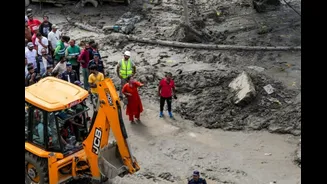








As Nepal battled one of its worst natural disasters in decades, helicopters became lifelines for communities cut off by torrents of water, mud and debris. Among the pilots repeatedly flying into some of the most
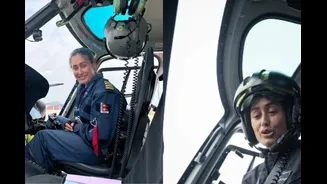
dangerous stretches of the Himalayas is Captain Priya Adhikari, Nepal’s first woman helicopter captain, who has carried out around 100 rescue missions in just six days.
Adhikari has been flying almost continuously over the flood-ravaged areas, particularly Timure in Rasuwa district near the Nepal-Tibet border. The scale of the operation has been extraordinary: around 20 helicopters were operating in and around the narrow valley, sometimes with five or six aircraft landing in the same area to evacuate survivors.
For Adhikari, this was not her first encounter with the Himalayas at their most unforgiving. But even her years of high-altitude rescue experience could not entirely prepare her for what she saw after the latest disaster.
Nepal’s First Woman Helicopter Captain
Adhikari’s route to the cockpit was far from conventional. She studied environmental science and initially worked as a member of cabin crew. A helicopter joyride, however, sparked an interest in flying that eventually changed the course of her career.
She travelled to the Philippines for helicopter training, built up the flying hours needed for professional aviation and became a full-time helicopter pilot in 2017. She subsequently developed expertise in high-altitude search-and-rescue operations across the Himalayas.
Her work has included rescuing injured climbers from extreme elevations, including missions reaching around 6,200 metres. In an industry traditionally dominated by men, she eventually became Nepal’s first woman helicopter captain, breaking through the scepticism she had encountered early in her career.
This experience has now been put to an extraordinary test.
100 Missions Through Mud, Mountains And Chaos
The flood-hit Timure region presented a unique danger. The terrain was not simply difficult to reach, even landing a helicopter could be hazardous.
Nepal’s first female Helicopter captain Priya Adhikari during rescue mission. She has flown over 100 rescue flights after massive flood. 🙏🇳🇵#nepal #highlight #everyoneシ゚ #follower pic.twitter.com/HVK3bqjdUj
— Nirmal Prasai🇳🇵 (@NirmalPrasai5) September 2, 2026
Speaking to CNN’s Anderson Cooper, Adhikari explained that what appeared from the air to be solid ground was often thick, unstable mud. A helicopter could sink into it, forcing pilots to keep the aircraft powered rather than safely shutting down after landing.
The situation in the air was equally demanding. With about 20 helicopters operating in the same narrow valley, pilots had to constantly communicate over radio, coordinating their movements and landing points.
“Just imagine 20 helicopters flying on that valley continuously talking with each other,” Adhikari told CNN, describing the pressure of navigating while simultaneously coordinating with other aircraft.
There was then the human toll below. Adhikari said the devastation was, in some ways, worse than Nepal’s 2015 earthquake because the destruction was concentrated in a small valley where entire communities were wiped out.
“This thing that happened, it’s bigger than the earthquake we had in 2015,” she told CNN.
During the first two days alone, more than 200 people were evacuated from Timure by several helicopters, including Nepal Army Augusta aircraft.
‘You Survived’: The Moments That Keep Her Going
From the cockpit, Adhikari witnessed scenes of devastation and death alongside desperate signs of life. Bodies lay scattered across the landscape, while survivors waited for the helicopters that might be their only route out. Yet she said it was the survivors who gave her a reason to keep smiling.
Priya Adhikari is Nepal’s first female helicopter captain and she’s flown over 100 rescue missions in the wake of the devastating flood. Anderson speaks with her about what she’s witnessed. pic.twitter.com/3YYXHZA60J
— Anderson Cooper 360° (@AC360) September 1, 2026
“Every time I go and land, I see people around and waving at them,” she told CNN. “I say, you survived.”
The emotional burden did not end when a rescue flight was over. Adhikari spoke of trying to find the parents of Radhika, an American-Indian woman whose family was caught in the disaster. She also searched for two Nepalese men, one volunteering with the Isha Foundation and another who worked at a bank in Timure.
“They are not my relatives,” she told CNN, but the scenes she had witnessed from the air had created an emotional connection that was difficult to shake.
She also pointed to a grim but immediate need in the aftermath: body bags, as rescuers continued recovering victims from the devastated region.
‘We’ve Been Trained For This’
After days of flying rescue missions almost without pause, exhaustion was inevitable. But Adhikari did not describe the work as extraordinary for herself. For her and the other pilots, it was what their training had prepared them to do. “Most of us are so exhausted because of all the flights we’ve been doing,” she told CNN. “We’ve been trained for this.”
For a week now, Priya Adhikari and other rescue pilots have turned the sky into Nepal’s emergency highway, making repeated journeys into a landscape where almost everything on the ground had vanished.