
Located in Maharashtra’s Buldhana district, Lonar Lake is regarded as one of the world’s most mysterious and scientifically significant lakes. More than a geological curiosity, it serves as a natural laboratory
for researchers across the globe.
While the lake drew attention five years ago when its water dramatically changed colour, recent developments have once again left scientists and environmentalists astonished.
Rising Water Levels Submerge Ancient Temples
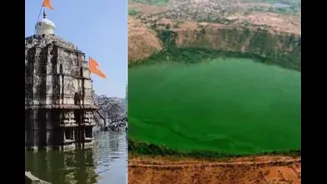
Over the past three months, Lonar Lake’s water level has continued to rise, flooding several centuries-old temples situated along its banks. Local residents say they have never witnessed such an event before.
The Kamaljadevi temple now has more than 15 feet of water inside it. Historically, the lake’s water had never even reached the temple steps, but it is now close to entering the sanctum. Several other ancient temples have been submerged, with access pathways completely underwater. Among the notable shrines affected are the Gomukh and Daityasudan temples.
Experts Step In
The unexpected rise in water has prompted the local administration to seek assistance from IIT Bombay. Experts from the institute have expressed concern, as the phenomenon cannot be easily explained.
According to scientists, the continued rise is puzzling because Lonar Lake has no inflowing rivers or streams. Apart from rainfall, there is no known source of water feeding the lake.
Water Level Rises By Nine Metres
From October to December this year alone, the water level has increased by nearly nine metres. This sharp rise has surprised experts, environmentalists, and conservation authorities alike, as such a change has never been recorded in the lake’s known history.
A Tourist And Educational Attraction
According to the Lonar Conservation Development Committee, the unusual transformation has drawn tourists from across Maharashtra, other parts of India, and even overseas. Schools are also organising picnic trips for children to witness the phenomenon firsthand.
Another major change observed in the lake is its declining alkalinity. In 2022, the lake’s pH level ranged between 10 and 11. It has now dropped to between 8 and 9, a significant shift that scientists are closely monitoring.
India’s ‘Moon Crater’ Lake
Lonar Lake, located about 79 kilometres from Buldhana city, was formed nearly 570,000 years ago when a massive meteorite struck the Earth at an estimated speed of 90,000 km per hour.
The impact created a crater approximately 1.8 kilometres wide and 150 metres deep, which later filled with water to form the present-day lake. Because it was formed on basalt rock from the Deccan Traps, Lonar Lake is the only known meteorite-impact lake of its kind in the world.
In the 1970s, scientists initially believed Lonar Lake was volcanic in origin. This theory was later dismissed, as a volcanic crater could not explain the lake’s depth of 150 metres. Earlier studies had estimated the lake’s age at around 52,000 years, but subsequent research revised it to 570,000 years.
Why The Water Is Not Drinkable
Lonar Lake has no natural outlet, meaning water does not flow out of the basin. Over time, evaporation leaves behind high concentrations of salts and minerals.
Due to the presence of sodium carbonate and bicarbonate, the lake’s pH typically ranges between 10.5 and 12, making the water highly alkaline and unfit for drinking.
Why The Lake Changes Colour
One of Lonar Lake’s most striking features is its ability to change colour. At different times, the water has appeared green, pink, red, or sea green.
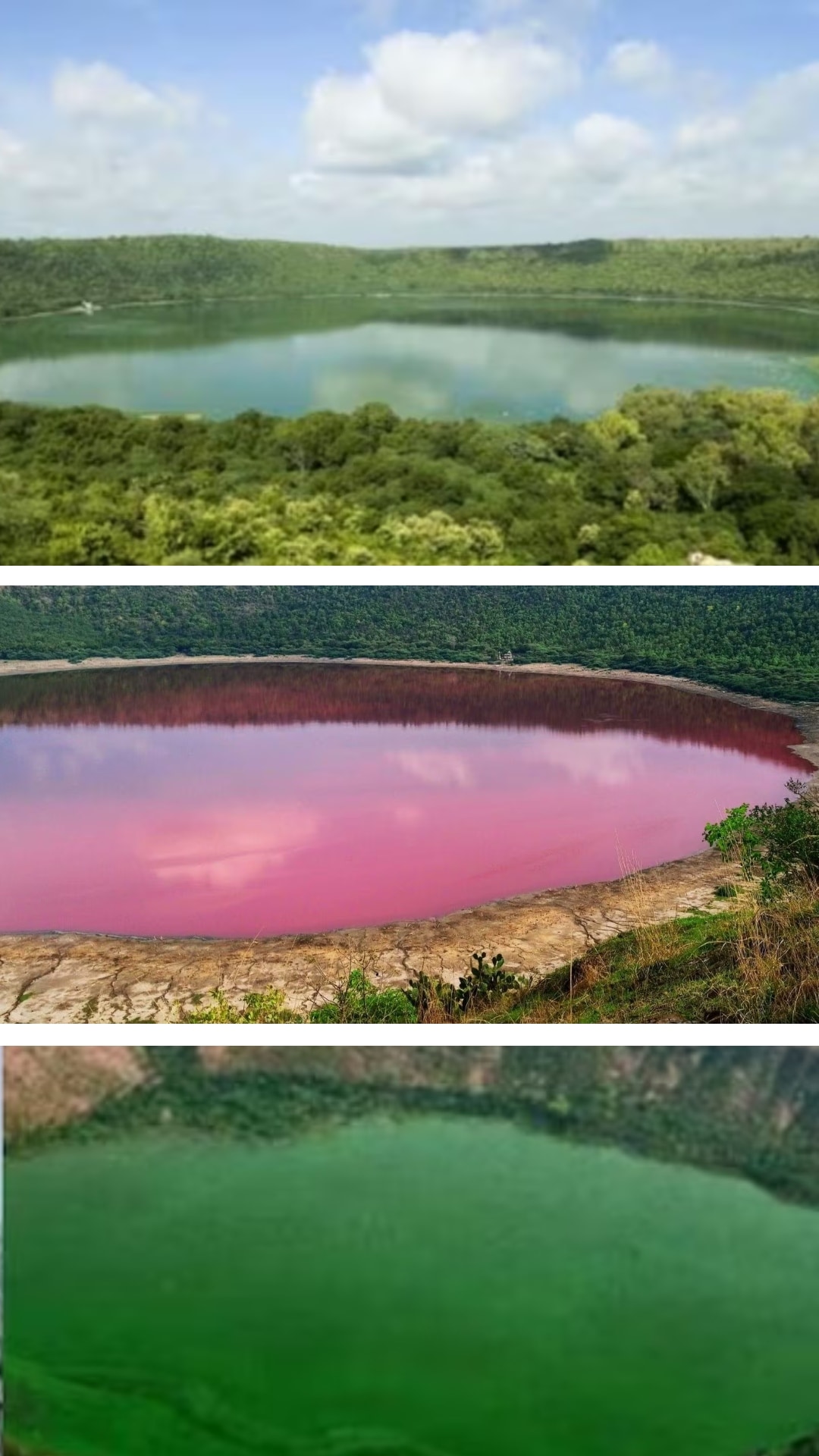
The green colour is caused by algae, while pink or red hues are attributed to salt-loving microorganisms such as Halobacteria. These microbes thrive in high temperatures and alkaline conditions.
In 2020, the lake’s sudden pink colour attracted global attention, with scientists linking it to changes in temperature, salinity, and biological activity.
An Extreme Environment Full Of Life
Despite its harsh conditions, Lonar Lake supports unique forms of life. Special bacteria and microorganisms survive in its highly alkaline, mineral-rich waters, making it an example of an ‘extreme environment’.
Scientists study these organisms to understand how life might survive under similar conditions on other planets.
A Window Into Life Beyond Earth
Lonar Lake’s similarities to craters on the Moon and Mars have made it a focus of international research. NASA and other global space agencies have studied the lake extensively to explore whether microbial life could exist in extraterrestrial environments.
The logic is simple: if life can survive in Lonar Lake’s extreme conditions on Earth, similar forms of life may exist on Mars or the Moon.
More Than A Lake
Lonar Lake is not merely a body of water, it is a living archive of Earth’s history and a vital key to understanding planetary science. As scientists continue to study its changing behaviour, the lake remains one of nature’s greatest mysteries and a bridge between Earth and space.