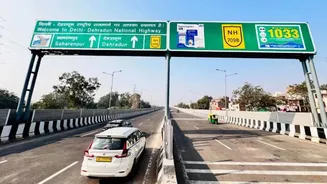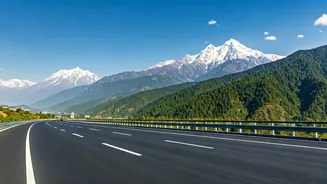





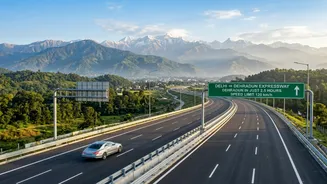
One of the most special features of the Delhi-Dehradun Expressway, to be inaugurated by Prime Minister Narendra Modi on Tuesday, is the wildlife corridor on the elevated section of the corridor in Saharanpur.
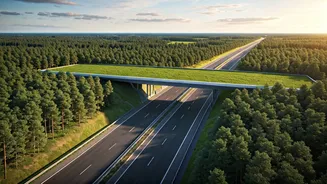
Built across ecologically sensitive forest stretches, this 12-km elevated section allows animals to move freely
beneath the highway, ensuring that rapid development does not come at the cost of biodiversity.More importantly, the corridor directly addresses a long-standing challenge in the Shivalik belt — human-wildlife conflict. By creating dedicated underpasses and uninterrupted movement paths, the project reduces the risk of accidents, habitat fragmentation, and animal deaths, making the expressway safer for both wildlife and commuters.
Why This Corridor Matters
The final stretch of the expressway cuts through dense forest regions, including parts of the Shivalik Forest Division and areas linked to the Rajaji landscape —home to elephants, deer, leopards, and several endangered species.
Traditionally, highways in such zones have disrupted natural migration routes, often leading to fatal encounters.
This is where the elevated design becomes crucial. Instead of forcing animals to cross busy roads, the highway has effectively been lifted above the forest floor. The result is continuity of habitat; a rare but critical intervention in infrastructure planning.
Officials have emphasised that this is not just about conservation optics. It is about preserving ecological balance in a region where animal movement is essential for survival, breeding, and access to food and water.
What Makes It Unique
At 12 kilometres, the elevated wildlife corridor is among the longest in Asia. But its importance lies not just in its length, but in the layered design approach.
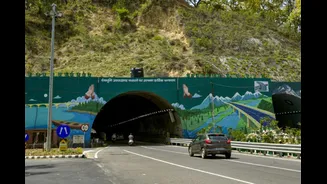
It includes eight dedicated animal passes, two large elephant underpasses measuring 200 metres each, and even a 370-metre tunnel near Maa Daat Kali Temple. These features ensure that animals of all sizes, from small mammals to elephants, can navigate the terrain safely.
During construction, special measures such as sound and light barriers were installed to minimise disturbance. This attention to detail reflects a shift from reactive conservation to proactive planning.
How It Works On Ground
The effectiveness of the corridor is not theoretical, it has already been tested and documented. A joint study by National Highways Authority of India and Wildlife Institute of India tracked animal movement across the stretch using 150 camera traps and 29 acoustic recorders over 40 days.
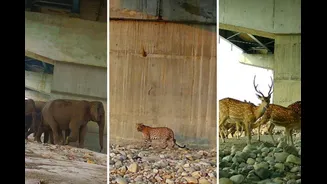
The findings were striking. Over 1.11 lakh images were recorded, of which more than 40,000 captured 18 different wild species actively using the underpasses.
NHAI and @wii_india Study Highlights Effectiveness of Wildlife Mitigation Measures on Delhi–Dehradun Economic Corridor!
The extensive WII report documents the first evidence of wildlife using animal underpasses on the Delhi – Dehradun Economic Corridor. Conducted along the… pic.twitter.com/mZLHaXCHo4
— NHAI (@NHAI_Official) April 10, 2026
From golden jackals and nilgai to sambar and spotted deer, a wide range of animals were seen adapting to the new structures. Even more significant was the movement of elephants — recorded 60 times — showing that even the largest mammals are comfortably using the corridor.
Can It Reduce Animal Deaths?
This is perhaps the most critical question, and the answer appears to be yes.
In forested stretches near Haridwar and Dehradun, animals frequently cross large distances. Without safe passages, highways become deadly barriers. The elevated corridor, combined with underpasses, eliminates this risk by separating traffic from wildlife movement.
It also reduces the chances of sudden animal crossings, which are a major cause of accidents in such regions.
In that sense, the corridor is as much a safety feature for humans as it is for animals.
A Model For Future Highways
What sets this project apart is its broader implication. The Delhi-Dehradun Expressway shows that infrastructure and ecology do not have to be at odds. With the right planning, data, and intent, both can coexist.
The ‘Landscapes Reconnected’ study reinforces this idea, demonstrating that wildlife mitigation measures are not just symbolic, they are effective. The project also highlights the importance of data-driven design, where monitoring and adaptation continue even after construction.
As India expands its highway network, especially through forested regions, this corridor could well become the blueprint, proving that development need not come at the cost of nature.