






Rich countries are not on track to meet their 2030 and 2035 climate commitments, warned a new report as international negotiators began discussions at the crucial mid-year UN climate talks in Bonn, Germany.
The ten-day-long climate meeting, formally called the 64th Sessions of the Subsidiary Bodies (SB64) under the UNFCCC, is where the agenda takes shape for the UN Climate COP in November each year. Delegates from various countries will discuss a range of issues from mitigation to adaptation, finance to technology, to agree on draft decisions for adoption at COP31 in Antalya, Türkiye in November. According to the study independently conducted by New Delhi-based Council on Energy, Environment and Water (CEEW), three major climate negotiating blocs – the Umbrella Group including Australia, Canada, Japan, the United States (US) and the United Kingdom (UK), the European Union (EU), and the Environmental Integrity Group (EIG) including Switzerland and the Republic of Korea – are collectively projected to fall short of both their 2030 and 2035 climate targets. These groups are projected to emit 9% more than their 2030 Nationally Determined Contribution (NDC) targets, with this projected to increase to 19% in 2035 compared to their 2035 target levels. The findings come at a time when international climate cooperation is under pressure from geopolitical instability, with climate experts in the Global South urging that the next phase of climate diplomacy must focus on accountability – who is acting, and who is falling behind. “Ten years after Paris, the world cannot keep measuring climate leadership by announcements alone. South Asia and the wider Global South are showing that development and climate action can move together, but this requires fairness in how ambition is judged and support is delivered. Wealthy economies must move faster to meet their own targets and to keep enough carbon space for countries still addressing basic development needs,” remarked Ravi S. Prasad, Distinguished Fellow, CEEW, and former Chief Climate Change Negotiator for India. According to the report, the EU would need to reduce emissions by 4.8% annually after 2022, nearly four times its earlier pace, while the United Kingdom would need to more than double its annual emissions reduction rate to 5.4% after 2022. The United States and Canada would need to increase their annual emissions reduction rates by 5% and 6%, respectively, after 2022.
BASIC Group Showed Stronger Climate Action
On the other hand, most of the countries in the BASIC group, including Brazil, South Africa, India and China, showed stronger alignment to their 2030 commitments, despite lower historical responsibility and greater developmental constraints, as per the report.
India has met its 50% non-fossil installed capacity target ahead of schedule and is progressing on its emissions intensity and carbon sink goals, achieving a ~37 per cent reduction in GDP emissions intensity and creating ~2.4 billion tCO₂e of additional carbon sink. China has met its wind and solar capacity target and forest stock volume target ahead of 2030. It has reduced energy-related CO₂ emissions per unit of GDP by ~51 per cent relative to 2005 levels. South Africa’s 2022 emissions, at ~394 MtCO₂e, were already within its 2030 target range.
“The first transparency cycle under the Paris Agreement gives countries a clearer mirror of implementation. Countries that are off track must strengthen near-term action before 2030, improve the credibility of their 2035 targets, and avoid shifting the burden of emissions cuts to the future,” said co-author of the study, Sumit Prasad, Senior Programme Lead, CEEW. The analysis is based on countries’ own submissions to the UNFCCC, including Biennial Transparency Reports, Common Tabular Format datasets, and Common Reporting Tables.
Ten-day-long climate talks begin at Bonn
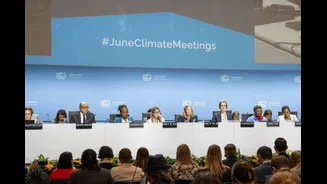
The UN Climate June meetings began on Monday at the World Conference Center Bonn (WCCB) in Bonn, Germany, where UN Climate Change (UNFCCC) is headquartered. The meetings are held over 10 days, ending this year on 18 June, and are expected to have over 7,000 participants, including negotiators from countries, which are Parties to the Paris Agreement, observers from civil society, as well as economy and sectoral leaders.
Speaking on the opening day, UN Climate Change Executive Secretary, Simon Stiell urged negotiators to ensure a stronger outcome. “As deadly heat kills thousands in a single day. As El Niño impacts – supercharged by the climate crisis – promise further pain and inflationary shocks. It’s crystal clear: continuing our fossil fuel dependency means continuing to import inflation and economic instability.”