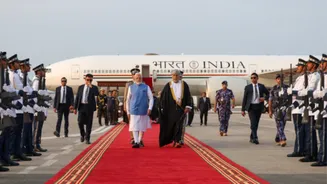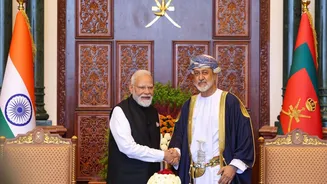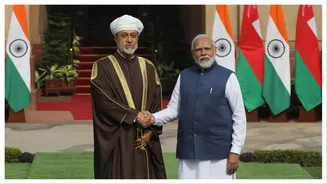









The Comprehensive Economic Partnership Agreement (CEPA) between India and Oman came into force on June 1, marking the fifth free trade pact implemented by India since 2014, following similar agreements
with Mauritius, the UAE, Australia and the European Free Trade Association (EFTA).
It is a major milestone in bilateral economic relations and strengthening India’s strategic trade footprint in the Gulf region. It also comes at a time when New Delhi is accelerating trade negotiations with key partners including the Gulf Cooperation Council (GCC), European Union and several developed economies.
The India-Oman CEPA is expected to provide a significant boost to exports, services trade, investment flows and professional mobility while opening new opportunities for Indian businesses across sectors ranging from engineering goods and pharmaceuticals to textiles and agriculture.
What Is a CEPA?
A Comprehensive Economic Partnership Agreement (CEPA) is a broad-based trade agreement that goes beyond the traditional scope of a Free Trade Agreement (FTA).
While an FTA primarily focuses on reducing or eliminating tariffs on traded goods, a CEPA covers a much wider range of economic activities including trade in goods and services, investment, intellectual property rights, customs cooperation, dispute settlement, professional mobility and regulatory collaboration.
Modern trade agreements generally contain around 20 chapters dealing with these areas to create a comprehensive framework for economic cooperation.
Similar agreements may also be known as Comprehensive Economic Cooperation Agreements (CECA), Comprehensive Economic Trade Agreements (CETA) or Economic Cooperation and Trade Agreements (ECTA), depending on the terminology adopted by participating countries.
How Is CEPA Different From an FTA?
The key difference lies in the scope of coverage. An FTA primarily deals with lowering tariffs on goods traded between countries. A CEPA, on the other hand, includes services, investments, movement of professionals, regulatory standards, government procurement and intellectual property protection.
For example, the India-Oman CEPA contains commitments related to services sectors such as information technology, engineering, healthcare, accounting, education and consulting services, making it far more comprehensive than a traditional tariff-reduction agreement.
India-Oman Bilateral Trade Growing Rapidly
Economic ties between India and Oman have strengthened steadily in recent years. Bilateral trade reached $11.18 billion during 2025-26, compared with $10.61 billion in 2024-25. India’s exports to Oman stood at $4.02 billion, while imports were valued at $7.16 billion.
Services trade has also expanded significantly. India’s services exports to Oman increased from $397 million in 2020 to $665 million in 2024, led by telecommunications, computer and information services, transport and travel.
Major Gains for Indian Exporters
One of the biggest outcomes of the agreement is that Oman will provide 100 per cent duty-free market access to Indian exports across 98.08 per cent of its tariff lines, covering 99.38 per cent of India’s export value.
These benefits will be available from the first day of implementation.
Currently, only around 15 per cent of India’s exports enter Oman duty-free under the Most Favoured Nation (MFN) regime. The agreement removes the existing 5 per cent import duty on Indian goods worth approximately $3.64 billion, improving their competitiveness in the Omani market.
Key sectors expected to benefit include textiles, engineering goods, agricultural products, marine products, processed food, gems and jewellery, chemicals, machinery, plastics, rubber products and automobiles.
The elimination of tariffs is expected to make Indian vehicles more competitive in Oman while also securing permanent zero-duty access for important medicines and vaccines.
Opportunities for India’s Services Sector
The services chapter is among the most significant components of the agreement. Oman’s global services imports stood at $12.52 billion in 2024, while India’s share was only about 5.3 per cent, indicating substantial growth potential.
The agreement provides stronger market access across 127 services sub-sectors and includes commitments covering professional services, IT services, education, healthcare, tourism and research-related activities.
Importantly, Oman has increased the ceiling for Intra-Corporate Transferees (ICTs) from 20 per cent to 50 per cent, allowing Indian companies to deploy more managerial and specialist employees.
For the first time in any trade agreement, Oman has also provided specific commitments for professionals in accounting, engineering, medical services, information technology, education, construction and consulting sectors.
Benefits for Agriculture and Food Exports
Indian agricultural exports such as natural honey, potatoes, cashews, boneless meat, bakery products and processed foods will receive immediate duty-free access to the Omani market.
Oman has agreed to eliminate tariffs ranging from 5 per cent to as high as 100 per cent on several food and agricultural products including dairy products, processed foods, chocolates, confectionery items and frozen fish.
The agreement is expected to create export opportunities for farmers and food-processing industries in states such as Uttar Pradesh, Punjab, Haryana, Gujarat, Maharashtra, Andhra Pradesh and Telangana.
India Protects Sensitive Sectors
While opening its market to Oman, India has adopted a calibrated approach to safeguard domestic industries and farmers. A total of 2,789 tariff lines have been placed on India’s exclusion list, meaning no tariff concessions will be offered on those products.
Protected sectors include transport equipment, key chemical products, cereals, fruits, vegetables, spices, coffee, tea and animal-origin products.
Strategic agricultural segments such as dairy, meat, edible oils, oilseeds and sugar also remain protected from liberalisation.
Strategic Importance Beyond Trade
The agreement carries significance beyond economic gains. Oman occupies a strategically important position near the Strait of Hormuz, one of the world’s most critical maritime routes through which a large portion of global oil trade passes.
The country is increasingly viewed as a gateway for Indian goods and services to wider Middle Eastern and African markets.
Nearly seven lakh Indians currently reside in Oman and send home around $2 billion annually in remittances. More than 6,000 Indian companies operate in the country, highlighting the depth of bilateral economic engagement.
The CEPA also strengthens India’s growing trade integration with the Gulf region following the India-UAE trade agreement and ahead of planned negotiations with Qatar and the broader GCC bloc.
For India, the Oman CEPA is not merely a trade agreement but a strategic platform to deepen economic integration, boost exports, support employment generation and strengthen its long-term presence in one of the world’s most important commercial and energy corridors.