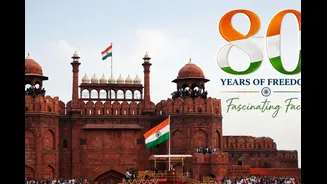



Indian Independence Day Facts: India celebrates Independence Day every year on August 15 to commemorate its freedom from British colonial rule in 1947. In 2026, August 15 will mark the country’s 80th Independence Day celebration.
The transition to independence followed decades of political mobilisation, mass movements, revolutionary activity, negotiations and sacrifices by people across the subcontinent.
Jawaharlal Nehru’s midnight address to the Constituent Assembly on the eve of independence became one of the defining speeches of the moment, while the national flag, the Red Fort and August 15 gradually became central symbols of the celebration.
Read More: Is Independence Day 2026 India’s 79th Or 80th? History And Facts Explained
Here are 80 facts about Indian Independence Day, the freedom struggle and the traditions associated with August 15.
Indian Independence Day: Basic Facts
1. India celebrates Independence Day every year on August 15.
2. India became independent from British rule on August 15, 1947.
3. August 15, 1947, was designated as the “appointed day” in the Indian Independence Act, 1947.
4. The Indian Independence Act provided for two independent Dominions, India and Pakistan.
5. The Act received Royal Assent on July 18, 1947, less than a month before independence.
Read More: Independence Day 2026: 10 Har Ghar Tiranga Rules You Must Know
6. Independence came after a prolonged anti-colonial struggle involving political organisations, mass movements, revolutionary groups and individuals from many regions and communities.
7. India became a Dominion in 1947 rather than immediately becoming a republic.
8. India became a republic on January 26, 1950, when the Constitution came into force.
9. The Constitution had been adopted earlier, on November 26, 1949, by the Constituent Assembly.
10. Independence Day and Republic Day therefore commemorate two different milestones: independence from British rule and the commencement of the Constitution as the supreme law of the Republic.
Facts About August 15, 1947
11. Jawaharlal Nehru became independent India’s first Prime Minister.
12. Pandit Nehru delivered his famous “Tryst with Destiny” speech in the Constituent Assembly during the midnight session of August 14–15, 1947.
13. The speech described the moment as the point when India would “awake to life and freedom.”
14. The midnight sitting of the Constituent Assembly marked the formal transfer of power at the national level.
15. Pandit Nehru also delivered a broadcast to the nation on August 15, 1947, as India’s first Prime Minister.
Read More: Independence Day 2026: How To Upload Har Ghar Tiranga Selfie And Get Certificate
16. In that broadcast, Pandit Nehru described Indians as a free and sovereign people.
17. The first years of independence were accompanied by enormous challenges, including Partition and the displacement and suffering it caused.
18. The end of British rule did not mean that all of India’s political and administrative challenges ended immediately.
19. The integration of princely states became one of the major tasks facing the new Indian Union.
20. India’s independence was therefore both an ending, the end of British colonial rule, and the beginning of a new political project.
Facts About the Freedom Struggle
21. The Revolt of 1857 was one of the major early challenges to British rule in India.
22. The 1857 uprising involved soldiers as well as civilians and rulers in several parts of northern and central India.
23. The uprising of 1857 is also commonly referred to as the First War of Independence, although historians use different terms and interpretations for the event.
24. After the 1857 uprising, the British Crown assumed direct control over India from the East India Company.
25. The Indian National Congress was founded in 1885.
Read More: Independence Day 2026 Speech Ideas: Short Speeches, Topics And Tips For Students
26. Dadabhai Naoroji was among the important early leaders of the Indian nationalist movement.
27. The Swadeshi movement became particularly prominent following the partition of Bengal in 1905.
28. The Swadeshi movement encouraged the use of indigenous goods and opposition to imported British goods.
29. The Indian freedom movement included both constitutional politics and more radical revolutionary traditions.
30. Women played important roles in the freedom movement, from mass civil resistance to underground revolutionary activity. Government historical records document the participation of women in movements including Civil Disobedience and Swadeshi campaigns.
Mahatma Gandhi and Mass Movements
31. Mahatma Gandhi returned to India from South Africa in 1915.
32. Gandhi’s political approach emphasised mass mobilisation, non-violence and civil resistance.
33. The Non-Cooperation Movement was launched in the early 1920s.
34. The movement encouraged Indians to withdraw cooperation from colonial institutions and goods.
35. Gandhi launched the Civil Disobedience Movement in 1930.
Read More: 10 Lines On Independence Day For Students: Simple Speech Ideas In English
36. The Salt March of 1930 became one of the most internationally recognised episodes of the freedom struggle.
37. Gandhi began the Salt March from Sabarmati Ashram and marched to Dandi in Gujarat.
38. The Salt March challenged the British monopoly and taxation of salt.
39. The Civil Disobedience Movement encouraged people to openly violate selected colonial laws as a form of non-violent resistance.
40. The Quit India Movement was launched in August 1942 during the Second World War.
41. Gandhi gave the famous “Do or Die” call during the Quit India movement.
42. The Quit India resolution was adopted at the All India Congress Committee meeting in Bombay on August 8, 1942.
43. British authorities arrested much of the Congress leadership soon after the movement was launched.
44. The Quit India Movement became one of the major mass challenges to British rule during the final phase of the freedom struggle.
45. The movement took place five years before India became independent in 1947.
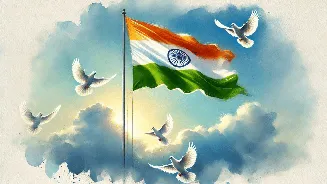
Netaji, INA and Other Strands of the Struggle
46. Subhas Chandra Bose was one of the prominent leaders associated with the Indian National Army, or INA.
47. The INA sought to fight British rule with military force during the Second World War.
48. The INA trials held after the war generated considerable public attention and nationalist sentiment in India.
49. The Royal Indian Navy mutiny of February 1946 was another major event in the final years of British rule.
50. The 1946 naval revolt began in Bombay and spread to ships and shore establishments in other locations.
Read More: 10 Best Independence Day Decoration Ideas For Schools And Offices
51. Government historical records say that more than 60 ships and shore establishments and about 10,000 sailors participated in the revolt.
52. The revolt demonstrated growing unrest among sections of the armed forces during the final phase of British rule.
53. India’s independence therefore resulted from a complex combination of political negotiations, mass movements, revolutionary activity, wartime developments and changing attitudes within the colonial system.
54. The freedom movement was not limited to a single organisation or individual.
55. People from different regions, backgrounds and political traditions contributed to India’s struggle for independence.
Facts About the Indian National Flag
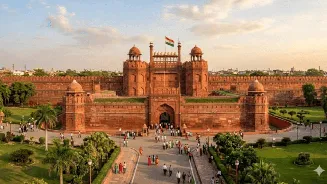
56. India’s National Flag in its present form was adopted by the Constituent Assembly on July 22, 1947.
57. The flag was adopted just weeks before independence.
58. The national flag is a horizontal tricolour of deep saffron, white and dark green.
59. The three bands of the flag are of equal width.
60. The flag has a navy-blue Ashoka Chakra at the centre of the white band.
Read More: Independence Day Drawing Ideas: 10 Creative Tricolour Art Designs For Students
61. The Ashoka Chakra has 24 spokes.
62. The Chakra is based on the wheel depicted on the abacus of the Lion Capital of Ashoka at Sarnath.
63. The official flag has a width-to-length ratio of 2:3.
64. Pingali Venkayya is widely recognised by the Government of India as the designer whose work formed the basis of the national Tricolour.
65. Venkayya presented a flag design to Gandhi at the 1921 Congress meeting in Vijayawada.
66. Before the present flag was adopted, different designs and variations were used during the freedom movement.
67. Bhikaji Cama became the first person to hoist an Indian flag on foreign soil, at Stuttgart, Germany, in 1907, according to the Ministry of Culture’s historical record.
68. The Flag Code of India was modified in 2002, allowing citizens to display the national flag on their premises on all days and occasions, subject to the code’s provisions.
69. The Tricolour is a symbol of India’s national pride and sovereignty.
70. The flag used by the Dominion of India from August 15, 1947, was the same national flag adopted by the Constituent Assembly and continued as the flag of the Republic after January 26, 1950.
Red Fort and Independence Day Traditions
71. The Red Fort in Delhi became closely associated with India’s Independence Day celebrations.
72. The Prime Minister traditionally unfurls the national flag from the Red Fort on August 15 and addresses the nation. The Government of India’s records describe the ceremony as a defining feature of Independence Day.
73. Jawaharlal Nehru was the first Prime Minister to unfurl the national flag from the Red Fort in the Independence Day tradition.
74. The Red Fort ceremony has been held annually as a major national Independence Day event.
75. The Prime Minister’s Independence Day address traditionally looks at India’s achievements as well as its challenges and future priorities.
76. The ceremony includes a ceremonial guard and national salute.
77. A 21-gun salute accompanies the flag-unfurling ceremony at the Red Fort. Government records of the ceremony describe the unfurling as synchronised with the 21-gun salute.
78. The Prime Minister’s Independence Day speech is one of the most closely watched national addresses of the year.
79. Independence Day celebrations take place across India, with flag-hoisting ceremonies, cultural programmes and public events at institutions and communities.
80. August 15 ultimately represents more than the date British rule ended: it commemorates the sacrifices and struggles that led to freedom and the continuing responsibility of building and preserving a democratic India.
Why August 15 Remains Significant
India’s Independence Day has evolved from a commemoration of the transfer of power into a wider national occasion. The day recalls the freedom struggle, honours those who contributed to it and provides an opportunity to reflect on India’s journey since 1947.
The official National Portal describes August 15 as the beginning of a new era following the end of more than two centuries of British colonial rule.
For generations of Indians, the Tricolour, the national anthem, the Red Fort ceremony and the words spoken by the country’s first Prime Minister at midnight in 1947 have become enduring symbols of that historic transition.