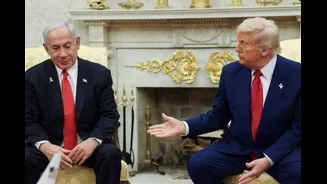



Israeli Prime Minister Benjamin Netanyahu’s rejection of US President Donald Trump’s 15-point Gaza roadmap has put a fresh question mark over efforts to move from the current ceasefire framework towards
Hamas’s disarmament, an Israeli military withdrawal and a new governing arrangement for Gaza.
Trump had announced a breakthrough late last month, saying Hamas and other armed groups had accepted a phased plan under which they would surrender their weapons to a new Palestinian governing body while Israeli forces began withdrawing as disarmament progressed.
Netanyahu has now rejected that sequencing.
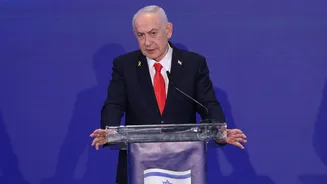
“Israel rejects the 15-point document,” he told a cabinet meeting on Sunday. The Israeli military, he said, “will not carry out any withdrawal until Hamas is genuinely disarmed and will continue to thwart threats against our forces and our citizens”.
The disagreement matters because disarmament and withdrawal are linked to several other parts of Washington’s plans for Gaza — from the deployment of an international security force and a new Palestinian administration to reconstruction and the territory’s longer-term political future.
What Is Trump’s 15-Point Plan For Gaza?
On July 30, the US-led Board of Peace proposed a 15-point roadmap setting out a phased and conditional framework for the disarmament and reconstruction of Gaza.
It provides for Hamas to disarm in exchange for a full Israeli military withdrawal, with governance transferred to an independent Palestinian National Committee supported by an international security force.
Trump said Hamas and other armed groups had accepted a phased process under which they would surrender their weapons, with Israeli forces withdrawing as disarmament advanced. But the sequencing has already become contentious.
Why Did Netanyahu Reject The Roadmap?
Netanyahu is demanding complete Hamas disarmament before Israeli troops make any withdrawal. “When I say Hamas must be disarmed, I mean heavy weapons, lighter weapons, all weapons. We are talking about genuine disarmament, not a fictitious one,” he said.
The prime minister nevertheless said Israel remained engaged with Washington over its concerns. “They have ideas; some of them are acceptable to us, and some are not, and we know how to stand our ground on these matters,” Netanyahu said.
His position puts Israel at odds with the earlier proposal for a phased withdrawal tied to progress on demilitarisation.
Hamas Has Conditions Of Its Own
Hamas has also attached conditions to disarmament. The group has said it is willing to discuss giving up its weapons, but only as part of a process that includes a complete Israeli withdrawal and an end to hostilities.
A member of its negotiating delegation told Al Jazeera last month that implementation would depend on Israel fulfilling its commitments.
NBC News reported that Hamas sees the surrender of heavy weapons as a later stage of the process and has also linked it to the establishment of a Palestinian state.
That puts the two sides at odds over what comes first: Netanyahu wants Hamas fully disarmed before Israeli troops leave, while Hamas wants withdrawal and other commitments to form part of the process leading to disarmament.
What Else Could Netanyahu’s Rejection Affect?
The dispute is not limited to when Israeli troops leave Gaza. Trump’s wider plan also sets out who would govern the enclave, who would provide security and how control would gradually shift away from the Israeli military.
Under the proposal, Hamas and other armed groups would have no role in governing Gaza. A temporary Palestinian committee made up of technocrats would instead handle day-to-day administration, under the oversight of the Board of Peace.
The plan also provides for an International Stabilization Force to deploy in Gaza, support Palestinian police and help secure the borders.
As that force takes control and Hamas is demilitarised, Israeli troops are supposed to gradually hand over the territory they occupy and eventually withdraw, while retaining a security perimeter until Gaza is considered secure.
The proposal also states that Israel would neither occupy nor annex Gaza.
What About Hostages, Prisoners And Aid?
Trump’s wider Gaza proposal also links the security arrangements to measures concerning hostages, Palestinian prisoners and humanitarian assistance.
It provides for the return of all Israeli hostages, alive and dead, and the release of Palestinian prisoners and detainees by Israel.
The framework also calls for full humanitarian aid to enter Gaza upon acceptance of the agreement, including assistance for water, electricity and sewage infrastructure, hospitals, bakeries, rubble removal and reopening roads.
Aid distribution is envisaged through the United Nations and its agencies, the Red Crescent and other international institutions, while the Rafah crossing would operate under an agreed mechanism.
If Hamas delays or rejects the proposal, the framework says measures including expanded aid would proceed in areas handed over by the Israeli military to the International Stabilization Force.
Reconstruction And Gaza’s Future Are Also Part Of The Plan
The proposal goes beyond ending hostilities.
It envisages a separate economic development plan for rebuilding Gaza, including a special economic zone and international investment intended to generate jobs and economic activity. It also states that Palestinians would not be forced to leave Gaza and that those who chose to leave would be allowed to return.
But the longer-term political question remains contentious.
The wider Trump framework says that as Gaza’s redevelopment progresses and the Palestinian Authority completes reforms, conditions could emerge for a “credible pathway” towards Palestinian self-determination and statehood.
Netanyahu has rejected that possibility. “As long as I am Prime Minister, there will be no Palestinian State,” he said on Sunday.
The Election Factor Behind Netanyahu’s Gaza Stand
The rejection comes just over two months before Israel votes on October 27. Al Jazeera reported that successive polls indicate Netanyahu is on course to lose, as he faces pressure from his right-wing base.
Taking a harder line on Gaza allows him to reassure voters on the right that he will not accept a deal that, in his view, leaves Hamas insufficiently disarmed or opens the door to a Palestinian state.
Al Jazeera’s Nour Odeh said discussions around the 15-point plan, including Hamas’s disarmament and Israel’s potential withdrawal, “are extremely controversial for the [Netanyahu-led] right-wing government”.
“It seems that Netanyahu, so close to elections, has hit the reset button, saying that none of that will happen under his watch,” she said.
Odeh added that this was “extremely problematic for the Board of Peace and the mediators who have been working for months now to try to find a way to carry out the disarmament of Hamas and have Israel commit to a phased withdrawal from Gaza”.
Former Israeli diplomat Alon Pinkas also argued that Netanyahu’s move should be seen through the election lens. “This Israeli rejection of the Gaza plan … should be viewed entirely in the context of the upcoming Israeli election on October 27,” Pinkas told Al Jazeera.
He said Netanyahu had made a “calculation that this is risk free”, believing “that he can supposedly defy Trump because Trump doesn’t care enough, because of the sequence, because Hamas hasn’t disarmed yet, because he can get away with it”.
“And this is all about the forever war and the election,” Pinkas said.