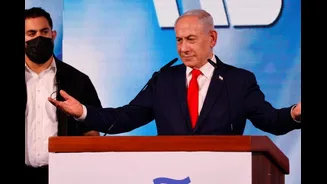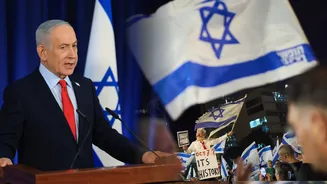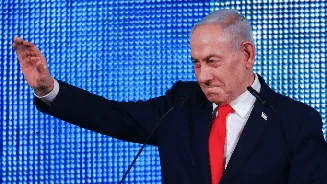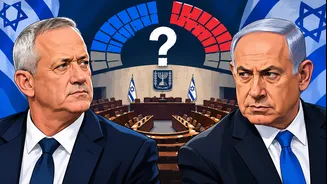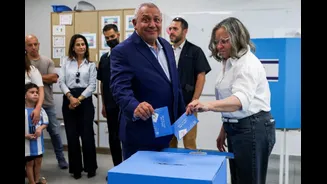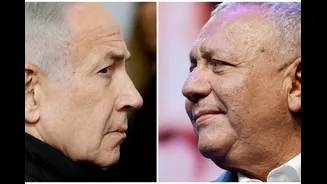





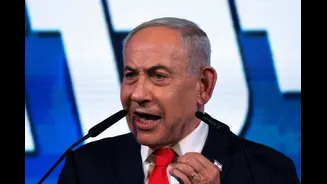
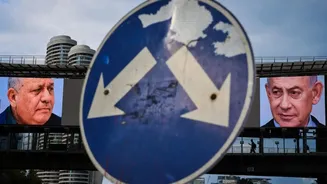
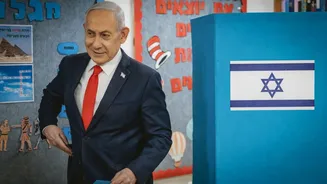
With all votes counted in Israel’s closely contested parliamentary elections, Prime Minister Benjamin Netanyahu has emerged with the largest party in the Knesset, but not the numbers needed to secure another
term in office. The results have instead set the stage for a complicated round of coalition negotiations, with Arab parties emerging as potential kingmakers and opposition leader Gadi Eisenkot facing some difficult political choices.
The final results give Netanyahu’s Likud 27 seats in the 120-member Knesset, followed by Eisenkot’s Yashar with 21. Naftali Bennett’s B’Yachad secured 12 seats, while the Joint List won 11. The Democrats and Ra’am secured eight seats each, followed by Yisrael Beytenu with seven.
Click here for LIVE updates on Israel election results and government formation
Netanyahu’s right-wing bloc has been reduced to 53 seats, while the four-party opposition grouping led by Eisenkot has 48. The two Arab-led parties, the Joint List and Mansour Abbas’ Ra’am, together hold 19 seats.
With 61 seats required for a parliamentary majority, neither camp can form a government independently. The outcome is a significant setback for Netanyahu’s coalition, which controlled 68 seats in the outgoing Knesset.
The question now is whether Israel will see an Eisenkot-led government backed by Arab parties, a broad national unity arrangement involving Netanyahu, or another election.
Can Eisenkot Bring Ra’am Into His Coalition?
One of the most closely watched possibilities is an alternative government led by Eisenkot with the support of Arab political parties. A survey released by the Hebrew University’s Accord Center on Tuesday evening, while voting was underway, offers some indication of how supporters of the opposition parties view this possibility.
According to The Jerusalem Post, 61 per cent of voters supporting the four main opposition-aligned parties – Eisenkot’s Yashar, Bennett’s B’Yachad, Yair Golan’s Democrats and Avigdor Liberman’s Yisrael Beytenu – favoured bringing Mansour Abbas’ Ra’am into a potential coalition government led by Eisenkot.
The proposal received the highest support among the coalition arrangements presented to respondents. Meanwhile, 20 per cent preferred fresh elections, 12 per cent backed a rotation government with Netanyahu, and just 7 per cent favoured an alliance with ultra-Orthodox parties.
The survey suggests that a section of the opposition electorate may be willing to accept cooperation with an Arab party if it means ending Netanyahu’s premiership.
The parliamentary arithmetic also makes the proposition attractive. The opposition’s 48 seats, combined with Ra’am’s eight and the Joint List’s 11, would give an Eisenkot-led grouping 67 seats, comfortably above the majority mark.
However, the numbers do not automatically translate into a workable coalition.
Eisenkot had previously ruled out forming a government with Arab-led parties, maintaining that any administration he leads must be based on Zionist parties. Bennett has also rejected such an arrangement, despite having relied on Ra’am’s support when he formed a government with Yair Lapid in 2021. Liberman, meanwhile, has insisted on a coalition comprising Zionist parties.
Yair Golan, leader of the Democrats, has been the most vocal supporter of cooperation with Arab political factions.
Golan has already met Abbas to discuss the possibilities of forming an alternative government. His outreach suggests that at least one section of the opposition is prepared to explore a political arrangement that was previously considered difficult to sell to Israeli voters.
Ra’am And Joint List Could Support Government From Outside
Another possibility is an Eisenkot-led minority government that does not formally include Arab parties but depends on their parliamentary support from outside the coalition. This arrangement could offer a political compromise to opposition leaders unwilling to reverse their campaign positions on including Arab parties in the government.
The Joint List has indicated its willingness to engage in political cooperation to remove Netanyahu from power, although it has not publicly spelt out the conditions under which it would support an Eisenkot-led administration.
Ra’am’s Abbas, however, appears less optimistic about the prospects of such an arrangement.
According to Channel 12 News, Abbas told party members that the establishment of an Eisenkot-led minority government relying on outside Arab support was unlikely or even impossible.
This complicates the opposition’s calculations further. Even if the parties agree on the objective of replacing Netanyahu, they may not necessarily agree on the terms of cooperation or the concessions required.
Could Netanyahu And Eisenkot Form Unity Government?
With both political camps struggling to reach 61 seats, a broad national unity government is another possibility being discussed. Such an arrangement could theoretically bring Likud together with Eisenkot’s Yashar, Bennett’s B’Yachad and Liberman’s Yisrael Beytenu. The combination would command 67 seats, even without the Arab parties.
There have also been calls from political and civic figures for Netanyahu and Eisenkot to consider working together rather than pushing Israel towards another election.
The Jerusalem Post reported that Modi’in Mayor Haim Bibas had called for a broad national unity government led by the two leaders, warning against another round of elections. Former defence minister Yoav Gallant has also advocated a Zionist unity government, cautioning against dependence on Arab parties.
However, the political obstacles are substantial. Eisenkot, Bennett, Liberman and Golan all campaigned on removing Netanyahu from office. Eisenkot has explicitly ruled out sitting under Netanyahu, even in a rotational premiership arrangement.
For Netanyahu, too, such a government would mean making concessions to politicians who have repeatedly criticised his leadership and handling of the country’s political and security challenges.
A unity arrangement may therefore be mathematically possible but politically difficult.
Could Ultra-Orthodox Parties Become The Deciding Factor?
The ultra-Orthodox parties Shas and United Torah Judaism have also emerged as important players in the coalition calculations.
Together, they hold 13 seats. In theory, an arrangement involving these parties could help the opposition move closer to a majority without depending on Arab factions. But this would require Eisenkot and his allies to reconsider one of their most prominent campaign promises: ending exemptions from compulsory military service for ultra-Orthodox men.
The issue has been a major source of friction in Israeli politics, with the opposition demanding greater participation by the Haredi community in military and national service.
The ultra-Orthodox parties, on the other hand, have consistently defended existing exemptions.
A coalition arrangement with them would therefore risk reopening a dispute that has contributed to the collapse of previous political partnerships.
Netanyahu’s Plan B And The Possibility Of Fresh Elections
Netanyahu, meanwhile, is not without options, although his path to a majority is equally complicated. His bloc is eight seats short of the 61-seat threshold. Bringing Ra’am into the coalition could theoretically improve his numbers, but Netanyahu has repeatedly rejected cooperation with Arab-led parties.
His far-right allies, particularly Itamar Ben-Gvir’s Otzma Yehudit and Bezalel Smotrich’s Religious Zionism, have also made clear their opposition to such an arrangement.
A unity government with Eisenkot could offer another route, but it would require the prime minister to make significant political compromises.
If neither camp manages to put together a viable coalition, Israel could eventually be headed for another election. However, this would mean prolonging the political uncertainty after a campaign that already witnessed one of the highest voter turnouts in decades.
According to the final figures, turnout stood at 77.9 per cent, with more than 5.7 million votes cast.
The formal government-formation process will begin after the Central Elections Committee submits the certified results to President Isaac Herzog. Herzog is expected to consult representatives of the elected parties before assigning a candidate the task of forming the next government. The designated candidate initially gets 28 days, with a possible 14-day extension.
The Knesset is scheduled to be sworn in on November 10, even as coalition negotiations continue.
For now, the election has produced an unusual political situation where Netanyahu has won the largest share of seats for his party, but his bloc has lost its parliamentary advantage. Eisenkot has emerged as the principal alternative, but cannot reach power without either securing Arab-party support or persuading political rivals to abandon their campaign commitments.
The 19 seats held by Ra’am and the Joint List have consequently become central to Israel’s political future. Whether those parties become formal coalition partners, support a government from outside or remain on the sidelines could determine not just who becomes prime minister, but whether Israel can avoid yet another election.