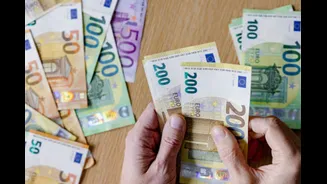










Bulgaria on Thursday officially adopted the euro, bringing an end to the lev, its national currency for nearly 140 years. With the switch, Bulgaria became the 21st member of the eurozone, taking a decisive
step closer to the European Union’s economic core.
The move marks more than just a change of banknotes. It reflects years of economic preparation, political alignment and public debate about what deeper integration with Europe really means.
Bulgaria’s transition has also renewed attention on the eurozone— what it is, why Bulgaria chose to join it, and what changes for ordinary citizens after the adoption of the euro. Here’s a closer look at the answers.
What Is the Eurozone And How Do EU Countries Join?
The eurozone is a group of European Union (EU) countries that have adopted the euro (€) as their common currency. Instead of managing their own money systems independently, these countries share a unified monetary framework overseen by the European Central Bank (ECB).
This means interest rates, inflation control, and monetary policy decisions are made collectively, not nationally. For citizens and businesses, this often translates into easier travel, smoother cross-border trade, and fewer currency-related uncertainties within Europe.
Under the 1992 Maastricht Treaty, EU member states must meet five criteria before they can join the eurozone. These set fixed targets for inflation, budget deficit, debt-to-GDP (gross domestic product) ratio, exchange rate stability and long-term interest rates. Monetary policy is centrally controlled by the ECB.
Why Bulgaria Chose The Euro?
Bulgaria joined the European Union in 2007, a move that also put it on the path to adopting the euro. While the switch was never meant to be immediate, using the common currency has long been seen as the final step towards full integration with the EU. Since then, the Southeast European country has steadily worked towards joining the eurozone.
That journey, however, has been far from smooth. Years of political instability and repeated allegations of corruption slowed down key reforms needed to qualify for eurozone membership, delaying Bulgaria’s ambitions.
Eurozone entry comes with strict conditions. Bulgaria had to demonstrate low inflation, manageable public debt, and fiscal discipline. Crucially, the lev had already been pegged to the euro for years, meaning its value was stable and predictable. Once inflation and budget targets were aligned, the technical barriers largely disappeared.
The breakthrough came in January 2025, when the European Union concluded that Bulgaria had finally met all the required economic and legal criteria.
This was followed by formal approvals in June and July from major EU bodies — including the European Council, the Economic and Financial Affairs Council in Brussels, and the European Parliament in Strasbourg — clearing the way for Bulgaria’s entry into the eurozone.
Trade and Business Advantages: A significant share of Bulgaria’s exports goes to eurozone countries. By adopting the euro, Bulgarian businesses no longer face currency conversion costs or exchange-rate risks when trading within Europe. This improves competitiveness and makes the country more attractive to foreign investors.
Stronger Financial Credibility: Joining the eurozone often signals economic stability. For Bulgaria, this can mean lower borrowing costs, improved credit ratings, and better access to European capital — critical for a country still catching up economically with Western Europe.
What Will Change For People And The Economy
The euro’s arrival affects daily life in ways both visible and subtle. Everyday Transactions Become Simpler
For travellers, freelancers, exporters and students, using the euro eliminates the need to exchange currency when dealing with most of Europe. Payments, pricing, and contracts become more straightforward and predictable.
Companies trading with the rest of the eurozone will no longer have to pay currency conversion costs, a shift that could save businesses around 1 billion levs every year, according to the Bulgarian National Bank.
All bank accounts, pensions, wages and contracts have been converted automatically at a fixed rate, ensuring no loss in value. The official conversion rate guarantees transparency and protects consumers from sudden financial shocks.
For several months, prices will be displayed in both levs and euros. This dual-pricing system is meant to help consumers adjust gradually and keep businesses from using the transition as an excuse to quietly raise prices.
Bulgaria’s central bank governor now sits on the ECB’s Governing Council. While Bulgaria no longer controls its own interest rates, it gains representation in shaping monetary policy for the entire eurozone.
Controversy And Concerns
Public opinion in Bulgaria remains divided over the move to the euro. A Eurobarometer survey conducted in March found that just over half of Bulgarians opposed joining the eurozone, while slightly less than half supported it. Another survey carried out later in the year reflected a similar split, showing that opposition to the single currency continued to outweigh support.
Much of this hesitation stems from fears of rising prices, with many people worried that businesses could raise prices during the currency switch, pushing up everyday costs.
Others see the lev as more than just money, viewing it as a symbol of national identity and economic independence, and are uneasy about giving it up.
Fear Of Rising Prices: Many Bulgarians worry that the euro will lead to price hikes, especially for everyday essentials like food, transport and services. Similar fears emerged in other countries that adopted the euro, even when official data later showed inflation remained controlled.
Loss Of A National Symbol: For some citizens, the lev was more than currency — it was a symbol of sovereignty and national history. Giving it up has stirred emotional resistance, particularly among older generations who associate national money with independence.
Political And Geopolitical Tensions: Opposition parties have framed the euro shift as surrendering economic control to Brussels. In a region where geopolitical influences — particularly from Russia and the West — intersect, the move has also taken on a broader political meaning beyond economics.
Bulgaria’s entry into the eurozone is a defining moment. Economically, it promises stability, easier trade, and stronger investor confidence. Politically and socially, it tests public trust in European institutions and the government’s ability to protect consumers during the transition.
The true impact of the euro will not be felt overnight. It will unfold gradually — in prices at local shops, in cross-border business deals, and in how Bulgarians see their place within Europe.