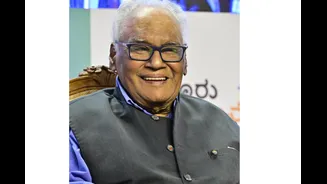




Bharat Ratna awardee and renowned scientist Professor CNR Rao was served a notice during the Special Intensive Revision (SIR) of electoral rolls in Karnataka over a mismatch in the spelling of his name
in electoral records. The 92-year-old scientist was asked to appear for a hearing in Malleshwaram in Bengaluru to establish his identity. The notice reportedly cites “self-name mismatch” as the reason.
According to reports, the older electoral rolls list his name as “Prof CNR Rao”, while the current electoral roll reportedly records it as “Proff CNR Rao”, with an additional “f” in the word “Prof”.
What Is ‘Self-Name Mismatch’?
A “self-name mismatch” refers to a discrepancy between an elector’s details in the 2002 electoral roll and the current electoral roll when the voter uses their earlier details while filling out the SIR enumeration form.
In Professor CNR Rao’s case, the reported discrepancy relates to the spelling of his name in the electoral records. He has consequently been called for a hearing in Malleshwaram, near the Indian Institute of Science (IISc), to establish that he is the same person listed in the earlier electoral records.
Reports said the notice is part of the wider SIR exercise in Karnataka, during which millions of electors have been asked to address discrepancies in their electoral records.
Who Is Professor CNR Rao?
Born in Bengaluru’s Basavanagudi, Professor CNR Rao is one of India’s most prominent scientists and is internationally known for his work in solid-state and structural chemistry.
Professor CNR Rao was awarded the Bharat Ratna in 2014, becoming the third scientist to receive India’s highest civilian honour after physicist C V Raman and former President A P J Abdul Kalam. He has also received several other major honours, including the Padma Vibhushan, Padma Shri and Karnataka Ratna.
Professor CNR Rao has had a long association with Bengaluru’s scientific institutions and played an important role in shaping India’s scientific research landscape. He headed the Indian Institute of Science and founded the Jawaharlal Nehru Centre for Advanced Scientific Research (JNCASR) in Jakkur, where he served as its founding president.
He has also advised several Indian prime ministers on science and technology. Professor CNR Rao was a member of the Scientific Advisory Council to former Prime Minister Indira Gandhi and later headed scientific advisory councils under Rajiv Gandhi, H D Deve Gowda, I K Gujral and Manmohan Singh.
Professor CNR Rao has made major contributions to the study of materials and solid-state chemistry and has authored numerous scientific publications and books. Over the course of his career, he has received several international awards and honours and is regarded as one of India’s most influential scientists.