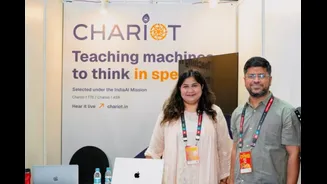







India has added another homegrown artificial intelligence development to its growing AI ecosystem with the launch of Chariot-1 foundation models. Developed by Chariot Artificial Intelligence under the IndiaAI
Mission, the models are designed to improve language processing and speech generation, with particular attention to India’s multilingual requirements.
The launch took place at Bharat Mandapam in New Delhi on November 26. S. Krishnan, Secretary of the Ministry of Electronics and Information Technology, inaugurated the models and research showcase.
Chariot-1 Foundation Models
Chariot is among the first four teams selected under the IndiaAI Mission to develop sovereign foundation models. The initiative aims to support the development of advanced AI technologies within India rather than relying entirely on models created by international technology companies.
The Chariot-1 family includes a large language model and a text-to-speech model. Both have been developed through pre-training from scratch in India, with the company focusing on computational efficiency and multilingual capabilities.
The Chariot-1 large language model is based on a mixture-of-experts architecture and contains 11 billion parameters, with four billion active parameters per token. The model family is available in three sizes: 10.7 billion, 1.7 billion and 745 million parameters.
Offering multiple sizes could make the technology more accessible to developers and organisations operating with different computing requirements. Larger models can support more demanding workloads, while smaller versions may be more suitable for deployments where computing resources are limited.
The text-to-speech model is another important part of the release. Chariot-1 TTS supports English and 10 Indian languages: Hindi, Bengali, Marathi, Tamil, Telugu, Kannada, Malayalam, Gujarati, Punjabi and Odia.
The model is designed to understand the context in which words, numbers and symbols appear. This is particularly relevant for Indian-language speech applications, where reading out a date, currency value, abbreviation or URL correctly can be challenging for automated systems.
For example, an AI assistant reading a financial statement should be able to interpret currency values naturally rather than simply pronouncing every individual character. Similar challenges arise when converting addresses, dates and measurements into speech.
Chariot has also highlighted research innovations incorporated into the training process. One of its approaches reduces the number of vocabulary entries that need to be scored per word by 5.7 times. The company reports that this delivers a 38% improvement in training speed on the same GPUs, with negligible changes in model loss.
The speech system recorded more than 97% verbalisation accuracy on the Async TTS Pronunciation Benchmark. It also reported a Hindi character error rate of 7.60% and an average of 6.47% across nine other Indian languages in its reported evaluations.
The launch reflects India’s broader ambition to build AI infrastructure and models that address domestic requirements. Multilingual speech technology could be particularly useful in education, customer support, government services and accessibility applications.
However, the real test will be how the models perform in practical deployments, especially when handling regional accents, code-mixed conversations and complex real-world speech.