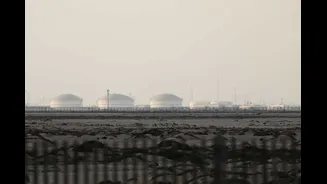








The blockade of the Strait of Hormuz — one of the world’s most critical shipping routes — by Iran has not only unsettled global energy markets, but its impact is also being felt in Asia’s food supply,
with Vietnam — the world’s second-largest rice exporter — cutting production.
According to the World Food Programme, an additional 45 million people could be pushed into acute food insecurity, taking the total global figure above 319 million, if the conflict does not end by June.
With countries like India and Sri Lanka reliant on imported fertilisers, gas, and fuel for agriculture, experts are urging caution. India consumes around 60 million tonnes of fertiliser annually, second only to China, with a significant share of its imports coming from Gulf countries via the Strait of Hormuz.
No oil or gas tankers have passed through the strait since the ceasefire between the United States and Iran on Tuesday, according to ship-tracking data from Kpler shared with The New York Times. Four bulk carriers—vessels that transport dry cargo—have managed to pass through.
What’s The Hidden Link Between War And Food?
To understand how the Iran conflict, thousands of kilometres away from India, could impact food storage, it helps to start with the Strait of Hormuz.
This passage is one of the world’s most critical energy routes. A significant portion of global oil and gas flows through it. Before the Iran war, the Strait of Hormuz handled roughly 15 to 21 million barrels of crude oil and petroleum products per day, accounting for 20% to 25% of the world’s maritime oil trade. This critical choke point averaged roughly 140 commercial ship transits per day, including large volumes of LNG.
Based on reports from early April 2026, including data from Bloomberg, Lloyd’s List, and the Baltic and International Maritime Council (BIMCO), it is estimated that roughly 800 to 1,000 cargo ships and tankers were trapped or stuck within the Persian Gulf.
Thus, with oil and gas becoming expensive or difficult to transport, fertiliser prices are rising across countries. FOB granular urea in Egypt — a bellwether of nitrogen fertilizers — jumped to around $700 per metric ton, up from $400 to $490 before the war began.
Oxford Economics’ Alpine Macro said on Monday that urea and ammonia prices had surged by around 50% and 20%, respectively, since the war began. Other fertilisers, like potash and sulfur, have also risen in price, according to a report by CNBC.
India remains highly dependent on imports for phosphatic fertilisers and almost entirely reliant on imports for potash, further amplifying its exposure to global supply shocks. Current domestic stocks are considered adequate for the upcoming sowing season, but analysts warn of shortages if the conflict persists.
The Impact On Global Fertiliser Market And Food Production
Between 2023 and 2025, Gulf countries emerged as the world’s most important regional suppliers of fertilisers. They were the largest exporters of urea and ammonia, both nitrogen-based, and the second-largest exporters of key phosphatic fertilisers such as diammonium phosphate (DAP) and monoammonium phosphate (MAP), according to the International Food Policy Research Institute.
The region’s importance goes beyond direct fertiliser exports. Liquefied natural gas (LNG) from the Gulf is critical for fertiliser production in countries that lack sufficient domestic gas reserves, including India, Pakistan, Bangladesh and Turkey.
This makes any disruption in Gulf energy supplies particularly significant. Qatar alone accounts for roughly 10% of globally traded natural gas. A sustained reduction in LNG output or shipments could sharply hit nitrogen fertiliser production worldwide. Natural gas is not only the primary energy source used in fertiliser manufacturing, but also a key raw material for producing ammonia—the base ingredient for all nitrogen fertilisers.
The Gulf has also built a vast export ecosystem around ammonia. A significant share of its natural gas is converted into ammonia and shipped globally, often through the Strait of Hormuz, either via pipelines or in liquefied form by sea.
The scale of this trade is substantial. Nearly 29% of global ammonia exports between 2023 and 2025 originated in the Gulf, with Saudi Arabia as the leading exporter. Major importers included India, South Korea, Morocco, Japan, South Africa and the US.
A similar pattern is visible in the urea trade. The Gulf accounted for 36% of global urea exports during this period, led by Iran and Qatar, followed by Saudi Arabia. In 2025, key importers ranged from India and Brazil to Australia, Thailand, the United States, Turkey, Ethiopia, and South Africa.
Phosphatic fertilisers tell a similar story. The Gulf supplies roughly 26% of global DAP exports and 13% of MAP exports, with Saudi Arabia dominating production. Key buyers again include India, Brazil, Australia and the US.
The region’s influence extends even further into the fertiliser value chain. Countries such as Saudi Arabia, Bahrain, the United Arab Emirates, Kuwait and Qatar together account for nearly half of globally traded sulphur—another critical input in fertiliser production.
The implications of disruption are significant. A prolonged rise in fertiliser prices, especially nitrogen-based products, could reduce crop yields in fertiliser-intensive farming systems. That, in turn, risks pushing up food prices sharply.
An analysis of the impact of the crisis on nitrogen-intensive rice cultivation by the International Rice Research Institute suggests that if shipping disruptions through the Strait of Hormuz continue, the fallout could extend beyond logistics. Energy and fertiliser shortages may become far more serious risks for Asia’s next crop cycle, potentially affecting both output and prices in the months ahead.
What Is Happening In Vietnam?
The first signs of strain are already emerging in Vietnam, one of the world’s key rice producers. The country produces over 43 million tonnes of paddy annually, with more than half of that output coming from the Mekong Delta — its agricultural heartland.
Vietnam also plays a critical role in global food supply. In recent years, it has consistently ranked among the top rice exporters, shipping upwards of 7.5 to 8 million tonnes annually to markets such as the Philippines, China and parts of Africa. But that system is now under pressure.
Rising energy prices linked to the Middle East conflict have pushed up the cost of fuel used in farm machinery, while also making fertiliser production significantly more expensive. At the same time, disruptions to maritime shipping have sharply increased logistics, freight, and insurance costs — burdens that are gradually being passed on to consumers.
Shipping costs from Vietnam have surged by more than 30%, with container rates climbing to $4,500-$5,000. This has added to inflationary pressures within the country, particularly on food products, as producers and exporters adjust to higher operating costs.
The broader regional outlook is also weakening. Slowing growth across Southeast Asia is beginning to weigh on export-dependent economies like Vietnam, affecting its ability to efficiently ship not just rice, but also other key commodities such as coffee and seafood.
Can The Shock Travel To India?
As the government absorbs much of the shock from rising import costs, the strain is beginning to show on public finances. With more money being diverted to cushion fertiliser prices, the fiscal space available for rural development and infrastructure spending is tightening.
Policy experts caution that this could mirror the subsidy surge seen during the Russia-Ukraine conflict, when fertiliser bills ballooned under similar external pressures. The dilemma for policymakers is a familiar one. Shielding farmers from rising costs helps sustain agricultural output, but it also stretches the fiscal deficit. Passing on the burden, however, risks lower fertiliser use and, ultimately, weaker crop yields.
Rising input costs are pushing up farm gate prices, while inefficiencies in the supply chain are further driving up retail inflation. The impact is felt most sharply by lower-income households, putting additional strain on India’s food security systems, including the Public Distribution System. Experts warn that if disruptions continue into the monsoon sowing season, the country could face a “second-round” food price shock, with more sustained pressure on prices, a report published in the Observer Research Foundation (ORF) mentioned.
Government data shows that the Food Corporation of India (FCI) currently holds 60.7 million tonnes of rice and wheat, nearly 185% above the April 1 buffer norm of 21 million tonnes. But these reserves offer only partial comfort. Perishable items have no such safety net, and that is where the impact of the crisis is being felt most acutely, experts say. With trade disruptions adding to the uncertainty, fruits and vegetables remain particularly vulnerable to spoilage.
The government on Monday said essential food prices are expected to remain stable despite tensions in West Asia, citing comfortable stock levels of foodgrains, pulses, edible oils and sugar. The Consumer Affairs Ministry noted that existing rice and wheat reserves are adequate to meet requirements under the Public Distribution System (PDS) and the National Food Security Act (NFSA), with the Food Corporation of India prepared to release additional supplies through the Open Market Sale Scheme (Domestic).
Officials highlighted that a record 10.52 million tonnes of rice were offloaded in FY26. Current stock levels stand at around 22.2 million tonnes of wheat and 38 million tonnes of rice, taking total foodgrain reserves to roughly 60 million tonnes.
For India, the risk is not an immediate shortage of food. It is something more gradual but equally significant: rising costs, stressed farmers, and a tightening balance between supply and demand.